
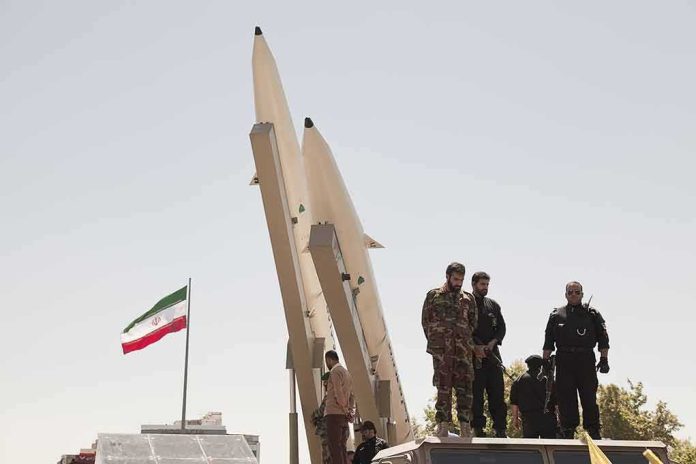
Deterrence works through clarity of will but ambiguity of method; Iran’s latest “no-limits” retaliation order codifies that logic at the highest level, formalizing a doctrine meant to raise the price of any new strike while keeping adversaries guessing about where, when, and how Tehran would respond.
At a Glance
- Iran’s supreme leader issued an explicit, attributable directive authorizing geographically unrestricted retaliation if the United States or Israel resume military or terrorist attacks.
- The order went beyond rhetoric: commanders were told to update target lists, increase munitions output, and strengthen intelligence and indigenous defense programs.
- Washington frames its operations as individual and collective self-defense in response to Iranian aggression and proxy attacks, situating Tehran’s threats within a cycle of reprisals.
- Historically, Iran’s retaliation has been calibrated—often limited and choreographed for signaling—suggesting the maximalist language is a coercive deterrent, not a guarantee of unlimited war.
The order: codified ambiguity and centralized authorization
Iran did not merely threaten; it promulgated a directive. Public statements attributed to Ayatollah Mojtaba Khamenei’s official channels framed any renewed U.S. or Israeli “military or terrorist” attack as a trigger for an “immediate, impactful, and geographically unrestricted” response; senior commanders reportedly received instructions to prepare accordingly. The specificity matters. Tehran signaled centralized authorization—orders to update target lists, to push munitions and weapons production, to harden intelligence and air defense—functions that convert words into operational posture. Unlike ad hoc warnings from mid-level officials, such a package couples declaratory policy to force-preparation, a classic design for deterrence signaling.
Yet the phrasing “without geographical limits” is deliberately elastic. It asserts reach without naming target classes, proportionality criteria, or civilian protections, and it introduces the term “material and immaterial” assets—language capacious enough to encompass cyber, commercial, diplomatic, or dual-use nodes. That breadth is the point: ambiguity multiplies an adversary’s risk calculations. But it also clouds outside assessments of legality and restraint, and it invites wider attribution for future incidents, some of which may not be Iranian at all.
How Iran uses threats: mechanism, not bluster
Iranian strategy relies on deterrence-by-punishment with flexible escalation ladders. In practice, that often looks like calibrated missile or drone salvos, proxy leverage across multiple theaters, and cyber operations—all orchestrated to impose costs without crossing thresholds that trigger regime-threatening war. Analytic work on prior episodes—after the 2020 U.S. strike on Qassem Soleimani, during the June 2025 confrontation, and across later exchanges—shows Tehran frequently pairs maximalist rhetoric with bounded kinetic action designed to signal capability and resolve rather than to seek unrestrained escalation. The new directive fits this playbook: it widens option space and updates the tools while preserving political deniability about exact limits.
Force-preparation orders embedded in the directive matter for credibility. Updating target banks translates strategic aims into taskable lists; ramping ammunition and indigenous systems reduces dependence on vulnerable supply lines; intelligence strengthening shortens sensor-to-shooter loops. Even if some threatened categories exceed proven reach, the signal is that gaps are being closed and timelines compressed—a message intended as much for Washington and Jerusalem as for domestic audiences who expect visible resolve.
The U.S. counter-case: self-defense and a record of Iranian attacks
American officials describe a very different narrative arc. Washington situates its operations within individual and collective self-defense—against direct Iranian actions and proxy campaigns targeting Israel, U.S. forces, and maritime commerce. Official legal and analytic summaries emphasize a pattern: Iranian attacks on U.S. naval vessels (including attempted missile strikes on a carrier and destroyers), efforts to menace shipping in the Strait of Hormuz, and strikes on regional infrastructure; U.S. and allied actions are cast as responses, not initiators. The 2025–2026 episodes—ranging from operations against nuclear sites to later maritime and infrastructure exchanges—are portrayed as justified, bounded counters to Iranian aggression.
Independent analysis reinforces the cyclical character of the conflict. CSIS and others describe a self-perpetuating dynamic of reprisals in which both sides calibrate costs and signals; U.S. options have at times been constrained or channeled—recall the cyber response rather than kinetic strikes after the 2019 drone shootdown—while Iran has used limited ballistic strikes to demonstrate resolve without inviting total war. Read together, these accounts don’t negate Tehran’s deterrent logic; they contextualize it inside a feedback loop where each side’s “defensive” move becomes the other’s provocation.
Where ambiguity helps—and where it backfires
Ambiguity is a tool of crisis bargaining; it deters by threatening a moving target. But it is double-edged. The “no geographic limits” formula expands deterrent coverage to a global commons—bases, embassies, commercial lanes, cyber backplanes—yet it also accelerates worst-case planning by adversaries and unnerves neutrals whose infrastructure could become a bargaining chip. Media dynamics amplify this effect: headlines elevate the phrase while burying the conditional trigger—“if the enemies resume”—which Tehran uses to frame its posture as defensive. In policy terms, the gap between maximal language and historically limited retaliation breeds two risks: miscalculation by outsiders who discount the threat as mere signaling, and misinterpretation by stakeholders who overread it as license for indiscriminate action.
This tension extends to diplomacy. Reports of ongoing talks and deconfliction efforts alongside orders to broaden retaliation plans create a surface contradiction. Practitioners will recognize the pattern: states negotiate under the shadow of force, both to stiffen their bargaining position and to hedge against talks failing. The trouble is audience costs. Ambiguous phrases like “material and immaterial assets” leave ample space for adversaries to attribute subsequent cyber or infrastructure incidents to Iran, further narrowing diplomatic off-ramps.
NEW: Iranian Supreme Leader Mojtaba Khamenei’s directed Iran’s three top military commanders to prepare to retaliate against US strikes by expanding Iran’s targeting bank, likely part of an Iranian effort to deter the United States and Israel from striking Iran. (1/2) #ISW…
— Hiro's gallery (@HiroGallery) October 31, 2026
Capability, credibility, and consequence
Does Iran possess the reach implied by “no geographic limits”? Not across all categories with equal reliability. The directive’s power lies less in proving universal capability today than in persuading adversaries that costly surprises are more likely tomorrow. That said, certain portfolios—theater-range missiles, drones, proxy networks, and maturing cyber units—have demonstrated real effects, including episodic disruption of shipping and strikes on regional infrastructure. The United States and Israel have shown they can penetrate Iran’s air defenses and degrade critical nodes; Iran has shown it can impose retaliatory costs and stress energy markets. Neither side has consistently compelled strategic concessions. Deterrence, in other words, has managed risk rather than resolved the dispute.
For policymakers, three implications follow. First, declaratory policy that ties retaliation to specific triggers, target classes, and proportionality—conveyed privately, if not publicly—reduces the odds of misread signals while preserving deterrence. Second, resilience investments in maritime security, cyber defense, and energy infrastructure blunt the coercive value of “immaterial” targeting. Third, crisis communication channels should be treated as force multipliers; when the action-reaction cycle is already primed, misattribution is the shortest path to unwanted escalation.
Bottom line
Iran’s “no-limits” order is best understood as structured ambiguity backed by real, if uneven, means. It is neither empty bluster nor an automatic path to unrestrained war. In a conflict long defined by retaliatory spirals, the directive raises the expected costs of renewed strikes while keeping Tehran’s options open. Whether it deters or inflames will turn less on the rhetoric itself and more on how precisely both sides connect words to thresholds, targets, and off-ramps—and on whether they can resist letting ambiguity do the work that only disciplined statecraft can finish.
Sources:
theamericanconservative.com, ckom.com, chronicleonline.com, mdjonline.com, yahoo.com, bloomberg.com, en.ilsole24ore.com, anewz.tv, timesofindia.indiatimes.com, indianexpress.com, onlinelibrary.wiley.com, csmonitor.com, aljazeera.com, congress.gov, washingtoninstitute.org