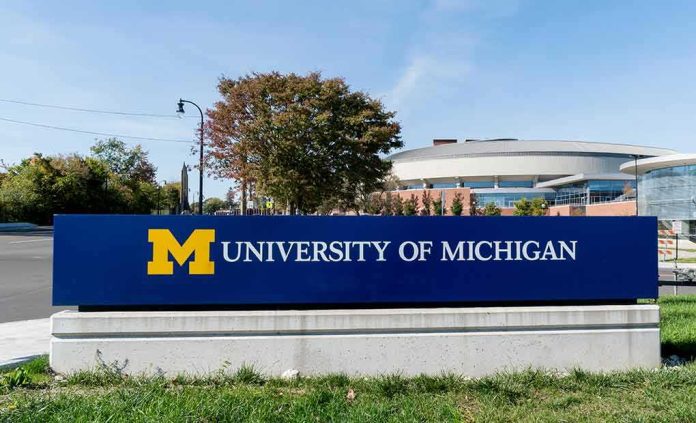
When protest crosses the legal boundary into coordinated threats and targeted harassment, it stops being speech and becomes a criminal enterprise; the University of Michigan case is a vivid study in where that line is drawn and why prosecutors say twelve defendants stepped over it.
The Short Version
- Federal prosecutors expanded a University of Michigan intimidation case to twelve defendants, alleging a coordinated campaign of threats, vandalism, and harassment aimed at forcing institutional divestment from perceived Israel ties.
- The superseding indictment describes a common objective and shared methods, treating the activity as conspiracy, not isolated misconduct.
- Civil-liberties advocates warn against conflating pro-Palestinian advocacy with crime; the legal line turns on threats, property damage, and targeted intimidation, not viewpoint.
- The case sits within a broader rise in threats against public officials and institutions across causes, sharpening the stakes for campuses managing contentious politics.
What the charges say: a coordinated intimidation campaign, not protected protest
Federal prosecutors in Detroit first charged eight individuals in June 2026, then added four more in a superseding indictment unsealed in late October, bringing the total to twelve. The government’s theory is straightforward: defendants agreed to use threats, vandalism, and targeted intimidation to pressure University of Michigan leaders, the Jewish Federation of Detroit, law enforcement, and businesses perceived to have ties to Israel. Prosecutors frame the pattern as conspiracy—agreement plus overt acts toward an unlawful end—rather than a string of unrelated incidents. That framing matters, because conspiracy captures coordination: a common objective, division of roles, and a sequence of planned acts that, taken together, amplify impact and fear beyond any single incident.
The Justice Department’s public charging materials point to specific target sets and tactics consistent with intimidation rather than spontaneous protest: threats directed at named university officials, actions at private homes, and defacement or damage aimed at signaling vulnerability and imposing costs. If proven, those acts sit well outside First Amendment protection. The rule-of-thumb many courts apply is simple: advocacy—even caustic—is protected; “true threats” (serious expressions of intent to commit unlawful violence), targeted harassment, and property destruction are not. The government’s decision to seek a superseding indictment that expands both the cast and the conduct suggests investigators see a single plan with multiple prongs rather than a campus protest movement that occasionally got unruly.
How the law draws the line: speech versus intimidation
Universities are familiar friction points in American politics, and the Gaza war era has intensified contention around divestment, speech codes, and protest rights. The law is not allergic to protest; it expects it. But it sorts methods by legal category. Peaceful assembly and advocacy—even disruptive civil disobedience—receive broad protection. Once conduct moves into threats, stalking, or property crimes, protection falls away. Prosecutors then consider whether conduct is episodic or coordinated. Conspiracy law asks whether two or more people agreed to achieve an unlawful objective, and whether any person took a step—an “overt act”—to advance the plan. That can include scouting targets, sharing addresses of private residences, or organizing night-time actions intended to terrify, if the underlying acts are unlawful. The Michigan indictments adopt this frame, alleging a shared objective (forcing divestment), common methods (threats and vandalism), and coordinated targeting of university leaders and Jewish communal institutions.
Defendants in the original tranche reportedly pleaded not guilty—a procedural posture, not a finding of fact—and civil-rights advocates have argued publicly that the government risks criminalizing pro-Palestinian advocacy. Those critiques serve an important function: they remind courts and the public that political viewpoint must never be the crime. The case will turn not on viewpoint but on whether the government proves specific criminal acts and the agreement to commit them. That is the right line, and it is durable across causes and eras.
Context: campus contention amid a broader rise in threats
What is happening in Michigan is not occurring in a vacuum. The United States has seen an uptick in politically motivated threats and violence across movements. Princeton’s Bridging Divides Initiative reported that political violence increased in 2025—still below the peaks of 2020–2021—while threats against officials and institutions remained a salient risk vector. Universities, school boards, public health officials, judges, and nonprofit leaders have all been on the receiving end. That pattern does not excuse overreach; it does explain why prosecutors may be quicker to treat coordinated intimidation as a public-safety problem rather than campus discipline. The lesson is not that protests should be chilled, but that institutions facing targeted threats will escalate to criminal enforcement when the means cross into coercion.
At the same time, rights groups document overbroad responses to campus activism after the Gaza war began: investigations, suspensions, and policy changes that swept in protected speech alongside misconduct. The healthiest system does two things at once—aggressively prosecutes genuine criminal intimidation and jealously guards peaceful dissent. Maintaining that distinction requires institutional discipline: precise charging by prosecutors, careful policy by universities, and, in court, vigilant application of First Amendment doctrine that protects advocacy while punishing threats and violence.
Mechanism of the alleged conspiracy: targets, tactics, and objectives
Read through the government’s releases and you see three structural features. First, target selection: not only public-facing events on campus, but named officials, private-sector entities with perceived supply-chain ties to Israel, and a local Jewish federation. Second, tactic repertoire: beyond protests and sit-ins, the charging materials cite threats and acts designed to project vulnerability—graffiti and vandalism at homes or workplaces—consistent with an intimidation model rather than a persuasion model. Third, strategic objective: force a divestment or severance of ties outside normal governance channels. These features are characteristic of coercive pressure campaigns; they collapse the distance between policy disagreement and personal jeopardy. In criminal law, that collapse is the problem the conspiracy counts are engineered to address.
Superseding indictments also signal that investigators are mapping network structure. Adding defendants often reflects new cooperation, additional digital evidence, or pattern linkage across incidents initially thought separate. In practical terms, the broadened case shifts leverage: it increases potential exposure for alleged organizers and can channel plea negotiations toward those whose actions were most integral to planning rather than peripheral participation. None of that predetermines the outcome at trial, but it does show how prosecutors believe the pieces fit together.
Why this matters for campuses and civic life
Universities occupy an unusual role: they are both workplaces and public squares. They must absorb conflict without normalizing menace. The Michigan case illustrates the cost of blurring categories. If protest organizers adopt coercive tactics, they invite felony exposure and erode public sympathy for their cause; if administrators conflate disruptive but peaceful protest with threat campaigns, they risk violating rights and feeding cynicism about institutional neutrality. The only sustainable posture is principled triage: protect vigorous speech and civil disobedience; investigate and punish threats, doxing intended to incite harassment, and property crimes; and, when coordinated intimidation emerges, treat it as conspiracy grounded in unlawful means, not unpopular ends.
Practical takeaways: drawing and defending the line
For advocates, the checklist is clear: keep tactics within protected categories; avoid private-residence targeting; reject language that can be construed as a serious expression of intent to harm; and separate issue campaigns from any actor proposing sabotage or terrorizing methods. For universities, precision matters: publish content-neutral protest rules, invest in threat assessment teams that know the First Amendment, and partner with law enforcement only when conduct crosses the legal threshold. For prosecutors, restraint and specificity win trust: charge the conduct, prove coordination, and make explicit in public filings that viewpoint is not the crime. The Michigan indictments, if sustained, will underscore that principle. They will also stand as a warning that the republic’s guarantees of speech and assembly are strongest when all sides police the boundary that keeps protest from becoming a campaign of fear.
Sources:
washingtontimes.com, justice.gov, clickondetroit.com, uc.edu