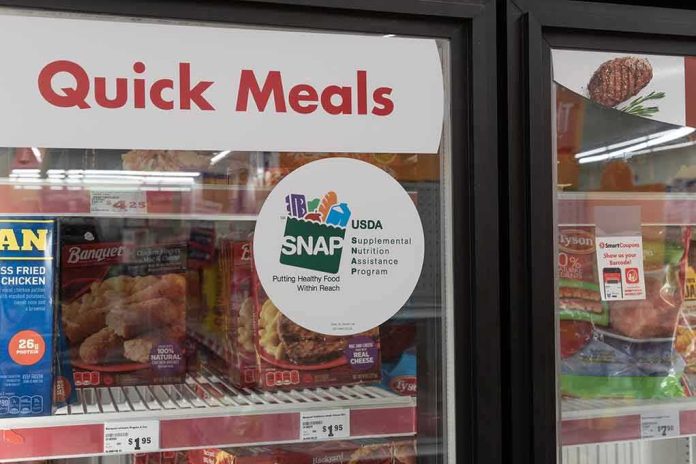
When freezers at multiple U.S. military commissaries in different states all shifted into heating defrost cycles within days of one another, investigators treated it not as bad luck but as an operational-technology event with cyber fingerprints—because that pattern, across distance and vendors, aligns with how modern intrusions manifest in the physical world.
At a Glance
- The Pentagon is investigating a cluster of commissary refrigeration failures as a suspected cyberattack, based on patterns across multiple bases and similar defrost behaviors.
- Incidents spanned at least six geographically dispersed installations, from Arizona to Rhode Island and California to Wyoming.
- Army and Air Force investigators initiated inquiries, joined by an Army cybercrime unit and later U.S. Cyber Command, underscoring the operational-technology focus.
- A recent French case showed hackers forcing defrost cycles and high temperatures across hundreds of supermarkets, a technically analogous precedent.
What Happened: A Clustered Failure Pattern That Looks Like Coordination
Multiple military base commissaries reported unusual freezer behavior in late August and shortly after: equipment entered defrost states and warmed food—some alarms described heating rather than simple loss of power—leading to spoilage and limited store operations while staff isolated and recovered affected systems. Public updates and base notices, collected across reporting, identify at least six installations with comparable outcomes: Fort Huachuca (Arizona), Fort Irwin (California), F.E. Warren Air Force Base (Wyoming), Naval Station Newport (Rhode Island), Columbus Air Force Base (Mississippi), and Travis Air Force Base (California). The defining commonality was not merely “failure,” but freezers behaving as if commanded to defrost—simultaneously and at distance.
That signature drew the attention of cyber investigators. Four officials familiar with the matter said the Pentagon was treating the events as a suspected cyberattack, triggering a coordinated inquiry that included Army and Air Force investigative elements, an Army cybercrime unit, and subsequently U.S. Cyber Command. The escalation reflects a lesson hardened over the last decade: when similar cyber-physical systems exhibit near-identical anomalous states across unconnected sites in a tight window, you have to rule out a common actor—not just a common defect—before you assume coincidence.
Why This Looks Like OT Intrusion, Not Just IT Trouble
Refrigeration controllers and building-management systems sit in the operational-technology (OT) tier, where digital settings govern physical processes—compressor start-stop logic, temperature setpoints, defrost schedules. Unlike classic IT compromises that steal data, OT intrusions can create kinetic effects without touching a database: a setpoint nudged upward here, a defrost routine extended there, supervisory alarms muted for hours. CISA guidance treats these environments as distinct from enterprise IT: inventories must be maintained, logs preserved, and incident response coordinated with federal partners precisely because small logical changes can yield outsized physical consequences.
The commissary pattern—freezers heating during defrost cycles, not simply going dark—points to control-layer manipulation. That does not prove a hostile actor, but it fits the modus operandi seen elsewhere. In France, an intrusion into retail refrigeration systems reportedly forced defrosts and pushed case temperatures dangerously high across a broad footprint, spoiling food and even contributing to equipment damage. The mechanics are straightforward: an attacker who gains access to the supervisory interface or the controller network can alter schedules and setpoints that devices obediently execute overnight, when staffing is thin and deviations may go unnoticed until morning.
How We Got Here: Connectivity, Convenience, and New Attack Surface
Modern food retail and institutional commissaries connect cold-chain equipment for remote monitoring, regulatory recordkeeping, and efficiency tuning. That connectivity—via vendor maintenance portals, VPNs, cellular gateways, or building automation networks—shrinks response times and labor but expands exposure. If remote access is weakly segmented, shared across sites, or left with legacy credentials, a compromise can scale horizontally across many facilities using the same integrator or platform. That is why contemporary OT security practice prioritizes precise asset inventories, well-defined trust boundaries, and auditable remote-access sessions correlated to change logs—so anomalous sequences can be reconstructed quickly and credibly.
In defense settings, commissaries are not mission systems, but they are mission-adjacent: they feed service members and families, and their spoilage cascades into logistics and morale. Military investigators responding to a patterned refrigeration anomaly are not being alarmist; they are applying the playbook refined across pipeline, water, and manufacturing incidents in recent years, where the first reliable signal of intrusion often arrives as a “dumb” physical symptom—pressure drop, pump trip, temperature spike—rather than a splashy ransomware note.
Where The Facts Are Solid—and What Remains Under Review
Several elements are established by on-record reporting and public base communications. First, multiple commissaries in different states experienced similar freezer anomalies over a tight period, in some cases explicitly described as freezers heating in defrost mode rather than losing power entirely. Second, the Pentagon directed a coordinated response: Army and Air Force investigative components engaged early, with an Army cybercrime unit and later U.S. Cyber Command joining. Third, investigators are treating the pattern as a suspected cyber incident; the language is careful but consistent across outlets citing officials familiar with the inquiry.
One caveat belongs in any accurate account: investigators have not publicly attributed the cause or named a perpetrator. That is standard for OT cases at this stage; attribution demands correlation of controller logs, network flows, remote-access records, and any recovered tooling. But the operational decision to pursue a cyber route reflects the evidentiary weight of the pattern itself. A string of similar, geographically distributed defrost behaviors justifies a cyber-physical hypothesis until proven otherwise, especially after the French retail precedent showed how readily such manipulations can be orchestrated at scale.
Six US military bases lost their freezers.
Late August.
At least six commissaries. Fort Huachuca. Fort Irwin. Others.
All of them went into defrost mode.
All the frozen food spoiled.
In at least one case the temperature got cranked up overnight.
Staff showed up in the… https://t.co/WOjfDDURGB pic.twitter.com/w012M3pwGS
— Abdulkadir | Cybersecurity (@cyber_razz) October 29, 2026
Mechanism and Forensics: What Investigators Look For
In practical terms, the teams will be comparing, across all affected sites: controller command histories relative to normal defrost schedules; authentication logs tied to supervisory or vendor accounts; network telemetry showing inbound sessions, lateral movement, or anomalous protocol use; and time-synchronized temperature and alarm histories to establish whether sequences align with authorized maintenance windows or deviate in concert. If many sites share the same vendor, software build, or remote-access path, analysts will test whether a single set of credentials or gateway could have provided the necessary reach. The goal is to discriminate among three classes of cause: deliberate remote command, systemic configuration or software defect, or coincident mechanical failure—a determination that rests on logs and consistency as much as on any single indicator.
Implications: Hardening Cold-Chain OT Without Halting Operations
Whatever the final root cause, the lesson set is stable. Treat refrigeration as critical OT, not a back-of-house afterthought. Maintain a current asset inventory that distinguishes controllers, gateways, and supervisory servers; segment them from enterprise IT; require per-session, per-user remote access with strong authentication; and correlate every remote session with any change to setpoints, defrost tables, or alarm thresholds. Preserve logs at the controller and network layers with time synchronization across sites. Rehearse incident response that includes food-safety triage and rapid rollback of known-good configurations. These are not exotic controls; they are the fundamentals that keep convenience from becoming an adversary’s leverage.
Bottom Line
The Pentagon’s choice to treat synchronized commissary freezer anomalies as a suspected cyberattack is the disciplined response to a modern OT signal: the machines behaved as if instructed, in multiple places, at roughly the same time. Whether the culprit proves to be an intruder, a shared defect, or a maintenance cascade, the remedy points in the same direction—visibility, segmentation, authenticated control, and forensic readiness. In OT, physics is the tell; cybersecurity is the means to keep it honest.
Sources:
washingtontimes.com, militarytimes.com, thenextweb.com, yahoo.com, taskandpurpose.com, insiderpaper.com, dailycaller.com, securitymagazine.com, cisa.gov, redseal.net