
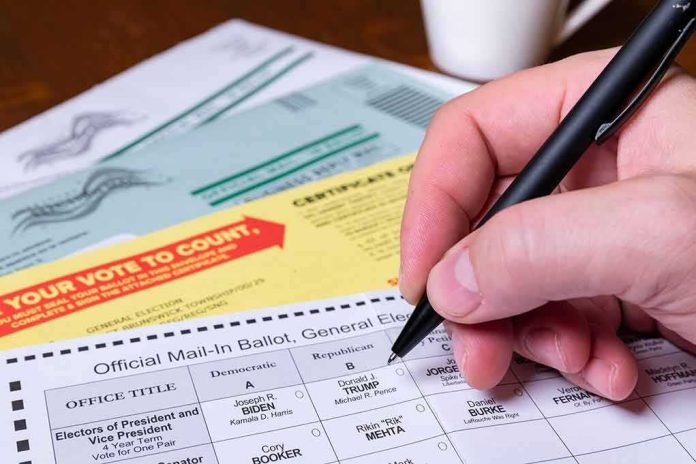
Ballots do not just register preferences; they shape them. When operatives engineer who appears on the ballot—and under what name—they are not merely competing within the rules, they are attempting to rewrite the conditions under which voters choose. The Alaska “Decoy Dan” episode is a case study in how far that impulse can go, what the law currently permits, and where democratic guardrails strain under pressure.
The Short Version
- Alaska’s 2026 Senate race featured two Republicans named Dan Sullivan—one the incumbent, one a late-arriving namesake—creating the precise conditions for a confusion-based ballot tactic.
- State election officials initially concluded the namesake bid aimed to mislead voters, but courts restored him to the ballot, emphasizing Alaska’s strong policy favoring ballot access over subjective “good faith” filters.
- Reporting, sourced to interviews, texts, and documents, alleges that Democratic-aligned operatives helped recruit the namesake; the campaign and national party deny it, and the full evidentiary record is not public.
- Historically, “same-name” candidates recur across U.S. elections; law has struggled to police intent without risking censorship of legitimate candidacies.
What was engineered, and why names matter on a ballot
The mechanism is straightforward: place a second candidate on the ballot who shares the incumbent’s name and party label, then rely on low-information cues, hurried voting, or ranked-choice misinterpretation to divert enough first-preference support to alter the elimination order and reallocations. In Alaska, that factual predicate existed. A man named Daniel J. Sullivan qualified for the same U.S. Senate primary as the incumbent Republican Senator Dan S. Sullivan. The Associated Press confirmed both shared the name and party, and that courts ultimately allowed the challenger to remain on the ballot. That is the sine qua non of a namesake-spoiler strategy: the ballot itself carries the confounding signal.
Whether anyone organized his entry is the more contested layer. A New York Times investigation, summarized by secondary outlets, reported interviews with a dozen sources, plus text messages and documents prepared for potential litigation, attributing recruitment to allies of Democratic candidate Mary Peltola and senior operatives. Those reports cast the activity as deliberate “ballot composition.” Peltola’s campaign and the Democratic Senatorial Campaign Committee issued denials, and the underlying materials have not been publicly released in full; as a result, the public record stops short of an authenticated, comprehensive evidentiary file.
How Alaska’s rules collided with the tactic
Alaska’s Division of Elections initially blocked the namesake’s path. In a June 15 final determination, Director Carol Beecher concluded the candidacy was not in good faith and was filed “with a purpose to confuse or mislead and compromise ballot fairness or neutrality.” That finding went directly to the tactic’s intent. But courts reversed. The Alaska Superior Court held that neither the state constitution, statutes, nor regulations included a subjective “good-faith” candidacy requirement the Division could enforce; the Alaska Supreme Court affirmed inclusion of Daniel J. Sullivan on the ballot. The legal principle at work was familiar: when in doubt, err on the side of ballot access and against administrative gatekeeping of political speech and candidacy.
That posture tracks broader doctrine. Courts, wary of partisan misuse of eligibility screens, have long protected access unless a clear statutory bar applies. It is easier to police whether forms were filed correctly than to adjudicate a politician’s sincerity. In Alaska, the upshot was paradoxical but clarifying: an agency could diagnose apparent manipulative purpose, yet lack the authority to exclude for that reason alone. Voters, not administrators, would have to sort the two Sullivans.
What we know, what remains disputed
Several points are firm. First, the namesake candidate was lawfully placed on the ballot after court review. Second, the Division of Elections plainly believed the filing sought to mislead; its written determination is part of the record even if it carries no adjudicative finality. Third, the alleged recruitment effort has reporting with some specificity—interviews, texts, and described documents—but the primary corpus is not public, and denials persist. Fourth, no court has reached a merits finding that the recruitment, if it occurred, violated campaign or criminal law; the litigation to date focused on eligibility and authority.
Two gaps remain. We do not have a quantified measure of voter confusion or diversion attributable to the namesake’s presence—how many ballots were miscast because a voter intended the incumbent but selected the other. Nor is there a definitive public record tying any named principal to authorizing recruitment. Those are empirical and evidentiary questions, solvable by subpoenas, depositions, campaign records, ballot-image audits, and post-election surveys; absent that, public argument leans on inference and rhetoric rather than dispositive proof.
This is not new: the long lineage of namesake plays
Same-name candidacies surface across American political history, recurring because they exploit a durable human heuristic: names anchor recognition. Early 20th-century and postwar episodes—involving figures like George W. Norris and the Kennedys—reflect the pattern; more recent cycles saw similar gambits in multiple states. Political scientists and legal scholars have chronicled the difficulty of writing rules that deter manipulative entries without chilling legitimate competition; name-format regulations and disclosure tweaks help at the margin but rarely solve intent. The Alaska case sits squarely in that lineage rather than apart from it.
Ranked-choice voting is not the culprit—confusion is
Some critics lay the blame at Alaska’s ranked-choice system. That overstates the point. Ranked-choice tabulates preferences differently, but a namesake tactic can distort any system that presents identical or near-identical cues to busy voters. In a ranked contest, a decoy could alter the elimination sequence; in a plurality primary, it can drain enough first-choice votes to change the frontrunner. The constant is not the counting rule but the cognitive shortcut. Research on instant-runoff voting shows mixed findings on confusion; where confusion arises, it is typically about instructions, not intrinsic to the method. Clearer ballot design and voter education mitigate both issues.
What better guardrails look like
Three categories of reform withstand legal scrutiny and address the real failure mode—voter misidentification rather than ex ante policing of intent. First, ballot clarity: include salient differentiators next to names—age, hometown, occupation, and the incumbent’s “incumbent” tag—so that identical names no longer look identical at a glance. Second, name-format integrity: require candidates to use their customary, verified name as used in official records and in daily life, enforced by affidavit and penalty; this curbs opportunistic middle initials and alias-like stylings aimed at mimicry. Third, transparency before policing: fast, public notice when a same-name candidate qualifies, with mandatory voter alerts and sample-ballot mailers highlighting the distinction, ensures the tactic loses oxygen quickly. None of these measures require adjudicating a candidate’s mind; all speak to what appears on the page.
Investigations still matter when coordination plausibly crosses into fraud—wire fraud theories hinge on schemes to obtain money or property by deception, not merely hardball politics—but the center of gravity for preserving trust lies in design and disclosure more than prosecutions. The Alaska controversy underscores that point: administrative exclusion failed on legal grounds, while public awareness arguably neutralized much of the confusion risk once the two Sullivans became a statewide story.
Alaska election officials fired back at the the Justice Department on Saturday, urging a federal judge to dismiss its lawsuit seeking to intervene in the state's Senate election over allegations that the similarly named "Decoy Dan" was recruited to confuse Republican voters.
— Richard Wiechmann (@RFWiechmann) October 31, 2026
The durable lesson
Democracy runs on legibility. If voters cannot reliably map their intent to the mark they make, the entire enterprise is vulnerable to small, cynical manipulations. Alaska showed both the vulnerability and the remedy. Courts rightly resisted subjective gatekeeping; election officials documented their suspicion; the press amplified the distinction; voters were placed in a position to discern. The next iteration should not hinge on a media firestorm to clarify who is who. It should be routine for the ballot itself to do that job.
Sources:
twitchy.com, public.courts.alaska.gov, washingtonexaminer.com, apnews.com, storage.courtlistener.com