Presidential rallies in the campaign’s final days rarely change many minds; what they do is tell you, with unusual clarity, where a party believes the real fight is happening — and South Carolina’s 2026 Senate race just became exhibit A.
Key Points
- President Trump rallied in Rock Hill, South Carolina, on October 29, 2026, five days before the November 3 midterm elections, at the Rock Hill Sports & Events Center.
- The rally’s central purpose was to boost Republican Senate candidate Darline Graham, who faced a tighter-than-expected challenge from Democrat Annie Andrews.
- Outgoing Governor Henry McMaster, gubernatorial candidate Alan Wilson, and several statewide and congressional candidates appeared alongside Trump.
- It marked Trump’s second South Carolina rally in eight days — an unusual level of presidential attention for a state Republicans normally consider safe.
- Academic research on prior Trump endorsements shows the political “boost” from a presidential rally is real but inconsistent, and sometimes even negative, complicating any simple read on what the Rock Hill event will mean for the outcome.
What Happened in Rock Hill
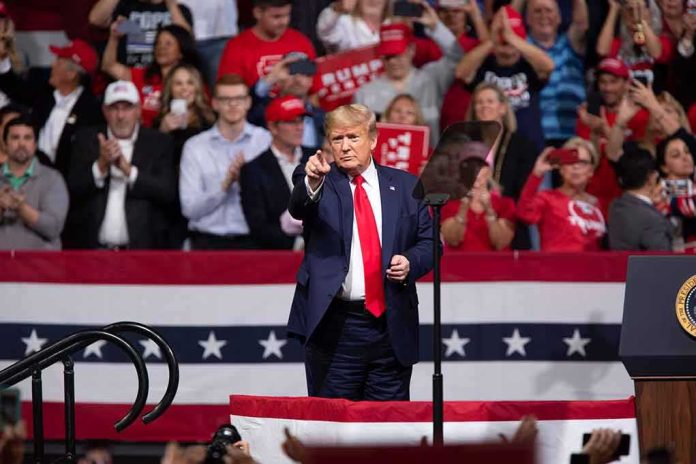
On the Thursday before Election Day, President Trump took the stage at the Rock Hill Sports & Events Center on Technology Way, a mid-sized venue that has become a familiar stop on South Carolina’s political circuit. Contemporaneous reporting from The Charlotte Observer placed him there five days ahead of the November 3 vote, delivering remarks aimed squarely at mobilizing Republican turnout in the race’s closing stretch. Supporters began lining up outside as early as 5:30 a.m., according to ABC News 4’s coverage of the event, a detail that underscores how much energy the campaign invested in making the rally feel like a culminating moment rather than a routine stop.
The stated purpose was never in doubt. The Associated Press reported that Trump traveled to Rock Hill specifically to support Darline Graham, the Republican Senate candidate, as she worked to fend off a challenge from Democrat Annie Andrews that had tightened far more than most analysts expected heading into the fall. The Charlotte Observer’s coverage confirmed the same framing, describing Trump urging the crowd directly to elect Graham. For a state where Republicans have not had to sweat a Senate contest in a generation, that level of presidential intervention was itself a signal worth noting.
A Full Ticket, Not Just One Race
Trump did not appear alone, and he did not limit his remarks to the Senate contest. The Charlotte Observer reported that he shared the stage with Graham, outgoing Governor Henry McMaster, and gubernatorial candidate Alan Wilson, along with candidates running for other statewide and congressional seats. In his remarks, Trump also urged voters to back David Stumbo for attorney general, Cody Simpson for agriculture secretary, and Wes Climer for Congress, according to the same reporting. That breadth matters: a rally built around one Senate race became, in practice, a closing argument for South Carolina’s entire Republican ticket — a common tactic when a party wants a marquee event to carry turnout benefits down the ballot rather than for a single contest alone.
South Carolina Public Radio’s coverage placed the Rock Hill appearance in a broader sequence, noting it was Trump’s second rally in the state within eight days specifically intended to boost Graham’s turnout numbers as polling in the Senate race tightened. Two presidential visits to the same state in under two weeks is not standard practice for a seat Republicans expected to hold comfortably; it reflects a campaign recalibrating its resource allocation in real time as the Andrews challenge gained traction.
Why a Normally Safe Seat Drew National Attention
South Carolina last elected a Democrat to the U.S. Senate in 1998. That history is precisely why national outlets treated the Rock Hill rally as more than a routine campaign stop. Multiple reports framed the event against the backdrop of what they described as rising Republican anxiety over a race that should not have been competitive at all. When a sitting president makes a second trip to a state his party normally carries without difficulty, it functions as an implicit acknowledgment that the race has moved — regardless of how the candidate or campaign publicly characterizes the visit.
That dynamic cuts both ways politically. Supporters can point to the rally as evidence of a mobilized, engaged Republican base rushing to defend its turf. Critics can just as easily read the same event as confirmation that Graham needed outside intervention to hold a seat her party once considered untouchable. Both readings rest on the same undisputed facts — the visit happened, its purpose was turnout, and it occurred because the race had tightened — and the interpretation says more about the observer’s priors than about any new information the rally itself supplied.
🇺🇸 Man on Fox live shot at Trump rally compares crowd to Jonestown
Before Trump's Rock Hill, South Carolina rally, a man interviewed live by Fox News compared the rally crowd to Jonestown.#Trump #Midterms2026 pic.twitter.com/l65hSGUBmm
— Notif News (@NotifNews1) October 30, 2026
What the Research Says About Presidential Rallies and Endorsements
Here is where decades of political science data complicate the instinctive assumption that a presidential rally simply moves votes. Studies examining Trump’s endorsements across the 2018, 2020, and 2022 cycles have found the effects are far less uniform than campaigns like to claim. One analysis of his midterm endorsements found that endorsed candidates, in aggregate, received no financial benefit and actually suffered a modest vote-share penalty in general elections, even as they fared measurably better in primaries. Another peer-reviewed study of the 2022 midterms concluded that not all presidential endorsements function as a positive signal to voters — some carry costs, depending on the district and the candidate.
A separate line of research adds an important methodological caution: presidents tend to campaign where races are already close or already favorable, which makes it genuinely difficult to disentangle a rally’s effect from the simple fact that it was held in a contest already trending toward intensity. One study of Trump’s endorsement patterns found he gravitated toward candidates already likely to win and toward races that were already competitive — which describes the Rock Hill situation precisely. The rally did not create the tightness in the Graham-Andrews race; the tightness is what summoned the rally.
What Comes Next
The practical significance of the Rock Hill rally will be legible only in the returns on November 3 — turnout figures, precinct-level results, and the final margin between Graham and Andrews will tell a far more reliable story than any speech can. What the event already establishes, without qualification, is that South Carolina Republicans treated this Senate race as genuinely at risk and were willing to deploy their most visible asset twice in two weeks to defend it. Whether that deployment moves the needle is a question election data will answer in due course, but the decision to make the trip at all is itself a data point — one that tells longtime observers of Southern politics that the electoral map, in at least one corner of the Carolinas, has shifted more than conventional wisdom assumed.
Sources:
youtube.com, charlotteobserver.com, wrdw.com, wsoctv.com, greenvilleonline.com, spectrumlocalnews.com, onlinelibrary.wiley.com, pure.uva.nl