When Washington argues over a monument, it is really arguing over power: who controls the capital’s symbolic core, who bears the operational fallout when ideals meet asphalt, and whether the rulebook for building in the nation’s front yard is a suggestion or a binding constraint.
At a Glance
- The Virginia–D.C. lawsuit targets concrete transportation, emergency-response, and cross-jurisdiction impacts at Memorial Circle, not just aesthetics.
- Plaintiffs stack multiple statutory claims — congressional authorization, height limits, environmental review, and historic-preservation — to support emergency injunctive relief.
- The administration’s public case emphasizes commemoration and international “icon” status; it offers limited rebuttal on traffic and operations.
- In Washington, major memorials typically move through years of congressional, planning, and preservation review — not rapid groundbreakings.
What the lawsuit actually argues: law, logistics, and irreparable harm
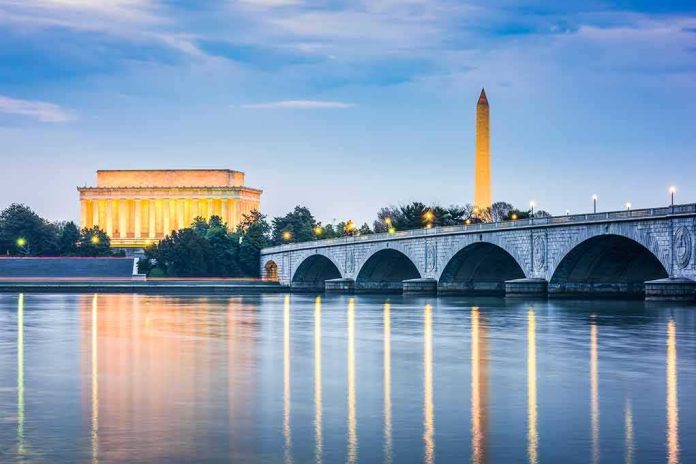
The core of the Virginia and District of Columbia suit is not taste but function. The 46-page complaint, filed in the U.S. District Court for D.C., fixes on Memorial Circle — the hinge where Arlington Memorial Bridge ties the monumental core to Northern Virginia — and on the daily realities of a constrained, multi-modal node: commuters, cyclists, pedestrians, emergency vehicles, and designated evacuation routes. The plaintiffs allege a three-year construction window would choke cross-river traffic, complicate mutual aid and emergency access, generate stormwater pollution to the Potomac, and strain an already brittle circulation system that was never designed for prolonged lane and access closures at its keystone junction.
Legally, the complaint is built as a multi-legged stool. First, it asserts the administration has not obtained the congressional authorization memorial projects require on federal land in the capital’s core. Second, it argues the design runs afoul of federal height restrictions. Third and fourth, it claims the government sidestepped environmental and historic-preservation review obligations that apply before the first excavator touches ground. This breadth is not decorative: in emergency motions, breadth supports an “irreparable harm” showing — the idea that once ground is broken, traffic patterns, sensitive landscapes, and historic sightlines are damaged in ways money cannot readily unwind — and improves the odds at the injunction stage.
Mechanics on the ground: why Memorial Circle is different
Memorial Circle is not a blank canvas. It concentrates vehicle merges from the George Washington Memorial Parkway, the Arlington Memorial Bridge, and access roads to Arlington National Cemetery; it also absorbs tourists on foot and bike, runners on the Mount Vernon Trail, and frequent ceremonial traffic. Projects at nodes like this fail or succeed on phasing, staging, detours, and emergency preemption — the unglamorous choreography that keeps an ambulance from adding four minutes to a cross-Potomac run or a hazmat unit from losing a ramp during a bridge incident. The complaint’s emphasis on evacuation routes and mutual aid is therefore on point; Washington is a layered capital where federal landownership, local responsibility, and regional mobility are inseparable. In that setting, a tall, heavy, multi-year site with crane swings, lane closures, and intermittent lockdowns is not just a skyline event; it is an operations problem.
Environmental claims fit the same operational logic. Construction at river’s edge, with cut-and-fill, dewatering, and staging, can push sediment, fuels, and concrete washout into the Potomac without strong controls; stormwater from new impervious surface raises post-construction loads. The allegations reported to date do not quantify these effects — a gap that technical filings or agency records could fill — but the concern is orthodox for a project of this scale adjacent to a major waterway.
The administration’s case: symbolism first, limited operational rebuttal
The White House frames the arch as commemoration writ large: a global landmark honoring military sacrifice and enhancing the visitor experience at Arlington National Cemetery. That is a coherent commemorative rationale; monumental cities are built on such arguments. But on the contested terrain where courts decide whether to pause a build, aspiration is not evidence. Beyond statements of purpose, the public-facing response has been narrow and largely aesthetic — for example, Interior’s modeling claim that only a small portion of the cemetery would see early-morning shadows for less than two weeks a year — and does not, as yet, grapple with traffic and emergency-service modeling at Memorial Circle.
The administration has also linked the project at times to national-security capabilities — storage for drones and ammunition, a sniper post — with Interior later suggesting the design could accommodate such functions. Those assertions, if pursued, complicate rather than simplify review: armed functions in a high-tourism, high-traffic node tighten safety, airspace, and hazard considerations, especially within the flight paths of Reagan National Airport. If anything, that framing raises the procedural bar; it does not lower it.
Process is the point: how Washington actually approves memorials
Washington’s commemorative works move through a codified process designed to temper haste with perspective. Congress defines sponsors and sites; the National Capital Planning Commission and Commission of Fine Arts review site and design; Section 106 and the National Environmental Policy Act force agencies to consider effects on historic resources and the environment; the Commemorative Works Act draws bright lines — including a protected “Reserve” on the Mall — and requires consultation. This is not bureaucratic theater; it is how the capital protects long views, traffic networks, and sacred ground from the well-intended but disruptive. The empirical baseline is long: the Desert Storm Memorial took over a decade and a half to matriculate through this gauntlet; rapid initial green lights for unusually “significant memorials” are anomalous in that context.
That history matters now because the plaintiffs’ most potent near-term claim is procedural: that the administration is moving to construction without completing — or, in places, even initiating — the statutory steps that legitimize a memorial and reveal its costs to operations and heritage. Courts are comfortable policing that boundary; emergency injunctions are a familiar tool to prevent agencies from making an unlawful action effectively irreversible by racing ahead with site work while the paperwork catches up.
Where the evidence is strongest — and where it still needs work
On the current public record, the plaintiffs’ case is strongest in two places. First, specificity of place: tying harms to the unique role of Memorial Circle and Arlington Memorial Bridge elevates this from a generic “we don’t like it” protest to an operations-driven challenge. Second, process: absent clear congressional authorization and completed reviews, a court has a clean threshold to enforce before the merits of design philosophy are ever reached.
The case will benefit from more quantified backing. Traffic-impact studies with lane-closure modeling, emergency response-time differentials, evacuation-route contingencies, and pedestrian conflict analysis would stiffen the operational spine. On the environmental front, a record identifying stormwater loads, construction staging risks, and mitigation feasibility would answer the inevitable “how much, how long, how bad” questions. Those filings typically surface through the very review processes the suit seeks to compel — a reminder that process is not delay for delay’s sake; it is how engineering reality enters the conversation.
What it means going forward: timing, optics, and the risk of fait accompli
Timing will decide the first round. If the administration can mobilize equipment quickly, mere trenching and tree-clearing can alter a court’s remedial posture by converting abstractions into sunk cost and disturbed ground — the classic fait accompli dynamic memorial litigants seek to avoid. Conversely, if a preliminary injunction issues, the dispute will migrate into a more regular forum: statutory compliance, jurisdiction, and the degree to which the arch’s site, scale, and functions conform to the capital’s settled planning frameworks.
Optics are not irrelevant. The administration’s emphasis on honoring service resonates, especially at Arlington, but Washington’s commemorative landscape has always balanced reverence with restraint. The rule of thumb that has kept the city legible — big ideas, carefully placed, slowly earned — is not sentimentality; it is systems thinking. In practical terms, the Virginia–D.C. suit asks a simple, durable question: before we reorder the capital’s hinge-point between Lincoln’s temple and Arlington’s graves, will we follow the rules designed to keep honor from colliding with how the city actually works?
Legal challenges to President Trump's proposed memorial arch are mounting, with Washington D.C. and Virginia suing in federal court today as the Trump Administration says construction could begin as early as next week.
Democrats waste more taxpayer money with these lawsuits than…
— Donnie Cope (@dcopechatter) October 31, 2026
Bottom line
This case is not a referendum on remembrance. It is a test of governance in a symbolic city: do we build monumental interventions only after the law’s full process has measured their operational, environmental, and historic consequences, or do we treat process as optional when purpose feels noble? The evidence marshaled so far favors the former — and the courts are likely to insist on it.
Sources:
nbcnews.com, abc27.com, wdbj7.com, startribune.com, washingtonexaminer.com, newsweek.com, nbcwashington.com, foxchattanooga.com