In commercial aviation, words alone can trigger a full security response; when a passenger’s text explicitly references hijacking and crashing, flight crews are obliged to treat it as an active threat and act fast, even if the sender later calls it a joke.
At a Glance
- A United flight from Las Vegas to Newark turned back after a flight attendant reported seeing a passenger text about hijacking and crashing the plane.
- The message was quoted in arrest-related reporting as, “I’m gonna hijack this b—- and crash ur row only”.
- The aircraft landed safely; police arrested the passenger on suspicion of making terrorism-related threats.
- The accused told police he had been drinking and described the text as banter, denying any intent to harm.
What Happened Onboard United 1681
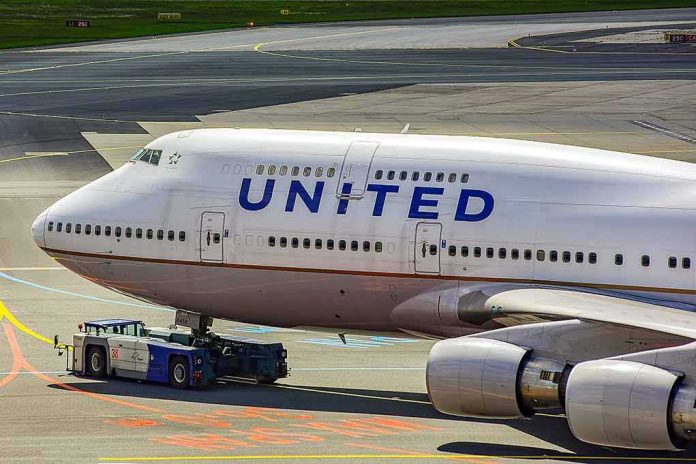
Shortly after departure from Las Vegas, a United Airlines crew received a report from a flight attendant that a passenger had been seen texting about hijacking the aircraft. According to accounts attributed to law enforcement and air-traffic-control audio, the attendant relayed that the passenger’s message said he was going to hijack the airplane; the cockpit treated it as a security incident and turned the flight back to Harry Reid International Airport. Reporting tied to the arrest record quotes an explicit text—“I’m gonna hijack this b—- and crash ur row only”—language specific enough to remove ambiguity about intent, at least from an operational standpoint.
The crew executed standard risk-reduction procedures: secure the flight deck, minimize onboard confrontation, coordinate with air traffic control, and return to the nearest suitable airport. The flight landed safely in Las Vegas without restraints used on the individual during flight, and the passenger was arrested upon arrival. Rough passenger counts put about 150 customers and six crew members aboard, amplifying the stakes of a conservative response to a clear-text threat.
Why a Single Text Can Drive a Turnback
Aviation security is engineered for uncertainty: crews must decide in real time whether a signal suggests intent and capability, often with incomplete information. The industry’s risk frameworks define threat credibility by a combination of intentions and capabilities—but recognize that during flight, intentions are opaque and capabilities are unknown. An explicit hijack-and-crash statement, observed by trained crew, is therefore treated as a high-consequence indicator even absent visible weapons or overt attempts to breach the cockpit. The guiding philosophy is simple and time-tested: if there is doubt, there is no doubt. Returning to base localizes risk, concentrates security resources at a prepared airport, and avoids committing the aircraft deeper into a route with fewer contingencies.
This posture is not theoretical. Airlines, regulators, and law enforcement have repeatedly confronted in-flight threat communications—sometimes hoaxes, sometimes symptomatic of impairment or mental-health crises, and sometimes malicious—and have diverted accordingly. International and academic guidance on aviation threat assessment underscores why: the cost of a false positive (a diversion for a non-credible threat) is far lower than the catastrophic downside risk of a false negative.
The Arrest and the Accused’s Explanation
Las Vegas Metropolitan Police Department officers booked the passenger on suspicion of making a threat or conveying false information regarding an act of terrorism; reports describe the charge using the familiar “terroristic threats” language employed in such cases. After landing, the individual reportedly told police he had been drinking and framed the text as ill-judged banter with a coworker, denying any intention to hijack or harm. That account explains motive—or the lack of it—from his perspective, but it does not alter the crew’s obligations in the moment: the specific words were visible, the medium was personal messaging rather than overheard sarcasm, and the recipient context was not known to the cockpit when decisions had to be made.
One narrow caveat applies: published coverage centers on arrest-report language and official summaries; final adjudication of intent and any criminal liability will occur, if at all, through the courts, not headlines. The operational record, however—turnback, safe landing, arrest—follows established security protocols for explicit threats in flight.
How Flight Crews Make These Calls
Cabin crews are trained to treat any explicit threat to the safety of the aircraft as actionable. The mechanism is structured and disciplined. Step one: contain. Lock and reinforce the flight deck, restrict movement, assign discreet surveillance of the subject, and minimize passenger awareness to avoid escalation. Step two: communicate. Relay precise observations to the captain, dispatch, and ATC; coordinate law enforcement response. Step three: decide. Weigh distance to suitable airports, aircraft weight and fuel status, weather, and runway length; if overweight for immediate landing, burn or dump fuel as procedures permit to return within landing envelope limits. Reports in this case align with that pattern—quiet cabin lockdown, coordination with ATC, and a controlled return despite operational considerations such as weight-on-landing management.
This approach fits the broader security logic described in ICAO-aligned risk assessment: when indicators suggest a credible threat and information is incomplete, prioritize options that preserve controllability and access to resources on the ground. Even when later evidence suggests the sender never intended harm, the initial handling is judged by what the crew reasonably knew at the time.
The Legal Frame: Words, Threats, and Consequences
In U.S. law, threatening communications involving aircraft or bombs can trigger felony exposure even absent weapons or physical action. Federal prosecutions for in-flight threat hoaxes and airport bomb-threat hoaxes are not rare; they reflect the legal system’s emphasis on deterrence in environments where stakes are existential. Charges referencing false information about an act of terrorism speak to the same principle: the act of conveying a credible-sounding threat can cause substantial operational disruption—diversions, emergency services mobilization, passenger displacement—harmful in its own right.
That is why the exact wording matters. A vague complaint or even aggressive profanity is unlikely to trigger a diversion; a text invoking hijacking and crashing crosses a bright operational line. Once a flight attendant reports such a statement, the captain’s discretion narrows toward the conservative path—turnback—because the cost of being wrong in the permissive direction is incalculable.
Hijack text sends a jet back. ✈️
United 1681 Las Vegas → Newark turned back after a flight attendant saw a passenger's hijack texts. Cockpit locked; 156 aboard, no injuries. A 25-year-old was arrested on a threat charge.Crew locks the cockpit first — right call? YES or NO? pic.twitter.com/eYRcVABPK6
— Aviation Daily Report (@AviationDailyRP) October 28, 2026
What This Means for Travelers and Airlines
For passengers, the lesson is blunt: there is no safe harbor for “jokes” that invoke hijacking or bombs. Digital messages are not private when they are plainly visible to nearby eyes; cabin crews are responsible for acting on what they see. Alcohol lowers inhibitions and judgment, but intoxication does not shield you from consequences if your words trigger a security response that disrupts a flight and endangers others. For airlines and regulators, the incident validates the training hierarchy: observe, report, secure, coordinate, and land—while minimizing confrontation and maintaining cockpit integrity. The visible result here—a safe return and a controlled arrest—tracks with the industry’s best practices in uncertain, high-consequence scenarios.
Sources:
foxnews.com, fox5vegas.com, whmi.com, people.com, casino.org, yahoo.com, cbs12.com, noticias.foxnews.com, usatoday.com, ndtv.com, nypost.com, pubsonline.informs.org, icao.int, justice.gov