
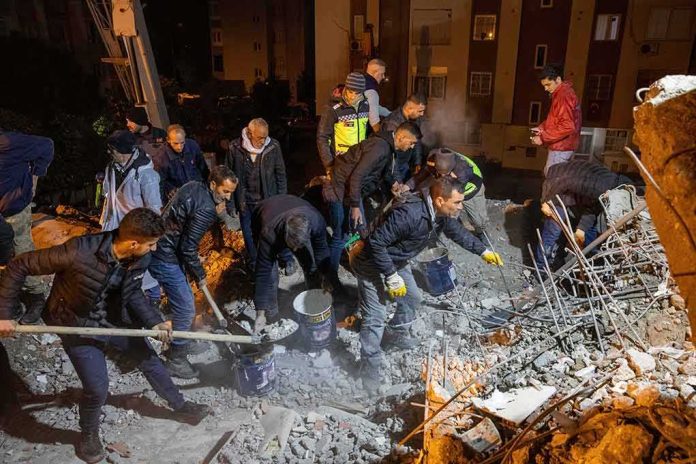
In steep Himalayan corridors, rescue decisions often hinge on hydrology, not heroics; in Tibet’s Gyirong region, officials paused frontline search operations because incoming rain and a growing dammed lake made a secondary flood both plausible and imminently dangerous to rescuers and downstream communities.
At a Glance
- Chinese authorities temporarily halted rescue work at the disaster epicentre due to heightened risk from an upstream dammed lake and continued rainfall.
- Forecasts called for rising lake levels over several days, elevating breach and downstream flood danger, including toward Gyirong Port.
- Authorities cited an expected inflow on the order of millions of cubic metres into the dammed lake, complicating on-the-ground operations.
- Villages in designated danger zones were evacuated; some rescues proceeded where conditions allowed.
Why operations were paused: risk at the source can be deadliest for rescuers
Chinese state media reported that search-and-rescue at the core of the Tibet disaster zone was suspended as rain continued to feed a dammed lake upstream, raising the probability that a sudden release would send a destructive surge into areas where teams were working. Broadcast guidance warned that lake levels would keep rising over a roughly three-day window, with the hazard peaking around September 1 if precipitation persisted, a classic pattern in post-landslide hydrology where unstable impoundments evolve hour by hour rather than stabilizing linearly. The calculus was straightforward: a breach would turn a difficult terrain problem into a lethal one for responders on foot, on road, and along river margins.
Downstream consequence framed the decision. Late on Thursday, state media emphasized that a failure could send floodwaters into settled and nodal locations including Gyirong Port, a critical cross-border gateway, magnifying the cost of any misstep at the epicentre. The same reports describe the hazard as dynamic rather than hypothetical—continued rainfall plus an existing blockage implies not merely high flow but unstable storage, where outburst risk rises nonlinearly with each additional increment of water.
The hydrologic mechanism: how a dammed lake turns rescue into a race against physics
When a large slope failure or debris flow chokes a valley, it can form a temporary dam that impounds water upstream. These “landslide-dammed lakes” rarely behave like engineered reservoirs; they are patchworks of boulders, fine sediment, uprooted timber, and ice, with internal seepage pathways that change as pore pressures build. Continued rain adds volume and head, increasing the likelihood of either overtopping—eroding the dam crest rapidly—or a piping failure, in which internal channels destabilize and collapse. In such systems, relatively modest additional inflow can tip a precarious balance into abrupt release, sending a debris-laden surge downstream at high velocity. That mechanism is what pushed commanders to step back from the most exposed positions until the risk curve flattened.
The reporting underlines scale. Authorities flagged an expected inflow on the order of 3 million cubic metres into the dammed lake over approximately three days—roughly 1,200 Olympic pools—concentrated into a narrow Himalayan reach. In a confined valley with fresh, unconsolidated debris, that is not a benign volume; it is a stress test on a structure with unknown shear strength, rapid drawdown behavior, and no engineered spillway. Against that background, a tactical pause is not a retreat from mission, but a standard control to avoid converting rescuers into victims and to preserve downstream evacuation time if conditions deteriorate.
What continued and what stopped: phased operations, evacuations, and standbys
Halting at the epicentre did not imply paralysis elsewhere. As the risk window opened, local authorities evacuated villages inside delineated danger zones and continued selective rescues where access and exposure were acceptable. Two villagers were reported rescued amid those constraints, and teams that would otherwise have pushed deeper into unstable corridors were held at command posts on standby because of continuing rain and landslide risk. This is the operating model seasoned mountain responders recognize: surge resources to staging, push where the hazard profile permits, and pull back when the upstream system signals instability.
In practical terms, that means traffic control on narrow approach roads to keep them clear for high-clearance assets, rotating reconnaissance to read slope and channel behavior, and prepositioning evacuation transport and medical support closer to likely impact zones downstream. It is unglamorous, but it buys time when minutes will matter if a breach initiates.
How we got here: a cascading Himalayan event with cross-border effects
The broader disaster began with a massive debris event on the Nepal side that propagated down-valley and across the border, a familiar transboundary pattern in high-relief terrain. Reuters’ early reconstruction emphasized a glacier- and landslide-linked chain of failures that mobilized enormous debris volumes and water, overwhelming valley infrastructure and communities before slowing in Tibet’s Gyirong sector. In such cascades, the initial wave is only phase one; blocked channels and stranded sediment set up phase two, where secondary floods—either from overtopping or partial dam failures—can be as damaging as the first surge. Chinese outlets reflected that staging, with their Friday warnings keyed to the evolving status of the dammed lake and its projected rise over several days.
The cross-border character imposes two practical realities. First, hydrologic inputs and blockages upstream can alter Tibet-side conditions with limited lead time; the signal for action is rain and lake level, not administrative boundaries. Second, responders on both sides must work with asymmetrical terrain access, communications, and institutional command structures. Those differences shape what can be paused, what must continue, and where the next life-saving hour is most likely to be found.
Where the risk thresholds sit: from forecast to go/no-go
In mountain flood response, the meaningful threshold is rarely a single number; it is a confluence of indicators—24–72 hour rainfall totals, observed seepage and turbidity at the dam face, small slump failures along abutments, and river-stage rises downstream. Chinese reports pointed specifically to a multi-day rainfall pulse and expected lake rise, which together increase breach probability and downstream impact potential. Layer on the anticipated three-million-cubic-metre inflow and you have a defensible trigger for a temporary stand-down at the most exposed sectors.
That choice aligns with the operational literature on landslide and debris-flow emergencies: when the hazard driver remains in flux, phased mobilization and short tactical pauses reduce responder mortality without measurably lowering survival odds for trapped victims, who in fast-onset events are often unreachable until access routes are cleared or stabilized. The objective is controlled tempo, not speed for its own sake.
NEPAL MUDSLIDE UPDATE 🚨
The death toll from the Nepal-Tibet flash floods and mudslides has risen to 579, with 1,924 people still missing.
🏔️ Cause: Glacier collapse triggered an ice-rock avalanche on Wednesday.
👷 Trapped Workers: Nepal Army rescued 350 workers from a… pic.twitter.com/HsmoM8UVno
— Abiodun (@abiodunjb) August 28, 2026
What it means next: watch the lake, hold the line downstream
The near-term priorities write themselves. Continue to evacuate and harden downstream communities inside the flood path; maintain reconnaissance on the dammed lake with the best mix of ground observation, drones, and satellite cues available; and treat any acceleration in overtopping or internal piping signs as a cue to surge medical and transport resources toward downstream choke points. In parallel, preserve responder strength—fatigue is a hidden risk multiplier when roadbeds are compromised and slopes are still shedding.
None of this precludes aggressive action once the curve bends. If rainfall abates and lake levels plateau, expect a return to deeper-entry search in the epicentre and systematic reopening of access corridors. Until then, the most life-preserving choice can be restraint. In catastrophe management, that paradox is not weakness; it is craft.
Sources:
insiderpaper.com, reuters.com, whtc.com, newindianexpress.com, aljazeera.com