
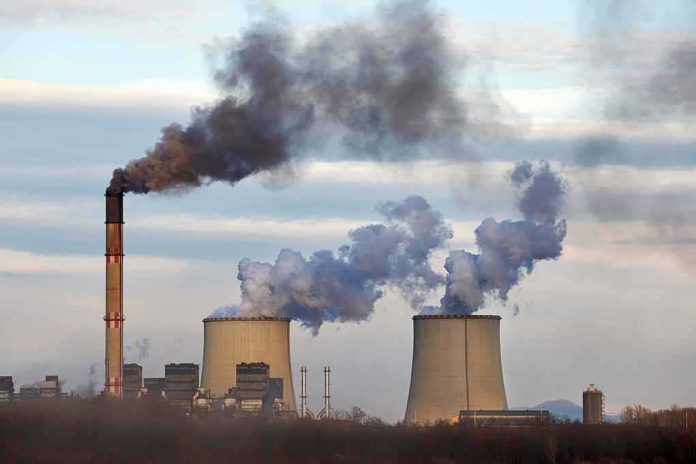
The fight over EPA authority is not about a single rule; it is about who—Congress, agencies, or courts—sets the terms for decarbonizing the U.S. power sector, and the Trump EPA’s partial repeal of power-plant carbon standards plants its flag firmly on the side of a narrower, court-policed reading of the Clean Air Act.
At a Glance
- EPA finalized a partial repeal of the Biden-era Carbon Pollution Standards for fossil-fueled power plants, withdrawing most of the 2024 rule after reevaluating what counts as the “best system of emission reduction” under the Clean Air Act.
- The agency’s rationale: Section 111 does not authorize climate-focused greenhouse gas controls for power plants; it cites West Virginia v. EPA as limiting mandates built on generation shifting or comparable sector-wide measures.
- EPA projects large cost savings and “regulatory certainty,” though the public record visible here offers headline numbers without a transparent, testable model behind them.
- Environmental and public health organizations have sued, arguing the repeal will impose substantial climate and health damages and shirks EPA’s statutory duties.
What the rule does and why EPA says it acted
EPA’s final rule, published September 17, 2026, repeals most provisions of the 2024 Carbon Pollution Standards for fossil fuel–fired electric generating units. In the agency’s telling, a fresh look at Section 111’s “best system of emission reduction” (BSER) shows the prior rule exceeded what the statute allows by centering controls aimed at climate outcomes and, practically, by favoring generation-shifting compliance pathways. The Federal Register notice anchors this: the agency “repeal[s] most provisions” after BSER reevaluation and resets the regulatory baseline for coal and gas units accordingly. The public-facing EPA page reflects that pivot and the companion proposal to withdraw associated greenhouse-gas determinations for power plants.
Legally, the administration ties the move to the Supreme Court’s West Virginia v. EPA holding, which rejected using Section 111(d) to force generation shifting as a primary mechanism for cutting carbon dioxide from existing power plants. That decision installed the major-questions doctrine as a constraint on expansive interpretations of old statutes—precisely the lever the agency now invokes to say Section 111 cannot bear climate-focused GHG mandates for this sector. In short: the agency argues Congress must speak more clearly if it expects EPA to restructure the grid in the name of climate policy.
The administration’s economic case—and what’s missing
EPA and allied voices frame the repeal as the largest power-sector deregulatory action yet, claiming it will save $310 billion and restore regulatory certainty for utilities planning multi-decade capital investments. The logic is familiar to anyone who has sat through utility integrated resource planning: compliance investments ripple through rate bases and dispatch; if you lift a costly mandate, you avert those costs. Yet the materials surfaced here do not show the supporting Regulatory Impact Analysis, the discounting assumptions, compliance scenarios across regional grids, or sensitivity to fuel and load trajectories that would let a skeptical reader interrogate the $310 billion figure. Without that visibility, the savings claim functions as an assertion, not a tested economic result.
EPA officials also contend the withdrawn standards offered “virtually no benefit,” language that, if intended as a benefit-cost judgment, needs a quantification of foregone climate and health co-benefits to be credible. That quantification is not presented in the accessible record here. A defensible analysis would surface emissions baselines with and without the rule, health-benefit valuations tied to co-pollutant changes, and explicit treatment of uncertainty. In its absence, the economic case remains rhetorically strong but analytically under-documented in public reporting.
The counter-case: health, climate, and statutory duty
Environmental and public health organizations contest the rollback on two fronts: consequence and law. On consequence, groups point to increased climate damages and classic criteria-pollutant exposures as plants avoid or delay controls, citing preliminary tallies of hundreds of billions to trillions in combined health and climate costs through the 2040s. The Environmental Defense Fund’s early analysis—offered as advocacy, not an agency-grade RIA—estimates roughly $1.0 trillion in health costs, more than 80,000 additional premature deaths, and $1.8 trillion in cumulative climate harms through 2047 if the repeal stands. These are order-of-magnitude claims and should be treated accordingly, but they underscore the stakes opponents will press in court and public debate.
On law, litigants argue EPA is abdicating responsibilities confirmed in a line of cases that recognized greenhouse gases as pollutants subject to regulation and upheld the agency’s role in setting emission limits from stationary sources. Their suits in the D.C. Circuit assert that repealing standards without replacement for a major emitting sector conflicts with the Clean Air Act’s public-health and welfare mandate. Expect the dispute to turn not on whether EPA can ever regulate power-plant GHGs—courts have said it can in some contexts—but on the permissible mechanism and the line West Virginia draws between source-specific controls and de facto sectoral transformation.
How we got here: three decades of statutory stretching and judicial pruning
Since Massachusetts v. EPA, climate rulemakings have cycled through a predictable arc: EPA identifies authority under the Clean Air Act to address greenhouse gases, builds a technical and legal case, and confronts challenges that push back on the breadth of the tool Congress wrote for conventional pollutants. The Obama-era Clean Power Plan tested systemwide “generation shifting,” which never took effect; the Supreme Court’s 2022 decision in West Virginia v. EPA narrowed the path by insisting on clear congressional authorization for measures of vast economic and political significance. The Trump EPA’s 2026 repeal is best understood as the institutional consequence of that judicial narrowing: a reset to source-specific interpretations of BSER and an explicit retreat from climate-led power-sector transformation by administrative rule.
This lineage matters because it clarifies what is actually in dispute. The fight is not whether decarbonization is desirable; it is whether Section 111, written for source-by-source standards, can be contorted into the nation’s energy-transition statute. Courts have repeatedly signaled discomfort with that move; absent new congressional text, agencies that reach for grid-wide levers will face the same headwinds.
NRECA Welcomes Partial Rollback of @EPA Power Plant Rule, Pushes for Full Repeal
Read more ⬇️ https://t.co/NjJyWV2KuX
— NRECA (@NRECANews) September 18, 2026
What changes on the ground—and what does not
Repeal of the 2024 standards removes federal pressure that would have accelerated carbon capture retrofits, early retirements, or gas-plant performance mandates in the 2030s. That eases compliance trajectories for coal and gas units and simplifies utility planning under federal law. But it does not freeze the market. State clean-energy standards, regional greenhouse-gas programs, tax incentives for low- and zero-carbon generation, corporate procurement, and aging fleet economics continue to push the mix toward lower-carbon resources. In other words, federal rollback adjusts one lever; it does not dictate dispatch or investment decisions on its own.
Price impacts, which loom large in the administration’s rhetoric, are inherently contingent: weather, fuel prices, load growth from data centers and electrification, transmission constraints, and local siting all swamp static rule-cost estimates in the near term. Absent a transparent, grid-by-grid modeling exercise, neither “hundreds of billions saved” nor “bills will soar” should be treated as settled; both are scenarios that depend on how utilities and states respond to a changed federal baseline.
The durable takeaway
EPA’s repeal is legally coherent within the post–West Virginia landscape and will likely survive or fall on how precisely it hews to source-specific readings of BSER. The economic narrative the agency advances—large savings, minimal benefits foregone—needs a public, technically credible analysis to carry weight outside supportive circles. Opponents’ sweeping damage estimates similarly demand transparent modeling to persuade beyond the already convinced. The constitution of U.S. climate governance all but ensures the next chapter will be written in the D.C. Circuit and, if history is a guide, the Supreme Court. Until Congress legislates with the specificity courts now require, power-plant carbon policy will continue to oscillate within the narrow corridor the judiciary permits.
Sources:
youtube.com, abcnews.com, aljazeera.com, politico.com, epa.gov, reuters.com, cen.acs.org, dailysignal.com