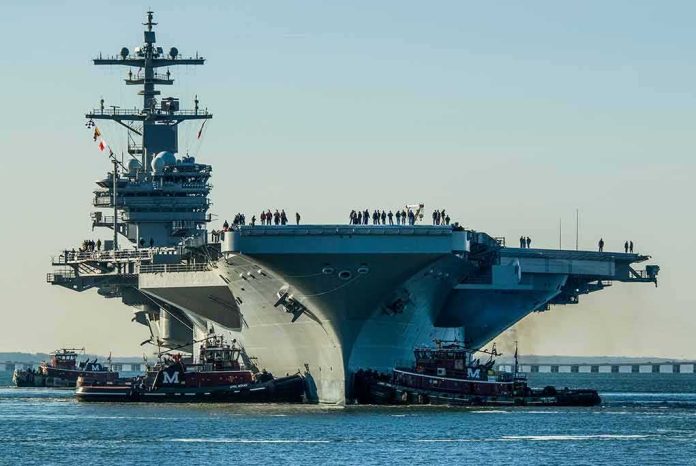
When a carrier strike group stays at sea for roughly ten months, two truths collide: the Navy can deliver extraordinary combat output at global scale, and the human system that enables it is run to the edge. The USS Abraham Lincoln’s return to San Diego forces a sober accounting of both realities—and of a force-management model that keeps producing these extreme deployments.
The Short Version
- The Navy touts the Lincoln’s deployment as a high-output success: hundreds of days in combat, thousands of sorties, and sustained operations across multiple theaters.
- Confirmed welfare crises surfaced alongside that output, including eight suicide attempts across the carrier strike group and periods of constrained resupply that reduced meal options.
- Congress has opened the aperture on oversight, seeking documents and explanation for why the deployment extended so far and how risks were managed.
- This case is not anomalous; it reflects a recurring cycle in which strategic demand outruns the Navy’s preferred 6–7 month deployment model.
What the Lincoln actually did: the operational record
Strip away the rhetoric and the core operational facts are not in dispute. Acting Secretary of the Navy Hung Cao publicly summarized the mission with specific output: 266 days deployed, 200 days in a combat zone, more than 10,000 sorties, and 1.5 million pounds of ordnance delivered—figures that, taken together, describe sustained carrier air wing employment at wartime tempo. A Navy official likewise confirmed that the ship and elements of Carrier Strike Group 3 returned after a 300-plus-day deployment, having steamed more than 85,000 nautical miles across chokepoints and contested waters from the South China Sea to the North Arabian Sea. These are the metrics the Navy is built to produce: mobile airpower, persistent presence, and the ability to surge combat aviation wherever combatant commanders ask for it. They are not conjured; they are generated by a machine—nuclear propulsion, industrial-scale logistics, deck-cycle discipline—run long and hard.
On its own terms, that machine performed. The strike group completed a prolonged mission and returned intact. The Navy’s public stance framed the extension as a planned rotation and an operational necessity rather than an improvised holdover, a signal that leadership views the length not as an accident but as a deliberate response to tasking. Whether that rationale holds under documentary scrutiny remains a separate question; publicly, the service offered outputs, not the contemporaneous decision calculus that extended the cruise.
Where the record is clearest: crew strain and confirmed incidents
The welfare picture is more than family rumor. In a letter cited by Reuters and reflected across major outlets, the Navy acknowledged eight suicide attempts across the Lincoln strike group during the deployment; there were no suicides. The department also conceded resupply limitations during major combat operations that led to reduced main-course options for a period; the line from leadership is that no meals were missed, but constraints were real. Families and sailors reported shortages of fresh food and hygiene products, plumbing and desalination problems, disrupted mail, and grinding work-rest cycles with little time off—complaints that were credible enough to trigger multiple congressional inquiries and a town hall focused on mental health and self-harm risks. These are material signals of a crew under prolonged stress, not a social-media narrative that can be dismissed with a flourish.
Two points are worth holding together. First, extended blue-water operations always tighten the logistics envelope; perishables run out, and supply chains routed through combat theaters become brittle. Second, carrier crews are built to absorb high tempo for finite intervals—measured in months, not almost a year. When that interval stretches, small degradations aggregate: sanitation fixes take longer, morale dips between replenishments, and the absence of liberty ports removes a long-proven pressure relief valve.
What is missing from public view: the decision calculus
The Navy has been specific about what the Lincoln did; it has been circumspect about why the deployment had to run that long. Absent from public release are the extension orders, the operational risk assessments, and the force-generation trade studies that would show, in black and white, why an earlier relief was not feasible without unacceptable risk elsewhere. Congressional letters now on the record request precisely that material—internal memoranda, sustainment plans, and anonymized health data—to test whether the extension was a prudent necessity or a symptom of structural overstretch. In other words, the open questions are not about whether the ship performed, but about the rigor of the choices that kept it out that long and the mitigation measures for predictable human costs.
This distinction matters. In naval operations, success and strain often coexist; the analytical task is to determine whether the strain was incurred by design, with mitigations in place, or by drift, with mitigations improvised. The Navy’s “planned rotation” language signals the former; the documentary record that would settle it has not yet been placed in the public domain.
The broader pattern: demand, inventory, and the 7‑month ideal
Seen against the last two decades, the Lincoln episode fits a familiar cycle. The Navy’s force-generation model aims for approximately six to seven months deployed at sea, with predictable maintenance and training blocks ashore; combatant commanders, faced with real-world crises, routinely ask for more presence than that model can supply. The result is a ratchet effect: a carrier extended to cover a gap here forces a later carrier to surge there, and the system’s buffers—maintenance windows, pre-deployment workups, port calls—get cannibalized to meet demand. The last several record-setting or near-record deployments, from pandemic-era cruises to recent combat-support missions, tell that same story in different theaters and with different acronyms; the constant is a fleet asked to be in more places, for longer, than its preferred cycle anticipates.
None of this is novel to sailors who have stood these watches. But it does clarify the policy choice. If strategic demand will continue to exceed the Navy’s planned deployment length, leaders can either grow the inventory of ready carriers and escorts, accept risk by leaving gaps, or normalize longer deployments and invest commensurately in crew sustainment—mental health capacity, resilient supply lines for perishables, and engineered redundancy for hotel services onboard.
🔴 USS Lincoln sets Navy record: 260+ days at sea; 8 suicide attempts disclosed
The USS Abraham Lincoln carrier strike group completed a deployment of over 260 consecutive days without a port call—a Navy record—after being redirected to the Middle East following the US-Israel… pic.twitter.com/6VTCcFc4ST
— NewsTongue (@NewsTongueX) October 7, 2026
What accountability should look like: specific, not theatrical
Accountability here is not performative outrage; it is granular verification. Investigators should examine deck logs and mission tasking to confirm when and why extensions were ordered; underway replenishment records to validate how often and with what shortfalls the ship was resupplied; maintenance and habitability work orders to map the scope and duration of sanitation and plumbing failures; and anonymized medical and counseling data to see whether demand for mental health care surged and how quickly sailors accessed it. The Navy has already acknowledged eight suicide attempts, a stark metric that demands context: distribution across units, timelines relative to operational peaks, and the lag (if any) between report and care. Those are empirical questions with documentary answers.
At the same time, the operational ledger deserves full publication, not just headline sortie counts. A transparent after-action report that links specific air wing outputs to combatant commander effects would let the public assess the trade: what risks were accepted to produce what outcomes, and are those tradeoffs sustainable given the fleet we have, not the fleet we wish we had.
The durable lesson
The Lincoln’s deployment is neither a singular triumph nor a scandal in search of a headline; it is the predictable consequence of a strategy-carrier mismatch that the United States has lived with for years. The ship and her sailors did what was asked of them, at measurable scale and for far longer than the model intends. The price—confirmed behavioral-health crises and periods of degraded shipboard living—was also real. If leaders want fewer stories like this, the remedy is not better messaging. It is more credible force planning, a resourced sustainment architecture for long-haul cruises, and the discipline to publish the rationale when deployments break the seven-month norm.
Sources:
military.com, gallego.senate.gov, scottpeters.house.gov, rmb.reuters.com, padilla.senate.gov, reed.senate.gov, bell.house.gov, nbcnews.com, navy.mil, reuters.com, bbc.co.uk