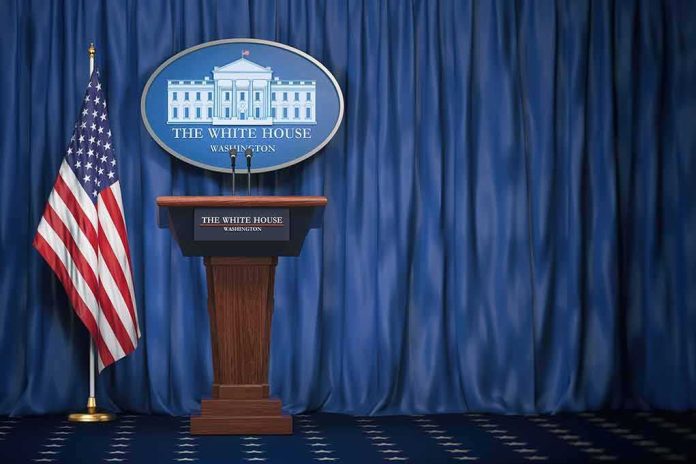
Personnel choices signal governing priorities; in the modern White House, few selections communicate more about strategy and risk tolerance than the person empowered to speak for the president in the briefing room.
The Short Version
- Multiple outlets reported that a White House official said President Trump offered Katie Zacharia the press secretary position.
- Reporting aligned on succession context: Zacharia would follow Karoline Leavitt, who left the post in late August.
- Zacharia’s background in law, federal communications, and conservative media makes the selection strategically legible.
- The press secretary role is the administration’s central conduit to the public record and daily media agenda.
What happened, and why it matters
On October 9, 2026, a White House official told multiple news organizations that President Trump offered Katie Zacharia the job of White House press secretary, a claim reported by Fox News, The Hill, BBC, Axios, USA Today, and CBS, among others. The accounts were consistent on the core point—the president made the offer—and on the context that Zacharia would succeed Karoline Leavitt, who departed in late August. Outlets emphasized that acceptance and start date were not yet specified, a common feature of fast-moving personnel shifts reported on background.
Treat this as more than a staffing note. The press secretary is the administration’s principal spokesperson and a custodian of the official record, responsible for shaping how the president’s priorities are framed, challenged, and understood in public. In practical terms, the role integrates message development with the mechanics of daily briefing, records management, and interagency coordination—functions that determine whether a White House communicates with speed and coherence or lurches from firefight to firefight.
The press secretary’s job: function, leverage, and constraints
The American presidency long ago professionalized the press operation; the secretary is the most visible node in an institutional communications system that drafts statements, curates guidance, and manages live exchanges with the press corps. This office does not simply socialize decisions after the fact; it cues news cycles, translates policy into intelligible narratives, and records the administration’s positions for history. The role therefore carries two intertwined responsibilities: advocacy—advancing the president’s agenda on the administration’s terms—and stewardship—maintaining a credible, citable record that agencies, courts, markets, and allies can navigate.
That dual mandate explains why presidents often tap figures who have operated on both sides of the lectern—inside government and in media-facing roles. The daily briefing is a contact sport, but the larger game is agenda control: selecting the top-line themes, sequencing announcements, and deciding when the White House itself should be the story and when it should fade behind subject-matter principals. In every modern administration, the press secretary’s morning begins with message alignment across the West Wing; the afternoon tests whether that alignment survives contact with breaking events and pointed questions.
Why Zacharia fits the moment
Reports identified Zacharia as a lawyer, a former Department of Homeland Security spokesperson, a conservative commentator, and a communications adviser to Trump Media & Technology Group—the company associated with Truth Social. That blend is instructive. Legal training offers fluency with precision language and exposure to the liabilities that imprecise answers can create; a DHS stint signals experience translating sensitive operational information under time pressure; commentary builds on-air composure and an instinct for sound-bite economy; platform advising suggests proximity to the president’s core digital audience. Administrations prize that mix when they expect protracted message combat over investigations, regulation, and legislative bargaining.
The timing is equally legible. With Leavitt’s exit at the end of August and a period of less frequent formal briefings reported thereafter, an offer in early October signals a decision to restore a more regularized podium presence ahead of consequential legislative and political windows. When the White House anticipates sustained attention on its priorities, the secretary’s job is not only fielding questions; it is also manufacturing windows of proactive communication—policy rollouts, surrogates’ kits, and coordinated interagency talking points that keep the initiative.
Continuity and change in White House communications
Viewed against the history of the office, the selection falls within a well-established pattern. Since the Reagan era, press secretaries have been embedded in a larger message architecture: early-morning strategy sessions, synchronized agency guidance, and disciplined sequencing of announcements. That architecture persists regardless of party; the variables are tone, aperture, and pacing—how combative the briefings run, how much detail is provided, and how often the principal appears personally to calibrate stakes.
Where administrations differ sharply is their integration with outside media ecosystems. Tapping a figure conversant with conservative media and social video implies an intention to accelerate clip-ready moments and to route around legacy gatekeepers when advantageous. That is not new, but the balance shifts with each app cycle. The secretary who can both survive the briefing room’s cross-examination and seed narratives that travel organically across aligned platforms gives a White House leverage that memos alone cannot buy.
What the reporting establishes—and the limits of the moment
The day-of reporting supports three firm conclusions. First, President Trump offered Katie Zacharia the position of White House press secretary; multiple outlets attributed this to a White House official, and some carried a direct formulation: “The President has offered Katie Zacharia the position”. Second, Zacharia would follow Karoline Leavitt, whose departure in late August created the vacancy. Third, at the time of publication, outlets said acceptance and an effective date were not yet specified; that is routine in backgrounded personnel disclosures and does not diminish the core fact of the offer.
One sentence of caution belongs here and no more: until acceptance and start-date details are formalized by the White House or the principal, this remains an offer rather than a completed appointment, as several reports made explicit.
BREAKING: President Trump has selected political commentator Katie Zacharia to replace Karoline Leavitt as White House press secretary. pic.twitter.com/WNLVPWlW1j
— Usha Vance (@Usha_Vance1) October 9, 2026
Implications for the briefing room and beyond
If Zacharia accepts, expect three near-term shifts. First, a reestablishment of predictable briefing cadence—weekly at minimum—paired with selective on-camera sessions by Cabinet principals to distribute issue depth. Second, more assertive narrative packaging: shorter top-of-briefing framers, tighter talking point discipline, and rapid-production clips tailored for social circulation within hours, not days. Third, firmer lines between on-the-record podium answers and policy development, with greater use of background calls to float trial balloons without committing the transcript—a technique administrations deploy when policy is live but not final.
Longer term, the yardstick will be credibility under pressure. The press secretary’s influence is not the decibel level at the lectern; it is the track record of statements that survive subsequent fact patterns. The durable secretaries, across parties, exhibit the same craft: they know when to hold a line, when to promise a follow-up, and when to escalate an answer to the president or a principal. If Zacharia brings that discipline to a White House intent on message dominance, the effect will be measurable in quieter corrections, steadier headlines, and a record that reads cleanly years later.
Sources:
cbsnews.com, foxnews.com, yahoo.com, bbc.co.uk, myfox28columbus.com, reference-global.com, lancaster.ac.uk, saylordotorg.github.io