
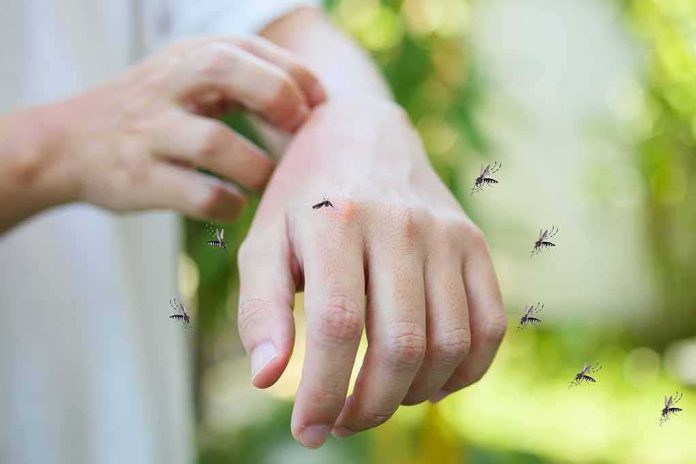
Florida’s 2026 dengue surge is not a blip of imported illness; it is a sustained, locally driven outbreak centered in Tampa Bay, defined by one serotype, multiple county emergencies, and an all-hands vector-control campaign that moved rapidly from press releases to helicopters, ground crews, and night spraying.
At a Glance
- Hundreds of locally acquired dengue infections were documented across eight Florida counties in 2026, with the Tampa Bay region at the epicenter.
- Clinical and lab data point to a concentrated DENV-2 outbreak, not a scatter of unrelated travel cases.
- Florida agencies escalated from alerts to operational response: aerial and ground adulticide, larval control, neighborhood canvassing, and trap-based surveillance.
- Hillsborough, Pinellas, and Pasco declared local emergencies; operations were reinforced by inter-county support and state-federal coordination.
What the evidence shows: a concentrated, local transmission event
By mid-October 2026, federal surveillance summarized 368 locally acquired dengue cases in Florida across eight counties, with the largest share in the Tampa Bay area, including Hillsborough, Pinellas, and Pasco. The CDC’s clinician briefing is unambiguous on two defining features: this was local transmission and it was overwhelmingly dengue virus serotype 2 (DENV-2), which accounted for 99% of 324 characterized cases spanning ages 3 to 89. That profile—cases without travel linkage, clustered geography, and one dominant serotype—is what an outbreak looks like in a continental U.S. setting where the vector is abundant and introductions arrive from dengue-endemic regions. The mechanism is straightforward: viremic people seed infections into local Aedes mosquito populations; those mosquitoes then transmit to nearby residents until control operations and seasonal declines in mosquito density break chains of transmission.
County-level alerts track the early arc of the event. Hillsborough’s health department announced a second locally acquired case on July 31 and an eighth by August 12, explicitly linking human cases to coordinated vector control in the surrounding neighborhoods. The guidance to residents—use EPA-registered repellents, fix screens, and, critically, drain water-holding containers like tires, toys, and flowerpots—maps directly to Aedes aegypti’s breeding ecology; one water-filled tire can generate hundreds of mosquitoes, turning a backyard nuisance into a neighborhood risk multiplier.
From alerts to operations: how Florida executed its vector-control playbook
Hillsborough County did not stop at messaging. It documented an operational surge that included nighttime ultra–low-volume (ULV) adulticide applications, targeted ground treatments, aerial larvicide missions, neighborhood canvassing, and door-to-door elimination of breeding sites. Interagency support was visible: Lee County helicopter assets flew larvicide missions over Hillsborough to suppress immature mosquito stages before they emerged. Operational notes reference trap deployment, positive mosquito findings, and the cadence of treatments—evidence that the county was running an integrated vector management program rather than a single-technology spray response.
Emergency governance followed the epidemiology. Hillsborough extended its local state of emergency in October, citing mosquito surveillance that detected dengue-virus activity; CDC’s briefing notes that Hillsborough, Pinellas, and Pasco each declared local emergencies in late September. These declarations are not rhetorical; they unlock procurement speed, mutual aid, and overtime capacity. In a vector-borne outbreak, time is transmission—compressing the interval between case detection, neighborhood notification, and larval/adult control is the practical difference between a handful of infections and a sustained chain.
Why DENV-2 dominance matters for risk and response
Serotype dominance is more than a lab footnote. Dengue comprises four serotypes (DENV-1 through DENV-4). Primary infection often produces a self-limited febrile illness; secondary infection with a different serotype raises the risk of severe dengue via antibody-dependent enhancement. A DENV-2–heavy season therefore has two implications: clinicians must stay alert for warning signs in patients with prior dengue history, and public health must anticipate that even a modest share of secondary infections can stress hospital capacity during peaks. The CDC’s clinician call situates the Florida pattern squarely in that framework and arms front-line providers with testing, supportive care, and reporting guidance tailored to a locally acquired context rather than the usual travel-associated baseline.
The Florida response strategy aligns with established dengue control doctrine. Aedes aegypti is a container breeder; it thrives in peridomestic microhabitats that evade broad-brush environmental management. That is why the county blended area-wide adulticide—useful for quickly knocking down infectious adults in a zone—with larvicide and human behavior change targeted at the actual production sites. The emphasis on “drain and cover” is not sloganizing; it is a mechanistic intervention to collapse the vector’s reproductive niche at scale.
Context: Florida’s recurrent vulnerability and the 2026 difference
Florida has toggled between sporadic local dengue transmission and periodic outbreaks since dengue reappeared in the Keys in 2009–2010. In the years since, the state has seen both concentrated clusters (e.g., Key Largo in 2020) and small numbers of scattered autochthonous cases. Nationally, locally acquired dengue remains rare compared with travel-associated illness—yet Florida’s climate, built environment, and travel ties to the Caribbean render it the continental state most exposed to introductions that can “catch” in urban Aedes populations.
What sets 2026 apart is scale and concentration. The CDC tally of 368 locally acquired cases by mid-October across multiple counties—dominated by Tampa Bay geography and DENV-2—signals a broader transmission footprint than the small clusters of prior years. That footprint triggered a coordinated multi-county emergency posture and sustained vector-control operations, including external helicopter support. While public reporting from media outlets traced case counts as they rose week by week, the CDC’s clinician-facing summary provides the clearest contemporaneous snapshot of scope and serotype.
I see @CDCgov data shows an outbreak of dengue fever in Florida: https://t.co/hclpEmal6w
The hemorrhagic virus spreads primarily through tiger mosquitoes (Aedes aegypti) & can cause severe illness & death.
No effective antivirals for it, yet.
Just don’t get bitten. https://t.co/IEbwBWePws pic.twitter.com/3jo1luusc8— Alexander B. Howard (@digiphile) November 2, 2026
What we know less well—and what it doesn’t change
Public health surveillance is a living system; case counts move as laboratories confirm pending tests and reclassify probable cases. In fast-moving outbreaks, totals cited on different dates can appear inconsistent without being contradictory. Media reported 296 Florida cases on October 3, while CDC’s October 15 cutoff showed 368. The variance reflects timing, not a substantive dispute over direction; both accounts depict a rapid, sizable increase in locally acquired cases as October progressed.
Operational documentation inevitably trails fieldwork. County updates describe ULV routes, aerial and ground missions, and neighborhood canvassing, but they do not publish controlled before/after mosquito indices or hospitalization curves in real time. That absence does not negate activity on the ground; it reflects the practical sequencing of outbreak control first, retrospective evaluation second. The decisive facts for residents and clinicians remain: local DENV-2 transmission occurred across Tampa Bay counties; authorities escalated promptly from alerts to integrated vector management; and seasonal decline plus aggressive control were expected to bend transmission down as fall advanced.
Practical implications for clinicians and communities
For clinicians in Florida, dengue should be on the differential for acute febrile illness even without travel history when community transmission is present. Test according to CDC guidance, avoid NSAIDs until dengue is excluded to reduce bleeding risk, and counsel patients on hydration and warning signs warranting escalation of care. Report confirmed and probable cases promptly; surveillance is not an abstract exercise—it is the trigger for block-by-block vector control that protects your next patient.
For residents, the most powerful interventions are mundane and proximate. Empty standing water weekly from containers; cover rain barrels; repair screens; use EPA-registered repellents; and cooperate with mosquito-control canvassing. Each backyard that removes breeding habitat starves the outbreak’s fuel supply. In a container-breeding system, community action is not a public-service announcement—it is the intervention.
Bottom line
Florida’s 2026 dengue outbreak is a locally propagated, DENV-2–dominant event centered in Tampa Bay that demanded, and received, a muscular operational response—county emergencies, interagency air support, and neighborhood-level control—backed by clinical guidance calibrated to local transmission. The details may evolve in surveillance tallies, but the core story does not: introductions found a ready vector, transmission took hold, and Florida’s layered response moved to cut the chains.
Sources:
hillsborough.floridahealth.gov, hcfl.gov, cdc.gov, wwwnc.cdc.gov, archive.cdc.gov