
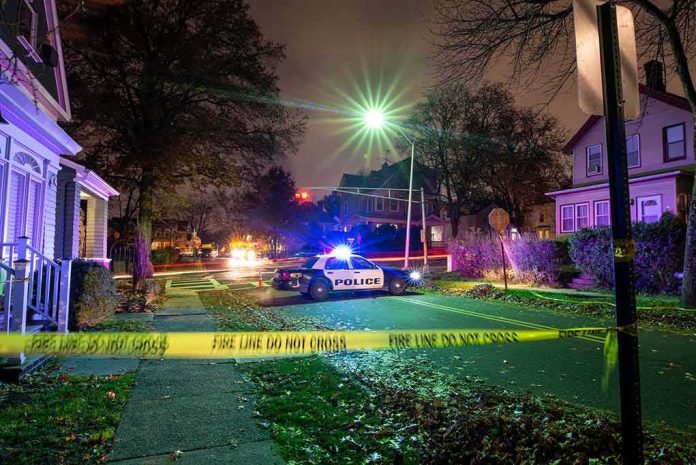
A predawn disturbance on a Fresno lawn escalated into a textbook self-defense shooting and a felony arrest, illustrating how quickly a routine trespass can become a violent, seconds-long judgment call about imminent danger and proportionate force.
At a Glance
- Police say a 72-year-old Fresno homeowner shot an off-duty ICE agent after the agent assaulted him and his adult daughter.
- The agent, identified as David Gonzalez, was first found asleep on the family’s front lawn around 3:30 a.m., appeared intoxicated, and allegedly refused to leave before the assault.
- The daughter’s off-duty police officer boyfriend arrived and handcuffed Gonzalez before Fresno officers took custody; the homeowner faces no charges.
- Gonzalez was booked on felony assault-related counts; the legal frame centers on reasonable fear, imminence, and proportionality in self-defense.
What happened on the lawn and why the shot was fired
According to Fresno Police, the confrontation began when a daughter discovered a stranger asleep on the family’s front lawn shortly before 3:30 a.m. She woke her father, who went outside to rouse the man and tell him to leave. Police identify the man as David Gonzalez, 32, an off-duty Immigration and Customs Enforcement agent visiting from Texas. Officers say Gonzalez appeared intoxicated, assaulted the 72-year-old, and then attacked the daughter when she intervened, forcing both residents to the ground during the struggle. Fearing for his safety and his daughter’s, the father produced a lawfully owned handgun and fired a single round, striking Gonzalez.
Fresno police reported visible injuries to the father and described the woman being knocked down when she tried to help. The department said the homeowner’s decision to fire was tied directly to fear for himself and his daughter, a core element of California self-defense doctrine. The daughter’s boyfriend, an off-duty police officer, arrived quickly and restrained Gonzalez with handcuffs; responding officers then took Gonzalez into custody after multiple 911 calls reported a gunshot in the neighborhood near East Dudley and North Broadway.
Arrest, charging status, and what police say about custody
Gonzalez underwent surgery and remained hospitalized in serious condition before being booked on felony assault-related charges described in media reports as battery likely to cause great bodily injury, felony vandalism tied to a damaged vehicle, and additional battery counts. Fresno police said the 72-year-old homeowner would not face charges; he possessed the firearm legally. A neighbor, recounting what police told him, said Gonzalez pushed the daughter into his parked car during the altercation, accounting for the reported damage. While secondhand, that detail aligns with the department’s outline of a sustained physical struggle outside the home.
Local reporting captured brief friction narratives about whether ICE sought to take custody of Gonzalez directly from the hospital; Fresno’s police chief publicly denied any improper request or interagency confrontation, stating Gonzalez would remain in city custody and that ICE supervisors were advised of the criminal case. ICE, for its part, referred questions back to Fresno police and indicated an administrative personnel review would proceed in parallel with the local investigation.
The legal mechanics: how California evaluates a case like this
Strip the badges and headlines, and the legal frame is consistent with any violent encounter on residential property: did the shooter reasonably believe he or another faced imminent danger of death or great bodily injury, and was the force used a proportionate response to that danger? California’s pattern instructions on self-defense and defense of others emphasize imminence—a threat judged in the moment, not after the fact—and reasonableness, measured from the perspective of a person in the same circumstances. Those instructions, used to guide juries in cases up to and including homicide, anchor the analysis here even though this was a single-shot, nonfatal incident.
California case law also recognizes heightened protection of the home, but it does not authorize lethal force merely for trespass; the threat must be violent or riotous and aimed at persons inside or at the threshold. In this case, the police narrative points outside the house, on the lawn and near a porch—still curtilage of the home—and describes a physical assault on two residents. That combination—physical battery on an elderly occupant and on his daughter in close succession—fits the classic fact pattern where defense of self and defense of another converge. One shot, delivered while the melee was ongoing, is exactly the sort of fact a jury would evaluate on proportionality if the state pursued charges, which police say they did not against the homeowner.
Alcohol, timing, and the problem of seconds
Late-night or pre-dawn disturbances often arrive bundled with impaired judgment, ambiguous cues, and compressed timelines. Officers said Gonzalez appeared intoxicated; while toxicology is a medical and evidentiary question, what matters most to self-defense analysis is how the assailant’s behavior registered in the moment—agitation, refusal to leave private property when told to do so, and rapid escalation to hands-on violence. In seconds, the interaction progressed from awakening a trespasser to a physical struggle involving a 72-year-old and his adult daughter on their own property. Police emphasized that the father fired because he feared for their safety; that link between contemporaneous fear and the discharge is the crucial hinge under California’s instructions on complete self-defense and defense of others.
The involvement of an off-duty officer—the daughter’s boyfriend—adds a detail that often matters afterwards rather than during: rapid restraint after the threat abates. The off-duty officer’s handcuffing of Gonzalez before on-duty units arrived suggests the struggle had ended and that scene control was established quickly, which is consistent with reports of only one shot fired.
Protesters gathered in northeast Fresno Saturday after a shooting involving an off-duty ICE agent, as demonstrators questioned ICE operations. https://t.co/YIAN3B0dRY
— ABC30 Fresno (@ABC30) October 11, 2026
Why the professional affiliation doesn’t change the criminal analysis
That Gonzalez is an ICE agent has obvious public salience, yet it does not alter the elements of assault or the standard for defensive force. In every jurisdiction, prosecutors and police must evaluate conduct, not employer. Fresno police treated the event as any felony battery case complicated by a defensive gun use: secure medical care for the wounded party, stabilize the scene, gather physical and testimonial evidence, and make a custody call. Their reported decisions—booking Gonzalez on assault counts and declining to arrest the homeowner—track that workflow. Any parallel administrative review by ICE concerns employment and policy compliance, not the criminal elements that Fresno investigators addressed on the curb and at the hospital.
What this incident teaches about home confrontations
Homeowners tend to imagine clear separations: inside versus outside, friend versus intruder, talk versus shoot. Real incidents collapse those lines. Most defensive gun uses happen close, move fast, and involve muddled signals—impaired speech, unexpected proximity, and bystanders stepping in. The Fresno case reflects the triad that governs these moments: imminence, reasonableness, proportionality. Police reports describe a sudden assault on an elderly man, an immediate attack on a family member who intervened, and a single shot fired to stop it. However different each case’s details may be, that sequence is precisely how the law expects residents to evaluate danger under pressure—and how investigators, afterward, evaluate the resident’s split-second choice.
Sources:
feedpress.me, abcnews.com, abc7.com, nbcpalmsprings.com, independent.co.uk, kmph.com, azfamily.com, ibtimes.co.uk, fresnobee.com