
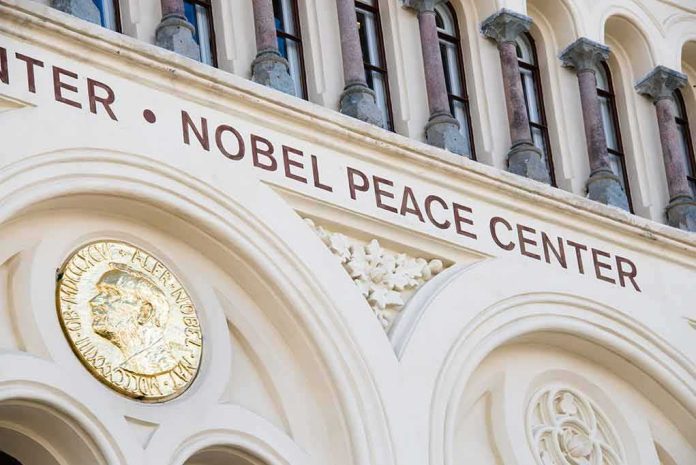
The Nobel Peace Prize is less a scoreboard of who “stopped the most wars” than a deliberate signal about what counts as peace; that is why a president’s claim of settling eight conflicts could be set aside in favor of a jurist honored for fortifying the rule of law.
The Short Version
- The Nobel Peace Prize encodes a theory of peace; in 2026, the Committee privileged international law and accountability over transactional conflict deals.
- President Trump publicly argued he deserved the 2026 prize for “settling eight wars,” but the Committee awarded it to South African jurist Navi Pillay.
- The Committee’s citation emphasized prosecution of atrocity crimes and the rule of law as conditions for lasting peace, not leader-centric dealmaking.
- Controversy is the norm in Peace Prize history; the institution is explicitly political in its choices, though independent of Norway’s government.
What the Committee actually rewarded in 2026
The Norwegian Nobel Committee awarded the 2026 Peace Prize to Navanethem “Navi” Pillay, citing her efforts to promote peace through international legal principles and her role in ensuring that war crimes, crimes against humanity, and genocide are prosecuted. The announcement framed the prize as an affirmation that peace requires justice and that the rule of law—national and international—underpins systems designed to resolve conflicts nonviolently. That is a coherent choice within the prize’s intellectual tradition: privileging institutions and norms that constrain violence over personal diplomacy that pauses it. The Committee also situated its decision in the present strain on international-law institutions, underscoring a defense of legal infrastructure as a peace strategy.
This is not semantic embroidery; it is the prize’s operating philosophy in action. When the Committee identifies a laureate, it selects a theory of change. In Pillay’s case, the theory is that sustained accountability alters incentives for would-be perpetrators, deters atrocity, and carves nonviolent avenues for political struggle. Whether one agrees, this is what the Committee endorsed, and it explains the selection as an alternative to recognizing tactical conflict bargains that may unravel once the spotlight fades.
Trump’s claim and how it intersects—then diverges—from Nobel logic
President Trump asserted he should receive the 2026 Nobel Peace Prize for “settling eight wars,” telling reporters he had resolved multiple conflicts and retrieved hostages. The argument is clear: judge peace by discrete outcomes attributed to executive will, not by the slower accumulation of legal constraints and institutional legitimacy. That is a recognizable school of statecraft—results-oriented, leader-driven, and skeptical of legalism’s leverage on armed actors. But the Nobel Committee was not choosing among versions of the same claim; it was choosing between different conceptions of what ends war sustainably. Its citation made the distinction explicit by rooting peace in enforceable law and accountability rather than leader-specific achievements.
Seen in that light, Trump’s frustration is unsurprising, but it does not amount to a counterfactual about the Committee’s mandate. The Peace Prize has never been a tally of battlefield de-escalations alone. At times it has honored cease-fire architects; at other moments it has elevated institutions, dissidents, or humanitarian norms. The 2026 choice slots into the latter category—rewarding a legal architecture that aspires to make certain kinds of violence politically and personally costly.
How the Peace Prize decides: mechanism, not mystique
Alfred Nobel’s will tasks a five-member Norwegian Nobel Committee, appointed by the Storting (Parliament of Norway), with awarding the Peace Prize. The Committee operates independently, but its work is unavoidably political in the broad sense: selecting people or organizations whose work they judge to advance “fraternity between nations,” disarmament, and peace congresses, adapted to contemporary challenges. Over more than a century, this has produced choices that crystallize a theory of peace in a given moment—sometimes celebrating negotiated settlements, other times championing law, civil resistance, or humanitarian protection. The 2026 decision belongs squarely to the “law as peace infrastructure” lineage.
Because the Committee is selecting a thesis, not simply auditing outcomes, its decisions often disappoint those who equate peace with immediate, leader-credited conflict cessation. That tension is by design. The prize is meant to point the world’s attention toward what the Committee believes will bend the arc of conflict over time; it is not a lifetime achievement award for statecraft, nor an automatic coronation for headline-grabbing mediation. Candidates who view the prize as validation of personal efficacy often misread the institution’s north star.
Why controversy is a feature, not a bug
Disputes over Peace Prize choices are as old as the award. The Committee itself chronicles major ruptures: Ossietzky in 1935, Kissinger and Lê Đức Thọ in 1973, and the Oslo Accords trio in 1994, among others. Each episode exposed deep disagreement about what constitutes real movement toward peace, and whether law, negotiation, or moral witness should take precedence. In some years, members resigned in protest; in others, laureates refused the award. That history matters because it reframes modern outcry as continuity. The institution sets a stake in the ground knowing it will anger some parties; the backlash is evidence that its choices are consequential, not that they are capricious.
Measured against that record, the 2026 debate is archetypal. One camp asks: did a leader bring guns to silence, even temporarily? The other asks: did a system strengthen the guardrails that prevent atrocities and channel disputes into courts rather than trenches? The Committee answered the second question this time. Another year, it may choose the first. Neither axis exhausts the meaning of peace; both are part of the prize’s repertoire. But in moments when international legal institutions are under pressure, it is unsurprising that the Committee would throw its weight behind their legitimacy.
What this choice means going forward
For practitioners, the lesson is practical. If you want to be legible to the Nobel Peace Prize in a year like 2026, demonstrate how your work reduces the impunity that fuels cycles of violence and how it embeds nonviolent dispute resolution into durable institutions. Tactical de-escalations remain vital to save lives; they may even be recognized in different years. But the Committee is signaling that justice and law are not luxuries appended to peace after the guns fall silent—they are mechanisms that stop guns from firing again.
For political leaders, a separate takeaway applies. Publicly demanding the prize on the basis of claimed tallies—“eight wars,” “hostages back”—misunderstands its selection grammar and invites a zero-sum reading the Committee rarely uses. The more persuasive case, if one exists, connects statecraft to measurable constraints on atrocity, strengthened multilateral norms, and institutional pathways that outlast any single administration. In the Nobel ecosystem, peace is not merely what one powerful actor orders; it is what the law makes harder to break.
President Trump:
"Based on my record of peace, a record like no one has ever had — I'm just saying how crooked the whole Nobel Prize deal is" https://t.co/pYLnHqRyH9 pic.twitter.com/rfcFNLJN6I
— HOT SPOT (@HotSpotHotSpot) October 10, 2026
How to read the next controversy
The next Peace Prize will likely trigger the same argument in new clothes. When it does, begin with the Committee’s citation: it always telegraphs the mechanism it is rewarding. Then map competing claims against that mechanism. Are critics offering a different, defensible theory of peace—deterrence, negotiation, social movements—or are they simply asserting entitlement? An informed reader does not have to agree with the Committee, but ought to evaluate its choices on their own terms. That discipline turns annual outrage into an education in how peace is made—and sometimes, how it is lost.
Sources:
newrepublic.com, indianexpress.com, nobelprize.org, independent.co.uk, nytimes.com