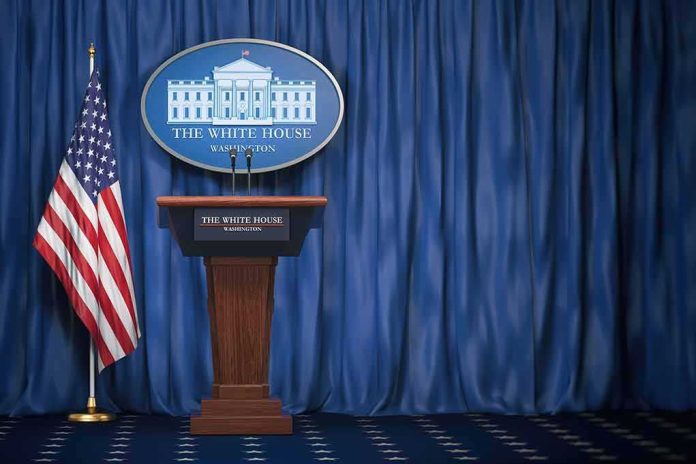
The fight over who gets into the White House briefing rooms is not a media spat; it is a recurring constitutional stress test over whether government may reward friendly coverage and punish critical reporting while still claiming to respect a free press.
At a Glance
- President Trump announced an “effective immediately” ban on CNN, MS NOW (MSNBC), and Politico from White House access, citing “fake news” as the reason.
- The move fits a long-running pattern: administrations try to manage access; courts scrutinize viewpoint-based exclusions under the First Amendment.
- The key legal fault line is narrow but decisive: once the White House opens newsworthy spaces to some journalists, it cannot exclude others because of viewpoint.
- The administration’s unverified claim that Politico received an “$8 million” federal payment is evidentiary weak ground for justifying a ban.
What actually happened and why it matters
President Trump publicly declared he was barring CNN, MS NOW (MSNBC), and Politico from the White House, “effective immediately,” and tied the ban expressly to what he called their “constant ‘reporting’ FAKE NEWS.” Multiple outlets reported the announcement contemporaneously and quoted the rationale, as well as the assertion that additional “fake news outlets” could follow. The declaration was categorical and retaliatory in tone, not couched in credentialing criteria, safety policies, or neutral rules of access.
Two features of the announcement are pivotal for assessing its durability. First, it targeted named outlets and tethered the punishment to perceived editorial failings—classic markers of viewpoint-based exclusion. Second, no formal directive defining scope, mechanism, or standards accompanied the rhetoric in the record presented here; reports even noted uncertainty about what, operationally, the “ban” altered (briefing-room access, pool rotations, on-grounds workspace, or travel with the President). Those two attributes—retaliatory purpose and procedural opacity—are precisely what have drawn judicial skepticism in prior access fights.
How White House access actually works
Press access to the White House is an accretion of practice, security protocols, and limited credentials rather than a single statutory regime. The Secret Service controls physical entry badges; the White House Correspondents’ Association (WHCA) helps administer pool rotations; and the Press Office sets event-by-event logistics. In First Amendment terms, courts treat many of these venues—Oval Office sprays, Air Force One gaggles, pool sprays in restricted rooms—as “nonpublic forums.” That label matters: in nonpublic forums, the government may impose reasonable, content-based restrictions tied to the forum’s purpose, but it may not discriminate by viewpoint. When the government opens these select spaces to some journalists, it must apply access criteria evenhandedly, not as a lever to punish unfavorable coverage.
That is not press exceptionalism; it is bedrock forum doctrine. The rules do not force the White House to invite the public into the Situation Room. They do, however, constrain the White House from opening a politically valuable press setting to its preferred outlets while excluding disfavored ones because of those outlets’ editorial stances. The line between permissible management and unconstitutional retaliation runs straight through motive and neutrality.
The AP case: the closest modern analog
The most instructive precedent is the Associated Press litigation over the Trump administration’s 2025 restrictions. A federal district court concluded the AP was likely to succeed on its claim that exclusion from restricted press spaces based on viewpoint violated the First Amendment, and it enjoined White House officials from denying access to events in places like the Oval Office and Air Force One on that basis. The reasoning was straightforward: once the government opens those nonpublic forums to a press pool, viewpoint-neutrality is mandatory.
The appellate posture grew more complicated—an interim stay, a subsequent ruling emphasizing the government’s latitude in restricted spaces—but the core constraint endured in the case law and commentary: management is permissible; viewpoint discrimination is not. Even scholars defending greater presidential control over intimate settings have acknowledged that the Brady Briefing Room, once opened to the press generally, cannot be policed by editorial litmus test. For a White House seeking to sustain a ban, the practical takeaway is clear: tie access decisions to neutral, articulated criteria, document their application, and avoid retaliatory rationales. The announced ban at issue here did the opposite on its face.
The administration’s stated rationales and the evidence problem
The President’s justification rested on two claims: pervasive “fake news” and, with respect to Politico, an assertion of an “$8 million” federal payment under the prior administration. The first is a conclusion, not a criterion; without a written access policy keyed to verifiable standards of accuracy or conduct applied across outlets, “fake news” functions as viewpoint shorthand rather than a neutral rule. Courts have shown little patience for that framing when it drives gatekeeping to newsworthy venues.
The second claim—the $8 million figure—remains unverified in the materials here. Multiple stories repeat the allegation, but none exhibits the contract file, purchase order, or agency record that would locate the payment in a lawful procurement, a subscription agreement, or any transaction at all. In litigation, that evidentiary gap matters: a contested factual assertion cannot carry the weight of a constitutional justification if the government cannot substantiate it with records, lawful purpose, and neutrality in application.
Competing views: genuine disagreement without false balance
The White House position is simple to state: access is a privilege, and chronic inaccuracy should have consequences. The difficulty is not the sentiment; it is the instrument. When a president singles out specific outlets by name and announces an “effective immediately” ban because he detests their coverage, courts hear a retaliation claim. News organizations, unsurprisingly, characterize such actions as an unconstitutional attempt to chill coverage and to skew the pool toward friendlier voices; CNN framed the threatened exclusion exactly that way and signaled readiness to challenge it. The legal literature and recent rulings offer the press solid footing when the government’s stated motive is editorial animus and the forum has been opened to others on similar terms.
Could a White House craft a durable, neutral access regime? Yes. It would look procedural, not polemical: published criteria (security, capacity, conduct), transparent allocation (rotations, lotteries), written warnings for rule violations, documented revocation for cause, and an appeal path. It would not read like a speech about “fake news,” nor would it rely on unproven allegations about a competitor’s funding.
Trump has no right to ban media agencies from the people’s White House. He is taking away their right to the 1st amendment for no reason or proof of what he is accusing the of. He doesn’t like them because they won’t kiss his ass or praise him. https://t.co/tMA9Cl5zLd
— MyOpinionMeansNada (@JoseCer42355893) September 18, 2026
What to watch next: mechanism, scope, and the courtroom
Three implementation questions will determine whether the ban stands or collapses. First, scope: does “ban” mean loss of hard passes, removal from workspace, exclusion from pool sprays, or denial of briefings? The narrower and more procedurally grounded the limitation, the stronger the government’s position; blanket exclusion tied to viewpoint is the weakest. Second, record: are there written directives, contemporaneous memos, and uniform enforcement across outlets, or only a public post and ad hoc follow-through? Courts credit paper trails. Third, remedy: if litigation ensues, expect rapid motions for temporary relief and a familiar doctrinal contest over nonpublic forum standards and viewpoint neutrality—terrain where, in this era, the press has often won at least partial reinstatement.
Bottom line
Administrations can organize their press operations; they cannot weaponize access to punish coverage. Declaring a ban “effective immediately” because named outlets publish “fake news” places the dispute squarely on constitutional ground the White House has struggled to hold in recent years. Unless the government can convert rhetoric into a neutral, documented access policy—and substantiate any corruption claims it invokes as justification—the courts are likely to treat this as viewpoint discrimination, not housekeeping.
Sources:
variety.com, dailysignal.com, fox17.com, commondreams.org, npr.org, politico.com, deadline.com, ifs.org, courthousenews.com