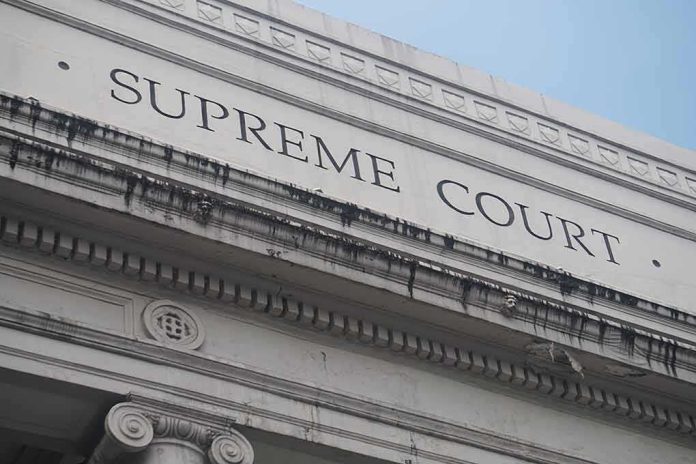
The Supreme Court just handed presidents sweeping new power over the federal bureaucracy, and that shift could reshape how every American is governed for decades to come.
Story Snapshot
- The Court’s 6–3 ruling in Trump v. Slaughter lets presidents fire leaders of most “independent” agencies at will.
- Justices overturned a 1935 precedent and struck down “for cause” job protections at agencies like the Federal Trade Commission.
- The ruling fits a long trend that strengthens the presidency but weakens Congress’s checks on the executive branch.
- Both conservatives and liberals now face a federal system even more controlled from the top, feeding fears of an unaccountable “deep state.”
A Term That Supercharged Presidential Control Over Agencies
During its 2025–2026 term, the Supreme Court made one of its most important moves in years on how the federal government is run. In Trump v. Slaughter, decided June 29, 2026, the Court ruled 6–3 that President Donald Trump could fire Federal Trade Commission Commissioner Rebecca Kelly Slaughter for policy reasons alone, without proving misconduct or “cause.” That single case opened the door for presidents to remove top officials at many agencies that had long been called “independent.”
Chief Justice John Roberts wrote the majority opinion. He said the Constitution gives “the Executive Power” to one elected president, not to boards or commissions that he cannot fully control. Because of that, Congress cannot block the president from removing officials who carry out his powers. The opinion states bluntly that “the President may remove his subordinates at will,” and that “for cause” limits on removal at the Federal Trade Commission violate separation of powers. That logic reaches across more than two dozen similar agencies.
Overturning 90 Years of ‘Independent’ Agency Protections
This term’s decision did more than settle one firing dispute. The Court openly overruled its famous 1935 case Humphrey’s Executor v. United States, which had shielded members of multimember commissions from at-will removal. In that older case, the Court allowed Congress to give commissioners fixed terms and protect them unless they were inefficient, neglectful, or guilty of malfeasance. Now the Court says that experiment failed, and that such protections “are contrary to the separation of powers enshrined in the Constitution.”
Legal analysts note that this ruling did not appear out of nowhere. For decades, conservative lawyers have pushed the “unitary executive” theory, which claims the president must be able to direct and fire any official who uses executive power on his behalf. Earlier decisions had chipped away at protections for officials at the Consumer Financial Protection Bureau and other agencies. This term’s opinion finishes that project for most executive-type commissions. It treats almost all “independent” regulators as presidential subordinates who can be dismissed for any reason, at any time.
A Narrow Exception for the Federal Reserve and Why It Matters
On the same day as Trump v. Slaughter, the Court decided Trump v. Cook, which involved Federal Reserve Governor Lisa Cook. There, a different 5–4 majority temporarily blocked Trump from removing her while legal challenges continue, recognizing the Federal Reserve’s “unique constitutional and historical status.” The Court signaled that the Federal Reserve Board is different because its decisions can shake the entire United States economy in ways that demand some insulation from daily politics.
That split result is striking. It tells presidents they can now freely fire many of the officials who regulate banks, labor, consumer safety, energy, and more, but they must move more carefully when it comes to central banking. For everyday Americans, this means economic policy may stay relatively stable, while rules in areas like workplace safety, environmental protection, and consumer rights could swing widely whenever the White House changes hands. Some business groups cheer this flexibility, but both workers and small businesses may worry about constant rule changes that make long-term planning harder.
What This Term Signals About Government Power and Public Frustration
For many Americans, left and right, this Supreme Court term confirms a bitter suspicion: the federal government is growing more distant and more controlled from the top, even as life feels less secure. Conservatives who resent “woke” agendas and heavy regulation may welcome a president’s stronger hand over agencies they see as part of a hostile bureaucracy. Liberals, who fear corporate influence and weak safety nets, see those same powers as a tool for gutting protections and favoring the wealthy.
Big surprises from this term’s Supreme Court: a Baker’s dozen of rulings that shifted the playing field in criminal procedure, executive power, and federalism. From Thomas’s flyover on equal protection for the federal government to Chatrie’s expansion of… https://t.co/WaS7gGC4ML
— GhostMint OPS (@GhostmintO71217) July 14, 2026
Yet both groups share a deeper concern. When one person gains power to purge regulators across most of the government, it can feed the sense that policy is driven by elites and loyalists, not by law or expertise. This term’s rulings shift real control away from Congress, which is supposed to speak for the people, and toward an executive branch many already view as captured by insiders. Whether readers support Trump or oppose him, the Court has made the stakes of each presidential election far higher, and the system more vulnerable if a future president decides to bend those new powers toward personal or partisan ends.
Sources:
reason.com, abcnews.com, wiley.law, newsbreak.com, bbc.com, cnbc.com, supremecourt.gov