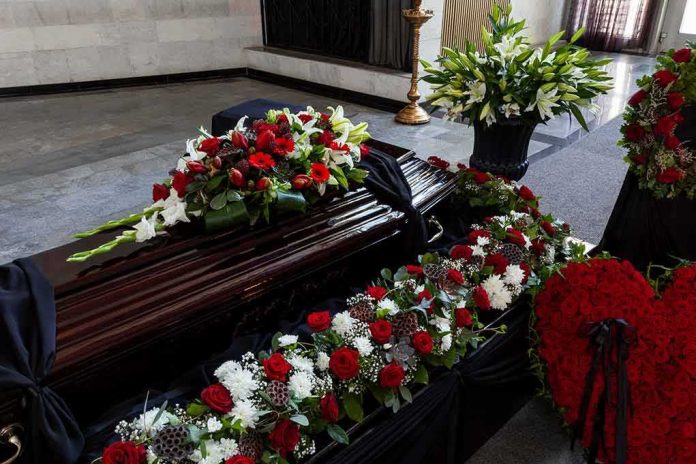
When a funeral director is accused of fabricating a marriage, forging probate papers, and leaving human organs in a bucket, it exposes how vulnerable families are at the exact moment they are least equipped to spot fraud.
Key Points
- Houston funeral home operator Unique Mica Green-Battle is charged with five felonies tied to an alleged scheme to steal more than $2.2 million from the estate of Lawrence Gammon by posing as his common-law spouse.
- Investigators say Green-Battle used personal information obtained through funeral arrangements to file a forged will and probate documents, then seized the decedent’s home, vehicles, and financial accounts.
- The business, A Community Funeral Home, was allegedly operating without a valid license; records indicate required licenses expired in 2021 and were later revoked, yet services continued.
- During a 2025 raid, police reported finding a Home Depot bucket containing human organs and dozens of boxes of cremated remains, amplifying concerns about mishandling of bodies as well as financial fraud.
- The case fits a broader pattern of funeral-industry abuse in which unlicensed or unscrupulous operators exploit trust, paperwork access, and regulatory gaps to defraud grieving families.
An Alleged Estate-Theft Scheme Built on Funeral Trust
Prosecutors in Harris County describe the Green-Battle case as a sophisticated exploitation of the funeral relationship, weaponizing paperwork and personal data to gain control of a dead man’s wealth. According to KPRC’s reporting and court records, 78‑year‑old Lawrence Gammon died of natural causes in the summer before the charges were filed. His family hired Unique Green (also known as Unique Mica Green-Battle) to handle funeral arrangements, providing him with Gammon’s personal information over email as part of that process.
Within weeks, investigators say, Green-Battle filed a fraudulent last will and testament in probate court, naming himself Gammon’s common‑law spouse and sole heir. Prosecutor Adam Broderick has publicly called the mechanism “diabolical” and “very sophisticated,” emphasizing that Green-Battle had no prior relationship with Gammon but nonetheless asserted a spousal connection on paper to claim the entire estate. Using that disputed will and related probate filings, Green-Battle allegedly took possession of Gammon’s three vehicles, his home on Tottenham Drive in southwest Houston, and nearly $2.2 million held in bank and retirement accounts.
The alleged fraud did not stop at estate documents. Some of the felony counts also arise from claims that Green-Battle submitted forged materials to the Texas Funeral Service Commission, including false assertions of military service and embalming skill, to support license applications and professional standing. Commission records reviewed by reporters show Green-Battle never served in the armed forces and never held a valid funeral director or embalmer license, despite operating A Community Funeral Home and presenting himself as an experienced practitioner.
From Licensing Violations to a Raid and Disturbing Discoveries
Regulatory records and investigative reporting indicate that licenses tied to the funeral home and its listed owner had expired by 2021 and were formally revoked in August 2025. Despite that, Green-Battle continued offering end‑of‑life services, placing the business squarely in violation of Texas law governing funeral directing and embalming. Houston Police Department Lieutenant Larry Crowson has described the probe as centered on “identity theft involving the identities of the deceased persons,” with detectives focusing on how information from funeral contracts was allegedly repurposed for fraud.
Those concerns led to a November 2025 search warrant and police raid on A Community Funeral Home in Houston’s Third Ward. During that operation, investigators reported finding a Home Depot bucket filled with human organs, along with 48 boxes of cremated remains, including Gammon’s. The discovery of unaccounted organs in a hardware‑store bucket, combined with the volume of stored cremains, raised immediate questions about whether bodies had been handled and processed in accordance with Texas law and basic professional standards.
The organ bucket has become a focal point in public coverage, not only because of its shock value but because it appears to confirm that regulatory breakdowns in the business extended beyond paperwork and licensing technicalities. In televised segments, when confronted with questions about the bucket, Green-Battle dismissed the issue, reportedly telling investigators it was “for you to eat for lunch,” a remark that prosecutors and families interpreted as flippant in the face of serious abuse‑of‑corpse concerns.
Courtroom Spectacle: “I’m a Celebrity” and Public Denial
By the time Green-Battle first appeared in Harris County criminal court on the felony charges, the case had already attracted substantial media attention. Bond was set at a total of $800,000, reflecting both the scale of the alleged theft and prosecutors’ view of the risk to the public. A judge barred Green-Battle from engaging, directly or indirectly, in planning any end‑of‑life services in Harris County while the case is pending, and from accepting money or presenting himself as authorized to perform funeral work.
Outside the courtroom, Green-Battle’s demeanor has contributed to the case’s visibility. In a widely viewed segment from KPRC, he storms out of the courthouse, initially insisting that he has “nothing to say,” then reversing course and hurling insults at a reporter, declaring, “I’m a celebrity. Get out of my face.” Social media clips amplify the same moment, framing it as emblematic of a defendant who appears to relish attention while declining substantive answers about the forged will, licensing claims, or the origin of the $800,000 bond.
Those public exchanges do not amount to a legal defense. Green-Battle’s attorney has said only that his client “has always claimed her innocence and she’s not guilty,” without engaging the evidentiary specifics of the probate filings, estate transfers, or licensing record. In the available public record, there is no point‑by‑point rebuttal of the will’s authenticity, the asserted spousal relationship, or the financial accounting underlying the $2.2 million figure. That silence allows the prosecution narrative to dominate the visible story, even though the ultimate burden of proof remains with the state and the criminal charges have not yet been adjudicated.
Patterns in Funeral-Industry Fraud and Abuse
To understand why the Green-Battle case resonates, it helps to place it in a broader pattern of funeral‑industry misconduct. Regulators and prosecutors around the United States have repeatedly confronted schemes in which unlicensed or unscrupulous operators exploit grieving families, leveraging access to bodies, paperwork, and financial instruments in ways that are difficult for victims to detect until significant damage has been done.
Recent examples include an Ohio minister, Shawnte Hardin, convicted on 31 charges for running an illicit funeral operation, engaging in a pattern of corrupt activity, abuse of a corpse, and unlicensed practice of funeral directing, among other offenses. In New York, Attorney General Letitia James announced a 20‑count indictment of Michael Naughton, charged with illegally performing funeral services after license revocation and defrauding dozens of families out of thousands of dollars. Other cases in Michigan, Pennsylvania, and Texas involve funeral directors accused of embezzling prepaid burial funds or posing as licensed professionals to steal insurance proceeds and client payments.
The mechanisms share familiar elements. First, grief creates a powerful trust asymmetry: families must hand over bodies and financial information to an expert, often under severe time pressure and emotional strain. Second, paperwork — insurance assignments, wills, authorizations for cremation or burial — becomes both the tool and the shield of misconduct; forged signatures, misrepresented relationships, and false credentials can pass unnoticed because the documents look official and the actors sound authoritative. Third, regulatory oversight is often reactive and fragmented. Licensing boards, health departments, and financial‑crimes units do not always share information promptly, which gives bad actors a window to operate across jurisdictions or under expired licenses before complaints coalesce into an investigation.
In that context, the alleged use of a forged common‑law marriage and will in the Green-Battle case is not an exotic device but a variation on a known pattern: an unlicensed funeral operator uses privileged access to a decedent’s identity to re‑write legal status and redirect assets. What is unusually striking here is the combination of high‑dollar alleged theft, organ‑bucket imagery, and the defendant’s combative public persona; together they transform a complex probate and licensing case into a vivid cautionary tale.
Identity, Sensationalism, and What the Evidence Actually Shows
Coverage from partisan outlets and social feeds has emphasized Green-Battle’s gender identity, routinely labeling him as a “trans funeral home director” as part of the headline framing. That descriptor, however, is largely extraneous to the legal theory of the case. The charges concern theft, forgery, tampering with government records, licensing fraud, and potential mishandling of remains — all offenses that hinge on conduct, not identity. The evidentiary backbone comes from probate filings, licensing records, search‑warrant returns, and financial transfers, the same categories that underpin other funeral‑industry fraud prosecutions across the country.
It is important to distinguish sensational rhetoric from proven facts. Based on the accessible record, there is strong documentary allegation — not yet proven in court, but specific and consistent across official and mainstream sources — that Green-Battle:
• Operated a funeral home while required licenses were expired and revoked.
• Claimed military and embalming credentials that licensing records do not support.
• Filed a will and probate documents asserting a spousal relationship with a decedent who appears to have had no prior connection to him.
• Used those filings to obtain control over real property, vehicles, and financial accounts valued at roughly $2.2 million.
• Maintained human organs in a bucket and large numbers of cremated remains at his facility, triggering questions about compliance with handling and disposition laws.
What remains unknown at the public level are the detailed defense explanations for each of those points: evidence of any legitimate relationship with Gammon, alternative interpretations of licensing correspondence, medical or forensic context for the organs and cremains, and a granular accounting of asset transfers that might narrow or refute the alleged loss amount. Those will, in time, be tested in court through discovery, motions, and trial — the proper venue for resolving contested fact patterns.
⚖️Human organs left in a bucket.
Unlicensed funeral home director Unique Mica Green-Battle aka Michael James Green,
is accused of forging a will, death certificate, to steal a dead man’s $2.2 million estate.The Houston funeral home had been operating illegally for years.
When… pic.twitter.com/KlvoEEefBe
— Tosca Austen (@ToscaAusten) August 1, 2026
Implications for Families and the Systems Meant to Protect Them
For families, the practical lesson of cases like Green-Battle’s is not that funeral directors are broadly untrustworthy — the vast majority operate ethically and competently — but that trust should be accompanied by verification at certain key points. Confirming licenses with the state commission, insisting on clear written contracts, and treating unsolicited changes to wills, beneficiary designations, or insurance assignments with skepticism can all reduce exposure to exactly the kind of exploitation alleged here.
For regulators and policymakers, these incidents highlight the cost of fragmented oversight. When expired licenses coexist with active advertising and apparent business operations, when complaints about one funeral home are not cross‑checked against other entities linked to the same individuals, and when probate courts and licensing boards do not share signals about unusual filings, bad actors can exploit the gaps. The Green-Battle investigation was ultimately triggered by families who did not receive promised services and by journalists who started asking pointed questions; ideally, the system should identify such problems before victims resort to the media.
Finally, for the justice system, the case is a stress test of how well criminal law can address exploitation that occurs under the guise of caregiving. Theft and forgery statutes are blunt instruments applied to a delicate realm: death, mourning, and the trust we place in those who tend to our remains. If the prosecution’s allegations are borne out, the Green-Battle case will likely join the growing roster of high‑profile funeral‑industry fraud convictions that spur tighter regulation. If elements of the state’s narrative fall short of proof, it will underscore the need for careful separation between vivid allegation and the evidentiary thresholds that should govern guilt.
Sources:
thegatewaypundit.com, ag.ny.gov, click2houston.com, cbsnews.com, abc13.com, wbur.org, bbc.com, reuters.com, fox26houston.com, upi.com, law360.com, yahoo.com