
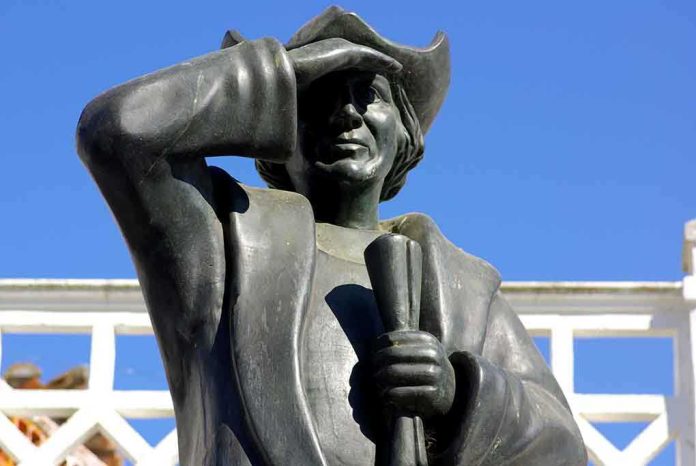
When a president labels Christopher Columbus “a true American hero,” he is not merely praising a 15th‑century navigator; he is asserting which values the nation chooses to elevate, and whose story anchors its civic calendar.
The Short Version
- President Trump explicitly called Christopher Columbus “the original American hero” in his 2025 Columbus Day proclamation and reiterated that view in official remarks.
- That language sits within a long federal tradition: Congress has requested annual presidential proclamations for Columbus Day since 1934, later fixed to a Monday by the 1968 Uniform Monday Holiday Act.
- The administration’s rationale emphasizes exploration, faith, courage, and perseverance as civic virtues Columbus symbolizes.
- Modern observance coexists with Indigenous Peoples’ Day in other federal proclamations, reflecting a broader debate about commemoration and belonging in the national narrative.
What the president said and how it was formalized
In October 2025, President Trump issued a Columbus Day proclamation that framed Christopher Columbus as a “giant of Western civilization” and, unequivocally, as “a true American hero.” The text lauded Columbus’s “faith, courage, perseverance, and virtue,” presenting the 1492 Atlantic crossing as an emblem of exploration and resolve. This was not off-the-cuff rhetoric; it was the language of an official presidential directive instructing national observance and display of the U.S. flag for the holiday. The same day, during a Cabinet meeting, Trump discussed the proclamation and the voyage—invoking the Niña, the Pinta, and the Santa María—in a manner consistent with the written designation. The administration continued this framing in subsequent proclamations, maintaining Columbus’s place within the ceremonial life of the executive branch.
The choice of words matters. Proclamations are genre pieces—symbolic instruments that translate a White House’s moral vocabulary into national ritual. By choosing “hero,” the administration did not offer a footnoted monograph on early modern empire; it made a judgment about character and public memory, using a legally recognized federal holiday as the stage. That judgment rests on a familiar civic logic: the figure of the explorer as archetype of risk, discovery, and world-altering consequence.
How Columbus Day became a federal ritual
Columbus’s place on the federal calendar was not conjured in the 21st century. The holiday’s nationalization built over generations and across institutions. After the 400th‑anniversary observances in 1892, momentum coalesced in Congress, which in 1934 adopted a joint resolution requesting an annual presidential proclamation of Columbus Day. In 1968, the Uniform Monday Holiday Act restructured several federal observances, fixing Columbus Day to the second Monday in October. Those statutes and resolutions codified a practice that presidents from both parties have continued: issuing language that frames the holiday’s rationale while calling for public observance. The modern proclamations—whether emphasizing exploration, pluralism, or reflection—operate within this same statutory scaffolding.
Institutionally, the holiday bears the imprint of Italian American civic life. Organizations such as the Knights of Columbus advocated for federal recognition in the early 20th century, seeing Columbus not only as an explorer but as a bridge for Catholic and Italian American incorporation into the American mainstream. Statues, parades, and schoolbook narratives followed, embedding Columbus in a patriotic register that linked maritime daring to immigrant aspiration. The present-day White House language inherits that tradition, even as the surrounding cultural ground has shifted.
The administration’s argument: heroism as civic pedagogy
The administration’s proclamations center four attributes as grounds for heroic status: vision, courage, perseverance, and the impulse to explore. In the rhetoric of statecraft, those are not antiquarian details about 1492; they are civic virtues the presidency seeks to bless and reproduce. By elevating Columbus, the administration is teaching by emblem—arguing that bold risk-taking in pursuit of discovery is part of the nation’s founding narrative and worthy of annual honor. This is why the proclamations make an explicit causal claim: voyages of exploration, however remote in time, “unleashed” historical forces that culminated in the creation of the United States. Whether one accepts the strength of that causal chain, the purpose of the assertion is clear: to situate national identity within a longer arc of Western exploration and its political offspring.
The Cabinet‑room reiteration of this message underscores its intended audience. Proclamations are read by lawyers and archivists; televised remarks translate them to citizens as a succinct catechism—three ships, an ocean crossing, a landfall that changed the world. In a crowded symbolic marketplace, brevity is strategy. Hero is a single word that carries the rest.
The broader commemorative landscape and its cross‑pressures
Columbus Day now coexists, sometimes uneasily, with Indigenous Peoples’ Day in federal and local proclamations. Recent presidential texts from other administrations have recognized both observances, signaling an institutional attempt to hold together plural memories: one honoring exploration and immigrant incorporation, the other foregrounding Indigenous survival and sovereignty. This is not a contradiction so much as a reflection of the American commemorative tradition itself, which has always braided disparate threads into a common civic calendar. The effect is to make each year’s Columbus proclamation not just an act of continuity, but also an intervention in an ongoing cultural argument about whose stories the nation elevates.
Within that argument, the title “American hero” is both imprecise and deliberate. Columbus was a Genoese mariner who sailed under the Spanish crown and never set foot on territory that would become the continental United States. Yet the epithet functions symbolically: American names the polity doing the commemorating as much as the person commemorated. The administration’s language treats Columbus as an ancestor of national identity—a progenitor by narrative rather than citizenship. That is how most civic hagiography works; it maps virtues onto founders beyond the reach of contemporary passports.
President Donald Trump hosted a Columbus Day celebration at the White House on Friday, underscoring his administration’s effort to honor Christopher Columbus as a hero and elevate the holiday ahead of Monday’s observance.
Read more: https://t.co/GRjCLOgytv#columbusday pic.twitter.com/fZ4rD76uRH— WLUK-TV FOX 11 (@fox11news) October 9, 2026
What this signals for public memory going forward
Presidential proclamations endure in the National Archives; their phrases often outlast the tempers of the moment. By inscribing Columbus as “a true American hero,” the White House fixed that language in the official record and invited agencies, schools, and civic groups to echo it in their own observances. Future presidents can adjust tone and emphasis—many have—but the statutory framework ensures that Columbus Day remains a recurring venue for articulating national values. The argument will continue, as it should in a republic that negotiates its identity in public. But on the core question posed here—did President Trump call Christopher Columbus a hero, and did he make that view an official act of state?—the answer is unambiguous: yes, in proclamation and in public remarks.
Sources:
youtube.com, whitehouse.gov, people.com, trumpwhitehouse.archives.gov, academia.edu, en.wikipedia.org, congress.gov