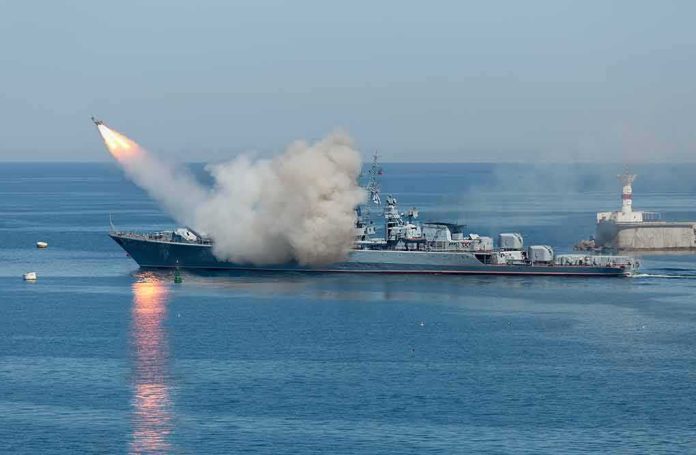
The paradox at the heart of Russia’s Admiral Nakhimov is simple: packing an outsized share of a navy’s striking power into a single, spectacular hull makes for impressive firepower—and a single point of catastrophic failure.
The Short Version
- Admiral Nakhimov concentrates roughly 176 major missile cells—about 80 for strike and 96 for long‑range air defense—into one 28,000‑ton platform.
- Modern threat geometry favors cheap, numerous missiles and drones over showpiece ships; layered defenses help, but they saturate under massed attack.
- The cruiser’s value depends on escorts, external targeting, trained crews, and robust damage control; absent those, its size does not confer survivability.
- Strategically, the ship is both a deterrent billboard and an attractive target; losing it would erase a disproportionate fraction of Russia’s deployable VLS capacity in a day.
What the Ship Is: A Missile Magazine That Moves
Admiral Nakhimov’s modernization centered on replacing legacy P‑700 Granit canisters with universal vertical launchers and upgrading its long‑range air defenses. Open‑source estimates converge on approximately 80 UKSK strike cells for Kalibr, P‑800 Oniks, and 3M22 Zircon, paired with about 96 launch tubes for long‑range surface‑to‑air missiles—variously reported as a navalized S‑400 derivative or Fort‑M lineage. In practical terms, that is a cruiser‑sized missile magazine with nuclear endurance: a platform able to project land‑attack and anti‑ship volleys while underwriting its own air umbrella, at least until the first stage of saturation begins.
The concentration is the point. In an era where vertical‑launch capacity often limits operational options, Nakhimov’s 176 cells change the math of a regional fight; the ship can hold dozens of aimpoints at theater depth while contesting the airspace above the formation. Yet the same concentration is the vulnerability. Lose the hull and you do not just lose a command node—you delete an outsized percentage of the fleet’s ready missile inventory and its most flexible launcher in a single incident.
How It Defends Itself—and Why That Still Might Not Be Enough
Survivability at sea is no longer a question of plate thickness; it is a systems problem that pits engagement capacity and reaction time against the attacker’s ability to saturate, confuse, or route around defenses. Nakhimov’s long‑range SAM battery is designed to thin inbound raids at distance, while point defenses and soft‑kill measures attempt to catch leakers. Reports describe an air‑defense fit equivalent in magazine depth to multiple ground battalions, a serious—and finite—resource measured in interceptors per minute and per sector. The challenge is that modern salvos and unmanned swarms scale cheaply; they exploit geometry (multiple bearings and altitudes) and timing (compressed endgame) to overwhelm fire control cycles, not just magazines.
This is why escorts, off‑hull sensors, and disciplined emissions control matter more than tonnage. The cruiser’s big radars and nuclear stamina help, but persistent maritime ISR and cheap, attritable drones have changed the detection and targeting equation. In the Black Sea, a handful of unmanned surface vessels and one‑way aerial drones repeatedly imposed risk on larger combatants, constraining operations despite traditional defenses. No capital ship—American, Russian, or Chinese—has proven immune to a determined, multi‑vector saturation attempt; the question is whether doctrine and architecture can keep the exchange ratio favorable long enough to matter operationally.
Why the “One Missile” Claim Resonates
“One missile can sink it” is a rhetorical shorthand, but it captures a real engineering truth: large surface combatants are not armored to defeat modern anti‑ship warheads; they survive by not being hit, or by limiting damage when inevitably struck. The Moskva’s loss to anti‑ship missiles—and multiple Russian ships degraded or destroyed by small drones—demonstrated that age, crew readiness, and damage control often decide outcomes more than displacement does. Nakhimov’s refit doubtless improved sensors, combat management, and internal survivability, yet none of that repeals physics. A modern warhead that penetrates vital spaces can cascade failures faster than repairs can staunch them, especially if a follow‑on hit arrives before systems are restored.
Critically, the ship’s impressive missile counts do not translate to infinite defensive endurance. Magazines deplete; directors and illuminators can be saturated, blinded, or physically destroyed; soft‑kill can be outfoxed by seeker diversity. Even the strongest long‑range shield yields gaps under stress if mass and maneuver are on the attacker’s side. That is the argument behind analysts’ warnings that Nakhimov’s combat value is inseparable from escort screens, external targeting, and rigorous training—and that without these, the ship risks becoming the most expensive target afloat.
Supporters’ Case—and Its Limits
Sympathetic coverage emphasizes Nakhimov’s raw numbers—176 VLS cells, the ability to fire hypersonic anti‑ship missiles, upgraded sensors, and a long‑range SAM suite described as the equivalent of multiple S‑400 battalions. It frames the cruiser as a Northern Fleet flagship for Arctic operations, supporting Russia’s ballistic‑missile submarines and controlling vast air‑sea volumes with a nuclear‑powered presence. There is likely truth in the concept: an endurance‑rich, high‑capacity shooter that compels adversaries to plan around it exerts real deterrent pressure. But numbers alone do not decide modern sea fights; integration, networking, and the ability to ride out the first broken pipe and the second fire do.
Even advocates implicitly concede the dependencies. The cruiser’s full value assumes robust offboard targeting, cooperative air defense with escorts, and combat systems that can manage simultaneous raids from sea‑skimming missiles, high‑diving ballistic‑like threats, and fast, low‑observable drones. Those are solvable problems in principle; they are also brittle under combat stress. If the ship is isolated, sensor‑poor, or forced to radiate predictably, its survival prospects shrink quickly against a competent foe.
The Strategic Trade: Spectacle, Risk, and Alternatives
Admiral Nakhimov embodies a strategic wager: that concentrating magazine depth and endurance in a capital ship generates coercive leverage worth its signature and risk. The counter‑wager is already visible in multiple theaters—disaggregate striking power across many cheaper shooters and unmanned systems, deny the enemy lucrative single targets, and win the cost‑exchange by exhausting his defenses rather than outgunning them in a duel. Western navies are chasing additional vertical‑launch capacity by fielding more hulls and exploring unmanned adjuncts precisely because the arithmetic of saturation favors the side that can mobilize mass at low cost.
For Russia, the cruiser’s logic may still hold in specific scenarios—Arctic patrols under friendly air cover, power‑projection against lightly defended shores, or as a command node behind a layered bastion. But the risks are asymmetric. A single successful strike removes not just a ship but an organizing principle of operations, and it does so at a cost the attacker can keep modest if he employs distributed fires and drones. That is why, despite its formidable inventory and nuclear stamina, Admiral Nakhimov reads less like an invulnerable behemoth and more like a floating porcupine—bristling with quills, dangerous to approach, and yet fatally reliant on seeing the blow in time and parrying it with finite quills of its own.
Bottom Line
Measured purely by missile tubes, Admiral Nakhimov is one of the most heavily armed surface combatants afloat. Measured by survivability in a world of massed, heterogeneous, often unmanned salvos, it is a high‑value magazine whose fate will turn on integration—escorts, sensors, doctrine, and damage control. The evidence supports both halves of that sentence. Its punch is real and concentrated; so is the risk that a single well‑placed hit, or a small cluster of them, could send 28,000 tons to the bottom and take a disproportionate fraction of Russia’s deployable strike capacity with it.
Sources:
19fortyfive.com, armyrecognition.com, en.wikipedia.org, militarywatchmagazine.com