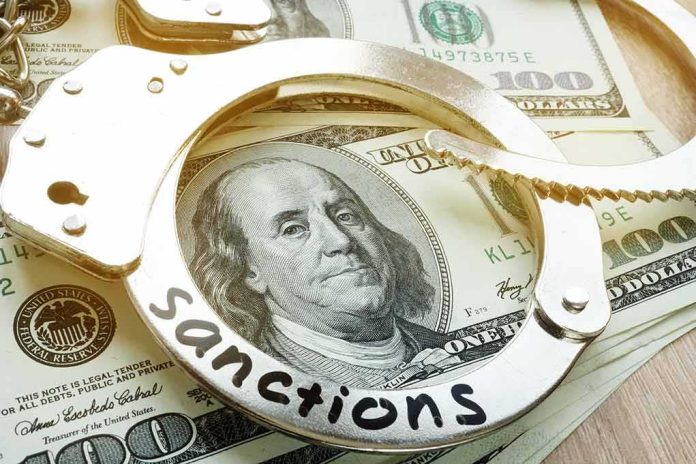
Sanctions are policy’s pressure point: when Washington couples primary restrictions with credible secondary sanctions that bite foreign banks, shippers, insurers, and refiners, the center of gravity in Iran policy shifts from Tehran’s choices to the world’s willingness to keep trading with it—and that is exactly what the United States has now set in motion.
The Short Version
- Treasury, at President Trump’s direction, launched Operation Economic Outcast: a whole-of-government sanctions campaign targeting Iran’s revenue networks and “enablers.”
- The initiative explicitly expands secondary-sanctions exposure for non‑U.S. actors that transact with Iran, raising global compliance stakes.
- Officials paired the rollout with warnings of escalatory enforcement and additional designations in the weeks that followed.
- This approach fits a decades-long U.S. sanctions arc in which secondary measures become decisive leverage short of war.
What Washington actually changed: scope, exposure, and enforcement tempo
Operation Economic Outcast is not just another tranche of designations; it is a structural reorientation of risk for any party facilitating Iran’s revenue, logistics, and financial channels. Treasury’s announcement—explicitly tied to presidential direction—frames a whole-of-government campaign to cut off Iran from convertible currency and choke points where transactions clear, cargo moves, and insurance is procured. Two levers matter most. First, broadened categories of sanctionable conduct reach beyond oil to aviation, shipping, banking, and procurement shells. Second, secondary-sanctions exposure is widened, signaling that non‑U.S. firms can be locked out of the American financial system if they continue facilitating Iranian trade; that threat is credible because prior waves proved banks and shippers will de‑risk when access to dollar clearing is at stake.
The follow-through began almost immediately. Within days, Treasury issued additional Iran-related sanctions packages, including actions hitting aviation-related entities and other commercial nodes that move parts, payments, and people. The key is cadence: steady, public, and globalized enforcement that turns risk managers in Hamburg, Dubai, and Singapore into force multipliers for U.S. policy, because the cheapest way for them to manage uncertainty is to exit Iran-facing business altogether.
How secondary sanctions do the heavy lifting
Primary sanctions bind U.S. persons; secondary sanctions weaponize access to U.S. markets and finance to influence non‑U.S. behavior. Since the 1996 Iran Sanctions Act, the United States has claimed authority to penalize foreign actors that materially support targeted sectors in Iran; by the 2010s, these tools matured into menu-based penalties that include restrictions on correspondent banking, export licenses, and access to capital markets. When enforced with clarity, they reshape incentives: a European bank weighing a modest fee on an Iran-linked transaction against systemic exclusion from dollar clearing will choose to walk away. The aftermath of the 2010–2015 period—and the run-up to the JCPOA—demonstrated how secondary sanctions can shrink Iranian oil exports and deter investment across energy, shipping, and aviation.
This is why naming the campaign matters. It advertises intent to sustain legal, financial, and diplomatic pressure across jurisdictions, while alerting compliance departments that the U.S. government will prioritize investigations, designations, and interagency coordination. In sanctions, perception is policy; the expectation of enforcement often moves faster than enforcement itself.
Why the strategy is familiar—and why that history matters now
The United States has iterated this playbook for three decades. Congress authorized successive rounds of Iran-focused sanctions through the 1990s and 2000s; after 2010, secondary sanctions became the fulcrum for multilateral leverage, culminating in steep declines in Iran’s oil exports during prior peak enforcement cycles. That history cuts both ways: it validates the mechanism’s potency in disrupting revenue, and it warns that Tehran adapts by diversifying export routes, shadow fleets, barter arrangements, and regional intermediaries. The renewed campaign acknowledges both realities, betting that faster designation pipelines, maritime domain awareness, and tighter banking surveillance can stay ahead of evasive patterns long enough to change Iran’s political calculus.
A sanctions regime’s effectiveness rests on three hard variables: the availability of alternative buyers and banks, the resilience of the target’s macroeconomy, and the enforcer’s willingness to sanction major foreign counterparties, not just marginal facilitators. Operation Economic Outcast addresses the third variable directly by expanding secondary exposure and telegraphing that significant institutions—if necessary—are sanctionable. That signal is designed to compress the market for Iranian commodities and the financial rails that settle them.
Mechanics on the ground: oil, shipping, aviation, and finance
Oil revenue remains Iran’s largest hard-currency earner; throttling it requires more than listing tankers. It means mapping beneficial ownership across fleets, flag registries, and insurers; catching ship-to-ship transfers; and sanctioning brokers and refiners that disguise cargo origin. Aviation provides a second pressure point: dual-use parts, repair services, and leasing arrangements are sanction-sensitive, and air-freight corridors often double as procurement channels for sanctioned goods. Banking is the keystone: correspondent relationships, trade finance instruments, and dollar-clearing exposure give Treasury leverage to force de-risking deep into supply chains. The early Outcast designations against aviation-related and commercial entities read like a template for progressively isolating nodes that keep Iran’s trade arteries open.
Compliance culture amplifies these moves. Once a campaign establishes that previously “gray” transactions now carry black-letter risk, global institutions adjust screening parameters, revisit know-your-customer files, and unwind relationships preemptively. That soft reaction—quiet exits, internal blacklists, higher due-diligence thresholds—can deny Tehran opportunities that never appear on a sanctions press release but matter enormously in practice.
The negotiation theory behind the pressure
Sanctions campaigns are not an end state; they are leverage designed to frame choices. The administration’s message is straightforward: as revenues contract and transaction costs rise, a negotiated deal becomes rational self-interest for Tehran. Secondary sanctions are central to that logic because they export the compliance burden to third countries, constricting Iran’s options without requiring U.S. or allied kinetic escalation. Historically, episodes of intensified secondary sanctions have coincided with Iranian consideration of diplomatic off-ramps, even as Tehran has simultaneously sought to demonstrate resilience and raise counter-costs. The present design—whole-of-government, named, and paired with public warnings—aims to accelerate that convergence toward talks on terms more favorable to Washington.
Critically, the “pressure-to-negotiation” pathway depends on enforcement stamina. Markets test resolve; so do state-backed evasion networks. The United States has an asymmetric advantage—control over key financial infrastructure and the world’s largest consumer market—but must refresh designations, prosecute material support cases, and coordinate with partners to close loopholes faster than they open.
Trump’s remarks at the United Nations on Tuesday were pitched to pressure Iran back to the negotiating table https://t.co/1cclyETeXQ
— MBN English (@MBNEnglish) September 22, 2026
What to watch next: signals that the campaign is biting
Several indicators will reveal whether Operation Economic Outcast is shifting behavior. Watch seaborne tracking for sustained declines in Iranian crude and condensate exports and for higher latency between loadings and deliveries as shadow-fleet tactics become costlier. Monitor premium spreads for insuring vessels with any exposure to Iran-facing routes; rising spreads indicate heightened perceived risk. In banking, the tell will be announcements—often quiet—of correspondent relationship closures and compliance advisories from major institutions; when tier-one banks exit, tier-two and tier-three lenders usually follow. In aviation, parts scarcity shows up as higher aircraft-on-ground rates and cannibalization of airframes; designations that target parts brokers and maintenance hubs can force those outcomes.
Expect additional designation rounds. Campaigns like this gain credibility by naming well-known facilitators, not only obscure shell companies. Should Treasury escalate to sanction larger foreign financial institutions that process Iran-linked transactions—as senior officials have suggested in parallel remarks—that would be a threshold moment, reinforcing that the secondary-sanctions threat is not theoretical.
Sources:
aljazeera.com, islamtimes.com, foxnews.com, cnn.com, irfajournal.csr.ir, academic.oup.com, pressto.amu.edu.pl, cnas.org