
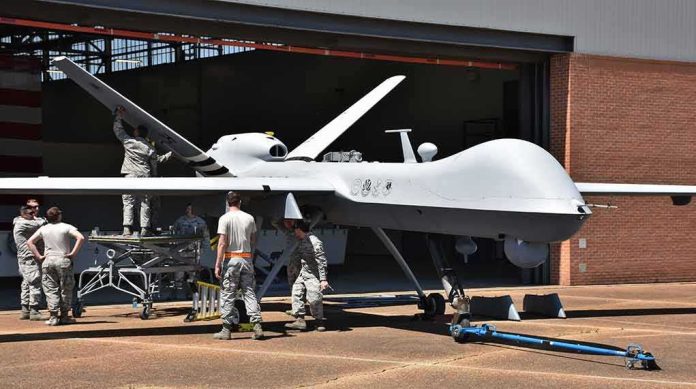
What looks like a viral oddity—a Florida charter crew hauling a military drone aboard between mahi and snapper—actually traces a straight line through how the U.S. Air Force tests, loses, and retrieves unmanned aircraft in the Gulf. The incident is uncommon to encounter, not uncommon to occur.
At a Glance
- A Pensacola-area charter crew recovered a U.S. military drone during a six-hour trip offshore and reported it to authorities; the aircraft was retrieved and returned to Eglin Air Force Base.
- Eglin confirmed a LUCAS unmanned aircraft impacted the water during routine testing two days before the fishermen found it; offshore losses are a known feature of Gulf test operations, not a scandal.
- The recovered airframe matches a class of delta-wing, low-cost attack/target drones the Air Force has used to develop tactics and defenses against Shahed-style threats.
- Because Eglin runs expansive sea ranges and dedicated recovery vessels, a floating test article can drift into public view before recovery teams close the loop.
What happened offshore, and why it mattered only briefly
During a routine six-hour charter out of Pensacola, the Hot Spots Charters crew spotted what initially looked like an overturned skiff roughly 20 miles off Pensacola Beach—outside the military exclusion zones—and realized it was a large drone. They recovered the waterlogged airframe to eliminate a hazard and notified authorities; local law enforcement coordinated with military contacts, and the unmanned aircraft was returned to Eglin Air Force Base the same day or shortly thereafter.
Eglin did not hedge. Base officials confirmed the test article had gone into the water two days earlier during scheduled range activity and that it was back in Department of Defense custody. This is the crux: the fishermen did not discover a mystery platform; they intersected a routine test loss before the recovery boats did. That sequence—loss during instrumented testing, public encounter, prompt retrieval—fits Eglin’s long-standing use of the Gulf as a live range where things occasionally end up in the water by design or mishap.
What the drone likely was: a LUCAS/Shahed-class test article
Imagery shared by the charter and subsequent reporting point to a small, delta-wing, pusher-prop unmanned aircraft in the same morphological family as the Iranian Shahed-136—long-span triangular planform, central fuselage pod, and aft-mounted propeller. Multiple outlets connected the find to the Air Force’s Low-Cost Unmanned Combat Aerial System (LUCAS), a program fielding inexpensive, attritable aircraft to simulate and counter massed loitering munitions; Eglin confirmed the downed article was a LUCAS UAS during routine testing. That tracks with the range’s recent focus on threat-representative targets and expendables.
Public performance details for specific LUCAS variants are sparse by design. But open statements and local broadcast reporting describe roughly 10-foot-long, sub-500-pound drones with modest cruise speeds and ceiling—consistent with loitering munition surrogates used as targets, decoys, or test beds for sensors and interceptors. The purpose is not speed or altitude; it is affordability, quantity, and reality-based signature. By flying Shahed-like articles over U.S. ranges, testers can validate detection, electronic warfare techniques, and layered defenses against the class of threats that has complicated battlefields from the Middle East to Eastern Europe.
Why Eglin’s sea ranges produce public encounters
Eglin is one of the nation’s premier test hubs, with expansive restricted airspace bridging to instrumented Gulf ranges. The base has used the Gulf for unmanned aircraft and target testing since the Firebee era in the 1950s, supported by specialized recovery vessels—120-foot boats that pluck subscale drones after live-fire events. When a drone impacts the water, recovery is usually swift and managed end-to-end by range control and contracted crews. Occasionally, tides, weather, and tasking mean a floating test article drifts into a spot where a fisherman, shrimper, or recreational boater sees it first. The public encounter is unusual; the underlying event is not.
That asymmetry explains the media dynamic. The object is photogenic and incongruous—a delta-wing aircraft lashed to a center console—so images jump platforms quickly. Official comment tends to be succinct because the test program is ongoing. The result looks mysterious to outsiders even when the facts are banal to range operators. In this case, the gap closed quickly: Eglin acknowledged the loss and recovery, and the aircraft went back to base custody.
Safety, jurisdiction, and what to do if you find one
Two points bear emphasis for coastal mariners. First, floating test articles are not ordnance; they are airframes, often composite and foam-cored, that pose more navigational hazard than explosive risk. Even so, range best practice is do not tamper: mark, monitor, and call the Coast Guard on Channel 16 or local law enforcement. The Pensacola crew took a cautious path, recovering the object only after assessing it with experienced eyes and then handing it over promptly—an outcome that minimized risk to others and expedited return to the test unit.
Second, the military’s recovery enterprise exists precisely to avoid ad hoc handling. Eglin’s offshore ranges are heavily used and well monitored; base regulations also restrict civilian drone use on or near the reservation, underscoring the managed nature of the airspace and water space. If you encounter a test article, the fastest way to make it disappear from your deck—and feed useful data back to testers—is to call it in and let the professionals do what their boats and procedures are built to do.
Why the programmatic context matters
The LUCAS class of systems sits in a broader portfolio of attritable and autonomous platforms the services are pushing from concept to field utility: decoys, jammers, and loiterers you can buy in quantity, lose without ceremony, and iterate quickly. That approach deliberately tolerates loss rates in testing that would be unacceptable for exquisite, high-dollar aircraft, because the point is to discover failure modes early and operationalize counters to adversary mass. Eglin’s test ranges—air, land, and sea—are built for that feedback loop, and their adjacency to a dense civilian coastline means the occasional public cameo is part of the price of speed.
Viewed through that lens, the Pensacola catch is less an anomaly than a snapshot of a system working: a test article flew, failed into the water, drifted, was recovered, and returned to its owner with minimal fuss. The headlines came and went; the data will persist in telemetry logs and post-recovery inspections in hangars you will not see. That is where the value accrues.
A Florida charter fishing group made an unusual catch on Saturday — a large drone. The Air Force has now recovered the drone found in the Gulf of Mexico.
READ MORE ON THE DRONE: https://t.co/L9cbNdItwc pic.twitter.com/Sp2uBOsCMg
— The National Desk (@TND) September 22, 2026
The bottom line
Offshore testing around Eglin produces the occasional public encounter with military hardware; this one just happened to share deck space with a day’s catch and a smartphone. The Air Force confirmed the loss and recovery of a LUCAS drone within its test range window, consistent with decades of Gulf-based unmanned aircraft work and the service’s dedicated recovery apparatus. Interesting to look at, yes. Operationally, routine.
Sources:
washingtontimes.com, people.com, patch.com, gadgetreview.com, chron.com