When diaspora movements choose a diplomatic summit as their stage, they aren’t chasing spectacle; they are forcing human rights into the same frame as statecraft, where leverage actually lives. That is what Uyghur activists—and a broader, long-familiar coalition of Tibetans, Hong Kong democrats, Falun Gong practitioners, Chinese democracy advocates, and allied groups—did in Washington as President Trump hosted China’s President Xi Jinping: they made the treatment of Uyghurs in Xinjiang and China’s wider rights record an unavoidable part of the meeting’s calculus.
The Short Version
- Uyghur activists protested in Washington during the Trump–Xi summit, urging President Trump to press Xi on mass repression in Xinjiang.
- The demonstrations were part of a multi-group mobilization that reliably surfaces around Xi’s overseas visits, each with distinct demands under a shared human rights banner.
- U.S. and international reporting continues to document crimes against humanity and genocide findings regarding Uyghurs in Xinjiang.
- Summit-time protests aim to convert attention into policy leverage—on political prisoners, sanctions, and resisting transnational repression.
What happened: a targeted protest strategy around a high-stakes summit
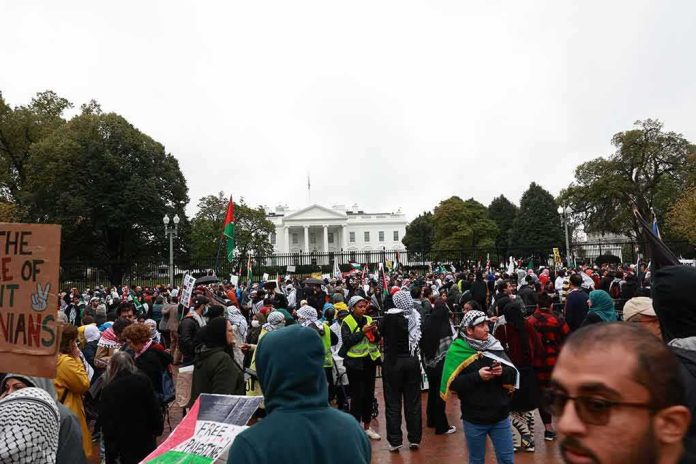
As Xi Jinping arrived in Washington for talks with President Trump, Uyghur activists joined a coordinated protest wave near the White House, Capitol area, Chinese diplomatic facilities, and expected motorcade routes. Their ask was direct: press Xi on the mass detention, coercive labor systems, and everyday surveillance that define the ongoing repression in Xinjiang, and tie any diplomatic deliverables to concrete human rights steps. Public footage and on-the-ground reporting showed Uyghur demonstrators highlighting family separations, long prison terms for peaceful expression, and the names of imprisoned intellectuals and professionals whose cases have become emblematic of the crisis.
These were not isolated actions. The Washington protests tracked a pattern that has become a feature of Xi’s foreign travel: cross-community coalitions—Uyghur, Tibetan, Hong Kong, Falun Gong, Chinese democracy activists—moving in tandem to maximize visibility when media and security are at peak attention. Framed that way, the question is not whether protests occurred; it is how they leverage the summit’s narrow window for policy influence.
Why Xinjiang remains a non-negotiable for rights advocates
On substance, the Uyghur rights case rests on a large, mutually reinforcing evidentiary record—government reports, international NGOs, satellite analysis, survivor testimony, and court-admissible documentation—reaching consistent conclusions: systematic abuses in Xinjiang meet the threshold for crimes against humanity and genocide determinations. The U.S. government’s annual human rights reporting has reiterated those findings, citing arbitrary detention, forced labor, family separation, religious and cultural suppression, and technology-enabled social control as integral features of the system. Those are not transient abuses; they are policy architecture.
Policymakers who take these findings seriously translate them into tools: sanctions on officials and entities, import bans targeting forced-labor exposure in supply chains, visa restrictions, and prisoner list diplomacy in leader-to-leader meetings. Protesters therefore anchor their demands in concrete asks: raise named prisoners with Xi; condition economic and tech exchanges that could reinforce coercive surveillance; and signal that transnational repression—harassment of activists’ families in China or pressure on protesters abroad—carries diplomatic cost.
How these coalitions work—and why the media’s “anti-China” shorthand obscures the stakes
Coalitional protests at Xi summits are not a single-issue bloc; they are a choreography of distinct grievance communities. Tibetans foreground religious freedom and cultural survival under intensified securitization; Hong Kong activists champion political prisoners and the dismantled civil liberties once guaranteed under Basic Law; Falun Gong practitioners document decades of persecution; Chinese democracy advocates focus on censorship, surveillance, and one-party dominance. Uyghur organizations concentrate on the Xinjiang repression system’s scale and intent. Grouping them as generic “anti-China” protest collapses essential differences and blunts the precision of their demands.
The coalition logic is strategic: more bodies, more cameras, a larger perimeter of persuasion. But the policy pathways differ—Tibet policy levers are not interchangeable with Xinjiang forced-labor enforcement, and Hong Kong political prisoner advocacy requires distinct diplomatic channels. The best coverage and the most responsive policymaking treat these movements as parallel lanes, not a single road. That insight is not academic; it shapes which files a national security staff pulls for a leader-to-leader brief and which concessions the White House actually pursues during a summit.
Protest, counterprotest, and the contested streets around state visits
Wherever Xi travels, a familiar street dynamic emerges: diaspora-led protests, organized counterprotests, and a security footprint that pushes demonstrators into defined pens. Investigations and human rights monitoring have documented episodes in which local authorities abroad curtailed protest rights around Xi’s trips, as well as patterns of harassment and intimidation of activists’ families back in China—forms of transnational repression designed to mute dissent around high-visibility moments. These tactics do not erase the protests; they shape their risk calculus. Knowing this, coalitions train marshals, coordinate legal observers, and build media relations so that the message survives the friction of the street.
That tension was visible in Washington: rights groups organized named events, briefed press on prisoner cases, and synchronized messaging in the days bookending the summit, while coverage acknowledged that peaceful demonstrations were expected alongside heavy security. The point of that disciplined choreography is simple—keep human rights on the agenda when the gravitational pull of trade, technology, and crisis management would otherwise monopolize the room.
WATCH: UYGHUR ACTIVISTS PROTEST XI JINPING’S VISIT TO WASHINGTON
Uyghur activists took to the streets of Washington as President Trump hosted Chinese President Xi Jinping for a closely watched summit. Demonstrators protested Beijing’s human rights record and urged Trump to press… pic.twitter.com/Ao3v1XaOQ2
— Sergeant News Network (@sgtnewsnetwork) September 24, 2026
What leverage looks like in practice
Summit-time leverage is rarely theatrical; it is procedural. First, leaders exchange names—Americans detained in China, high-profile prisoners of conscience, family members of U.S. residents. Second, working-level teams quietly link increments of diplomatic progress to verifiable steps on those cases. Third, legislatures and agencies execute the outer ring of pressure: sanctions designations; withhold-release triggers in export controls; and procurement and customs enforcement to choke off forced-labor exposure in global supply chains. Even modest movement—a family contact reestablished, a sentence reduced—can start with a leader’s insistence at the top of a meeting.
Protesters understand this cadence; their demands map to it. In Washington, Uyghur advocates and their allies called for the release of named prisoners, for firm articulation of red lines on surveillance tech transfers, and for renewed attention to the systematic abuses that U.S. government and independent reporting have already codified. The White House signaling around detainee issues suggested at least part of that agenda would reach the table, even if the broader rights docket had to compete with strategic and economic files in a compressed schedule.
Why these demonstrations matter beyond one summit
No protest rewrites a summit communique on its own; what it does is reset the moral and political context in which policy is made. For Uyghur communities, that means keeping genocide findings from slipping into background noise and ensuring that businesses, universities, and agencies feel the scrutiny that evidence warrants. For Washington, it means accepting that values and interests are not parallel tracks: in U.S.–China relations, forced labor, digital authoritarianism, and transnational repression are operational questions with direct implications for supply chains, data security, and alliance politics—not ornamental “human rights” chapters to be flipped past.
That is why the image of Uyghur flags in Washington during a head-of-state visit is not simply protest theater. It is a reminder that diplomacy is choice-laden, and that leverage exists where leaders are willing to spend it. When activists force that choice into view, they are not interrupting foreign policy; they are helping define it.
Sources:
facebook.com, rfa.org, thediplomat.com, thehill.com, us.headtopics.com, visiontimes.com, reuters.com, uhrp.org, newsable.asianetnews.com