When grieving families end up teaching Congress how federal force should be overseen, it signals a system that has ceded credibility; Renee Good’s mother and brother used that forum to say the quiet part aloud — they voted for protection, and instead encountered opacity.
At a Glance
- The Good family’s testimony placed voter expectations of safety squarely against the realities of federal use-of-force secrecy.
- The January 2026 shooting of Renee Good by an ICE officer is undisputed; what remains contested is whether it was justified self‑defense.
- Officials advanced a self-defense narrative, while city leaders and witnesses challenged it, underscoring fragmented accountability.
- The structural problem is bigger than one case: investigations of federal agent shootings are diffuse, delayed, and often nontransparent.
What the family said, and why it cut through
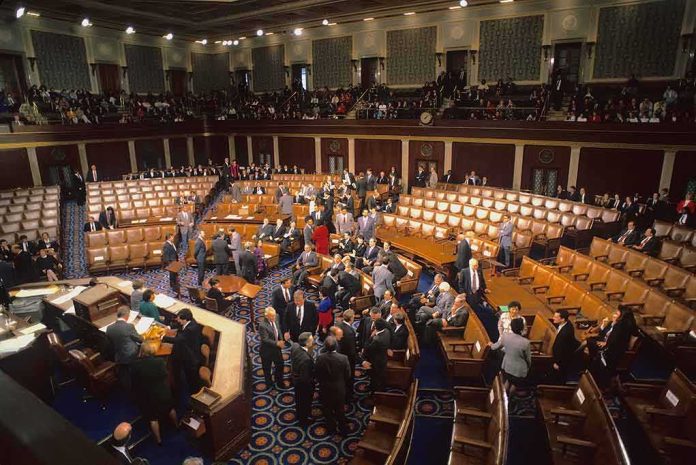
In a joint Senate–House hearing focused on killings by federal immigration agents, Donna Ganger explained why she had cast her ballot for President Trump: she believed federal agents existed to protect Americans. Her daughter’s death, she testified, shattered that premise. Multiple outlets documented her plainspoken point — protection is the baseline promise of enforcement, not its counterfactual — and her son Brent added the nonpartisan claim at the center of the family’s ask: deaths of innocent people caused by taxpayer-funded agents cannot be a team sport and warrant accountability that feels real to those left behind. The venue mattered; congressional hearings create an institutional record and impose discipline on claims, especially when families are speaking to lawmakers on both oversight and investigations committees.
Underneath the rhetoric is an uncontested core: an ICE officer shot and killed Renee Good in Minneapolis in January 2026. Local and national reporting fixed the timeline and immediate aftermath; a city fire-department report described her as unresponsive with an irregular, thready pulse when responders arrived. The point of dispute isn’t whether the shooting happened — it is the why, and whether existing oversight mechanisms can credibly answer that question in public view.
The contested narrative: self-defense versus reckless force
Federal officials framed the shooting as defensive: they said the officer followed training and fired because Good allegedly tried to ram agents with her car — even characterizing the act as domestic terrorism in early statements. The White House amplified the view; Vice President JD Vance defended the officer on social media as acting in self‑defense. That account drew support from a short cellphone video taken from the shooter’s perspective, verified as genuine by CBC. The clip is striking precisely because it is not cinematic — the officer’s phone records a brief, direct interaction through an open driver’s window, then gunshots. Advocates of the self-defense account cite it as context for a vehicle-as-weapon threat; skeptics argue its calm prelude undermines the claimed immediacy of lethal peril.
Local officials pushed back. Minneapolis leaders publicly described Good as caring for her neighbors when she was killed, and the city’s mayor faulted the shooter’s judgment. This isn’t dispositive forensic proof; it is a competing public-interest framing that demands a full evidentiary record to reconcile starkly different accounts. That record — comprehensive incident reports, body‑camera footage if any, radio traffic, autopsy findings, and independent reconstruction — is exactly what families say they still lack, which is why their testimony landed as a critique not merely of a decision to fire, but of the decision-making system around it.
How we got here: the architecture of opacity around federal force
The Good case sits atop a pattern the investigative literature has mapped for years: when federal immigration agents use deadly force, review is fragmented among agency offices, local police, and prosecutors; outcomes are slow, often unpublished, and frequently deferential. That fragmentation is not an abstraction — it governs who collects evidence on day one, who controls video, and who decides what the public will ever see. A multi-year collaboration by Business Insider, The Trace, and Type Investigations cataloged dozens of ICE shootings, including fatal ones, and documented lapses against the agency’s own policies. ProPublica’s work on why local and state police rarely investigate on-duty federal agents adds the jurisdictional reason the vacuum persists: locals often stand down, assuming federal primacy, while federal internal affairs processes are not designed for public transparency.
When families testify that they still do not know basics — which officer fired, whether warnings were given, what the use‑of‑force review concluded — they are describing the predictable output of that architecture. The result is not simply delayed closure; it is a credibility deficit that invites political actors to fill the gap with their preferred narrative, whether of justified heroism or reckless brutality. Both sides can cite a fragment — a 47‑second clip, a neighbor’s account — while the integrated, authoritative record remains locked inside the system that is being asked to judge itself.
What accountability would look like in practice
Accountability is not a slogan; it is a chain of concrete steps that are possible inside existing law. First, contemporaneous evidence must be preserved and, where it does not compromise ongoing prosecutions, released in comprehensive form rather than in selective clips — including any body‑worn or in‑vehicle cameras, dispatch and radio traffic, and complete incident reports. Second, administrative findings from DHS’s Office of Professional Responsibility and the Inspector General should be published with redactions limited to legitimate privacy or safety needs, not embarrassment. Third, when federal agents use deadly force in a local jurisdiction, parallel, independent review by state investigators or a special prosecutor can mitigate the perverse incentives of intra-agency self‑assessment, an approach consistent with broader research on reducing officer‑involved shootings through external oversight.
Technology helps only if policy compels its use. The Brennan Center has argued that body cameras can document critical incidents involving federal agents and provide contemporaneous evidence for administrative and judicial review. That potential evaporates when cameras are absent, deactivated, or footage is withheld; equipment without disciplined disclosure policy produces the illusion of transparency without its substance. The Good family’s legislative ask — routine cameras, timely release, independent eyes — is not exotic. It is table stakes for credible adjudication.
Why the family’s voter-centered critique matters
The most resonant line from the hearing was not about ideology; it was about a promise. When Donna Ganger said she voted for President Trump believing agents were there to protect citizens, she translated an abstract policy debate into a customer’s warranty claim. If enforcement exists to safeguard the public, then the public must be able to examine, in full, how and why lethal force was used — especially when the victim is a neighbor sitting in her car on a city street. That is not a left or right proposition; it is the minimal requirement for trust in the state’s unique power to take a life.
None of this predetermines the investigative outcome in the Good case. Self‑defense is a legally robust justification when the facts fit it; objective evidence should demonstrate whether a vehicle was used as a weapon and whether lethal force was the necessary last resort. What the family demands — and what the pattern of prior cases validates — is that the judgment should rest on a record the public can see, not on dueling press statements or a single shaky clip. In that sense, the ask is modest. It is also overdue.
BREAKING: Grieving families tell Congress ICE STILL won't reveal who killed their loved ones — or return their basic belongings.
At a congressional hearing led by Senator Richard Blumenthal and Congressman Robert Garcia, the families of Americans killed by ICE and Border Patrol… pic.twitter.com/9tLIu8CfCB
— Occupy Democrats (@OccupyDemocrats) September 23, 2026
The enduring standard
If the United States wants public consent for assertive immigration enforcement, it must run those operations inside an accountability framework that the public recognizes as fair: comprehensive evidence capture, independent review, and transparent conclusions. Families should not have to become investigators to learn why their loved one died. When they do, they expose not only a singular tragedy, but a structural failure that Congress — and the agencies it oversees — can fix.
Sources:
youtube.com, bringmethenews.com, cbsnews.com, yahoo.com, commondreams.org, cnn.com, fox9.com, wjno.iheart.com, congress.gov, cbc.ca, nbcnews.com, bbc.com