
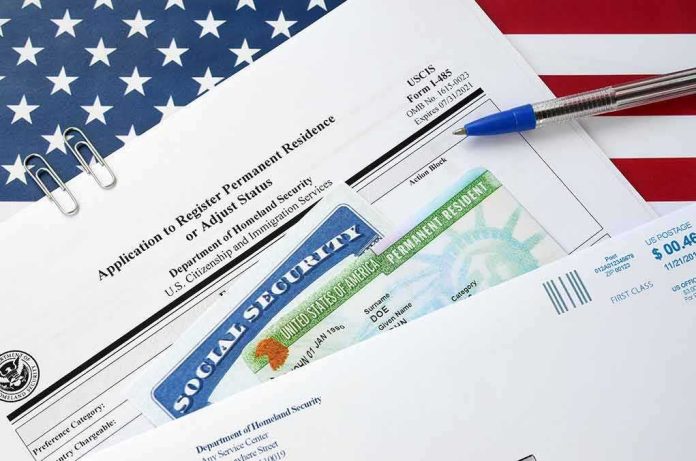
The Trump administration has turned access to ordinary banking into a new lever of immigration enforcement, using executive action and regulator guidance to make undocumented status financially costly enough that some people may choose to leave rather than remain embedded in the U.S. economy.
At a Glance
- The policy is not a blanket account-closure order; it is a regulatory campaign to make banks treat immigration status as a credit and compliance risk.
- The May executive order “Restoring Integrity to America’s Financial System” is the central instrument, and it set the legal and administrative machinery in motion.
- Subsequent guidance from federal banking regulators framed lending to unauthorized workers as higher-risk, which gives banks a formal basis to tighten access.
- This fits a longer U.S. pattern: officials have repeatedly tried to use financial rules to pressure undocumented immigrants, but implementation is uneven and often depends on how aggressively banks de-risk on their own.
How the Banking Crackdown Works
The practical mechanism is subtler than the headline suggests. The administration is not, at least in the reporting available here, simply ordering banks to close immigrant accounts overnight. Instead, it is telling regulators to treat immigration status as relevant to the kinds of risk judgments banks already make under anti-money-laundering and know-your-customer frameworks. That matters because banks are highly sensitive to supervisory signals. When regulators tell them a class of customers carries elevated credit, compliance, or documentation risk, many institutions respond by tightening onboarding, demanding more paperwork, or declining products altogether.
That is why the July guidance from the FDIC, OCC, and NCUA is so consequential. According to the reporting, the agencies said lending to people not legally authorized to work in the United States may present elevated credit risk. In banking, “risk” is not just an abstract label; it shapes whether a customer can open an account, obtain a mortgage, qualify for a car loan, or move through compliance review without delay. Once immigration status enters that calculation, the system can exclude people without ever announcing a formal ban.
The policy also relies on a familiar administrative logic: use existing law more aggressively rather than wait for a new statute. Bloomberg’s reporting says the May executive order directed regulators to issue guidance on banking services for undocumented migrants, while the White House-linked description of the order says it was intended to identify immigration-related red flags and revise standards under the Bank Secrecy Act. In other words, the administration is not reinventing the financial system; it is repurposing it.
Why Self-Deportation Is the Strategic Goal
The phrase “self-deportation” captures the policy’s economic theory. If undocumented immigrants find it harder to hold accounts, send money, borrow, or establish credit, life in the United States becomes less stable and more expensive. That pressure is meant to be cumulative. A person who cannot comfortably deposit wages, finance a car, qualify for housing credit, or maintain a predictable payment history is easier to push outside the mainstream economy. The administration’s critics describe that as debanking; supporters describe it as enforcing the consequences of unlawful presence.
The research package makes clear that the White House’s framework is tied to broader immigration enforcement, not isolated financial regulation. The executive order is framed around financial integrity, but the policy rationale stretches well beyond bank compliance. One cited basis is that people without work authorization may be structurally less able to repay loans if they lose employment or face deportation, which turns immigration status into a proxy for future repayment risk. That is the essential argument: if lawful residence is part of economic reliability, then immigration status becomes a banking variable.
That argument is not new. Brookings noted two decades ago that lawmakers at both state and federal levels had already been pursuing ways to restrict immigrants’ access to U.S. financial institutions. The American Immigration Council likewise documented that many banks, in practice, have long accepted ITINs and foreign consular IDs for basic banking access, which shows that the system has historically included undocumented or mixed-status households when institutions viewed them as workable customers. The current policy is therefore less a rupture than an escalation.
The Legal and Regulatory Significance
The legal significance lies in how much discretion the administration is trying to place in regulators and banks. If the rule is framed as guidance rather than a direct command, it can still reshape market behavior through supervision, examination, and fear of compliance scrutiny. That is a classic regulatory move: the government does not always need to outlaw a practice outright when it can make the practice expensive, uncertain, or risky enough that institutions retreat voluntarily.
That said, the reporting also suggests an important limitation. The executive order and subsequent advisories do not automatically force immediate account closures, and at least one transcript summary from the social research package makes the same distinction: the order directs agencies to propose rules and issue advisories, but it is not self-executing. That matters because the real-world effect may depend less on a single presidential signature than on how banks interpret the signal. Some may wait; others may “de-risk” quickly to avoid trouble. The policy’s reach, in other words, can exceed the formal text of the order.
There is also a practical reason financial access is such an effective pressure point. Banking is not a luxury add-on to modern life; it is the infrastructure beneath wage labor, housing, taxes, remittances, and consumer credit. If the rules make undocumented people harder to serve, the burden falls not only on the intended target but also on mixed-status families, employers, and even banks trying to reconcile inclusion with compliance. That tension explains why immigrant advocates have long treated debanking as an indirect but powerful form of enforcement.
What the Broader History Tells Us
Attempts to police immigration through finance have always run into the same structural problem: banks are private businesses, but they are also heavily regulated utilities of modern life. The state can instruct, nudge, and threaten, but it cannot fully control how each institution prices risk or interprets guidance. That creates uneven implementation. Some banks will narrow access aggressively; others will continue serving customers with ITINs or alternative documents if their compliance teams judge the business manageable.
That history also explains why this kind of policy has persistent political appeal. It is visible enough to signal toughness, but it avoids the legal and operational drama of mass account seizures or immediate account closures. It allows officials to say they are not targeting lawful residents while still making undocumented presence materially harder to sustain. In that sense, the banking move is a bureaucratic version of attrition: reduce the friction of leaving the country’s financial system until exit becomes the easier path.
What Matters Going Forward
The key question is not whether the administration can announce the policy; it already has. The real question is how deeply the guidance migrates into bank behavior. If regulators continue to treat immigration status as a negative factor, the likely result is narrower access to loans, slower onboarding, more document demands, and greater reliance on cash or informal financial channels. That would not simply inconvenience undocumented immigrants; it would make them more visible to law enforcement, more vulnerable to predatory alternatives, and less able to participate in ordinary economic life.
That is why the policy is best understood as an enforcement architecture rather than a single rule. The executive order, the joint guidance, and the broader supervisory environment work together. One creates the directive, another supplies the compliance language, and the market does the rest. For the administration, that is the point. For everyone else trying to understand the policy, the crucial fact is this: the strategy is less about a headline ban than about making access to banking conditional enough to produce departure pressure.
Sources:
thegatewaypundit.com, cnbc.com, bloomberg.com, time.com, wsj.com, spectrumlocalnews.com, theindianalawyer.com, nclc.org, instagram.com, brookings.edu, publications.iadb.org