
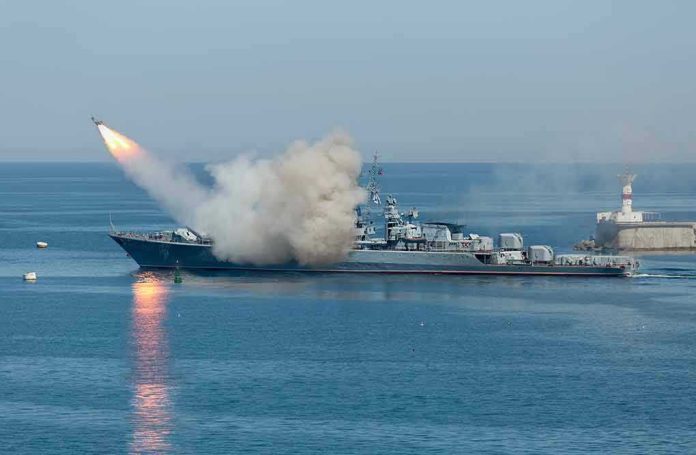
U.S. forces shot down Iranian ballistic missiles aimed at Americans in Kuwait and answered with precise self-defense strikes—sending a clear message that attacks on our troops will be stopped at the source.
Story Highlights
- U.S. Central Command reported intercepting two Iranian ballistic missiles targeting U.S. forces in Kuwait, with no American casualties [1][5].
- Reports indicate U.S. self-defense strikes hit Iranian radar and drone control facilities tied to recent hostile activity [4].
- Early public evidence is dominated by U.S. military reporting, while Iranian counterclaims lack verifiable data in the initial record [6][7].
- The incident fits a recurring pattern where force-protection actions precede full disclosure of technical details and legal analyses [12].
CENTCOM Reports Interceptions Over Kuwait
U.S. Central Command stated that American forces intercepted two Iranian ballistic missiles targeting U.S. bases in Kuwait at approximately 11 p.m. Eastern Time, preventing casualties and damage to personnel [1]. Additional reporting echoed the official account, noting that the missiles were “immediately defeated,” with no American casualties reported by command authorities [5]. Broadcast segments reinforced the timeline and targeting description, attributing the engagement to integrated air and missile defense that neutralized the threat against U.S. locations in Kuwait [2].
Coverage emphasized that the incident followed a period of heightened tension involving Iranian weapons activities in regional waters and along critical chokepoints. Prior U.S. reporting on Iranian arms transfers and missile component trafficking underscored a sustained pattern of malign support to proxies and the development of strike capabilities that threaten American forces and partners [3]. These factors formed the immediate backdrop for the Kuwait interceptions and informed the U.S. posture to act rapidly to protect deployed personnel [1].
Self-Defense Strikes Target Iranian Military Sites
Following the interceptions, reports indicated U.S. forces conducted self-defense strikes against Iranian military infrastructure associated with radar coverage and drone command-and-control, including facilities described near Goruk and Qeshm Island [4]. Video reporting characterized the targets as nodes used to enable or direct unmanned systems and tracking, which can facilitate missile or drone attacks on U.S. personnel and assets [4]. These descriptions align with a defensive objective: deny the adversary’s ability to launch or guide follow-on attacks against American forces [4].
The broader record in recent months includes U.S. statements of intercepting Iranian threats against commercial shipping and U.S. vessels, framing the current action as part of a consistent force-protection approach in and around the Strait of Hormuz [6]. Commentators also highlighted that preliminary details often emerge first from operational commands, with more granular data on munitions, trajectories, and assessments becoming public later, which is typical in fast-moving military engagements [12]. This cadence shapes early understanding while investigators assemble technical evidence [12].
Claims, Evidence, and What We Know So Far
Iranian state-linked counterclaims circulating in media clips have not, in the initial public record, been paired with verifiable telemetry, radar logs, or damage evidence that would directly contradict Central Command’s account of two missiles intercepted near U.S. positions in Kuwait [7]. By contrast, the U.S. account is supported by multiple aligned reports reiterating intercept timing, intent to target American forces, and the absence of U.S. casualties, which together strengthen the defensive rationale for subsequent strikes [1]. Given the stakes, independent technical validation may follow as commercial imagery and tracking data are analyzed [12].
USCENTCOM: 2 Iranian missiles intercepted targeting US forces in Kuwait, no casualties — regional risk rising, possible retaliation options ahead pic.twitter.com/gO2bz5jL6l
— Banking With Billy (@BillyOfYoutube) June 2, 2026
U.S. readers should watch for additional declassified details clarifying interceptor types, exact target sets, and proportionality assessments, which commonly trail initial announcements in these scenarios [12]. For now, the public evidence stack supports a clear bottom line: American forces faced a real and immediate threat, defeated incoming missiles, and struck military sites tied to enabling that threat [1][4][5]. Under long-standing rules for self-defense, this sequence reflects the duty to protect U.S. service members and deter further aggression in a volatile theater [1][4].
Sources:
[1] Web – NEW: US Central Command Says US Forces Intercepted Iranian Missiles …
[2] Web – U.S. Intercepts Two Iranian Ballistic Missiles
[3] Web – US forces intercept Iranian ballistic missiles targeting Kuwait
[4] Web – CENTCOM Intercepts Iranian Weapons Shipment Intended for Houthis
[5] YouTube – US Strikes Iranian Drone Sites, IRGC Responds As Kuwait …
[6] Web – US says it intercepts 2 Iranian missiles targeting US forces in Kuwait
[7] Web – US forces intercept Iranian attacks on commercial vessels …
[12] YouTube – NEW: US forces INTERCEPT Iranian ballistic missile