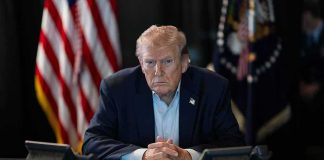
President Trump is telling oil-hungry allies to stop free-riding on American power and help reopen the Strait of Hormuz before the global energy squeeze hits U.S. families at the pump.
Quick Take
- President Trump says the U.S. has severely degraded Iran’s military but the Strait of Hormuz remains effectively shut to commercial traffic.
- Trump is pressing NATO members and major Asian importers to share the burden of securing a chokepoint that moves about 20% of global oil and gas exports.
- Major partners have publicly resisted sending warships, underscoring alliance friction even as energy prices and shipping risks surge.
- The Pentagon says U.S. strikes targeted Iranian military assets while sparing oil infrastructure, but Iran retains asymmetric tools like mines, drones, and missiles.
Trump’s message: secure your oil lanes—or expect consequences
President Trump’s mid-March push is simple: countries that rely on energy transiting the Strait of Hormuz should help protect it. Public statements and reporting describe Trump urging NATO members and key Asian economies—countries with the most at stake in uninterrupted Gulf shipping—to contribute to reopening the passage. The backdrop is an active U.S.-Iran conflict and a maritime chokepoint paralyzed by Iranian attacks and disruptions.
Trump’s argument leans on claimed battlefield results. Reporting describes U.S. strikes and maritime actions that Trump says have devastated Iranian forces, including claims of hundreds or thousands of targets hit and large numbers of Iranian vessels destroyed. Yet, multiple outlets also report a key reality check: despite intense U.S. operations, commercial traffic is still not moving normally through the Strait, keeping markets on edge and leaving consumers exposed.
Why Hormuz matters: a 21-mile bottleneck with global consequences
The Strait of Hormuz is only about 21 miles wide at its narrowest point, but it carries roughly one-fifth of global oil and gas exports. That math is why any prolonged disruption quickly turns into higher fuel costs and broader inflation pressures. In conservative terms, this is the real-world cost of insecurity: when trade routes are threatened, working families pay first—especially those already worn down after years of price spikes and fiscal mismanagement.
Iran’s playbook is not new. Reporting notes Tehran has long threatened the Strait during conflicts, and past episodes—from the 1980s tanker war era to more recent tanker seizures—show how mines and missile threats can chill shipping. What appears different now is the scale: this is not isolated harassment but a wartime scenario where mines, drones, and missiles have contributed to an effective shutdown, with war-risk insurance and shipping costs rising.
Military gains vs. the hard problem of clearing a mined waterway
Reports describe U.S. operations intended to reduce Iran’s ability to strike shipping while avoiding destruction of oil infrastructure. That distinction matters because it signals Washington is trying to degrade Iran’s military tools without triggering a scorched-earth energy crisis. Still, even severe damage to Iranian platforms does not automatically reopen a sea lane. Mines and the persistent threat of missiles can keep insurers, shipping firms, and captains from transiting until clearance and protection are convincing.
That gap helps explain why Trump is demanding burden-sharing. Sustained maritime security requires ships, aircraft, surveillance, mine countermeasures, basing, and rules of engagement—costs that typically fall on the U.S. taxpayer. Trump’s posture reflects a broader “America First” logic: if wealthy allies benefit from a stable world economy and secure sea lines, they should put real assets on the line rather than issuing statements while America does the heavy lifting.
Allies hesitate, exposing the limits of “collective” security
Public reporting indicates several countries have rejected or resisted Trump’s calls to deploy warships, citing escalation risks and domestic political constraints. That hesitation is politically revealing: when the situation turns dangerous, many governments prefer de-escalation language over operational commitments. For U.S. voters who watched prior administrations apologize abroad, overspend at home, and blur priorities, this moment reinforces why alliances must be measured by capability and action, not slogans.
At the same time, the record described in reporting shows real uncertainty. Trump has made sweeping claims about Iran’s military being “decimated,” yet Iran has continued launching attacks. Analysts and outlets also flag competing narratives about the war’s necessity and timing, including unresolved questions around the immediacy of Iran’s nuclear progress beyond Trump’s assertions. Those unknowns matter because Congress and the public deserve clarity when conflicts carry inflationary and strategic consequences.
What happens next: energy prices, Marines, and pressure campaigns
As of the latest reporting window, the Strait remained impaired and U.S. forces were still moving into the region, including additional Marines. Trump also predicted oil prices would fall as the situation stabilizes, but he has not declared the passage fully secure. The most concrete near-term indicators will be whether commercial shipping resumes at scale and whether allied navies contribute to patrols, escorts, or mine-clearing missions.
If allies continue to refuse participation, the burden-sharing dispute will likely intensify—exactly the leverage Trump appears to be creating by tying security commitments to the benefits other nations receive. For constitutional-minded Americans, the key issue is accountability: major military and economic decisions should come with transparent objectives, defined responsibilities for allies, and a clear explanation of how U.S. actions protect American lives, trade, and household budgets.
Sources:
Trump: We want other nations to “help us with the Strait” (CBS News)
Trump Calls on Other Nations to Secure the Strait of Hormuz (TIME)
Report to Congress on the Iran Conflict and Strait of Hormuz (USNI News)