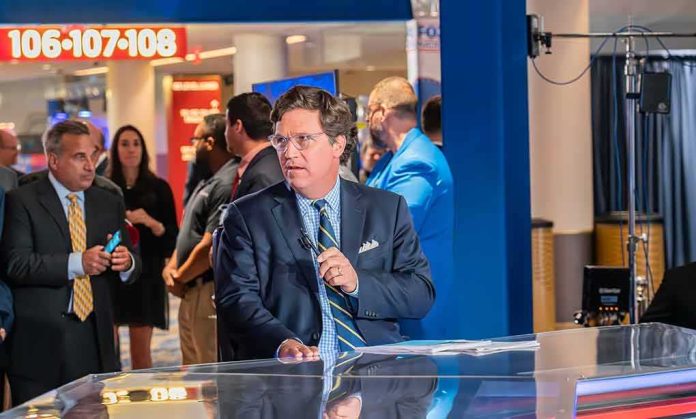
Tucker Carlson says he is not running for president in 2028, but the political world is behaving as if he already is.
Quick Take
- Carlson publicly denied plans for a 2028 presidential run while sharply criticizing both the Republican and Democratic parties.
- Prediction markets are already pricing a Carlson candidacy at roughly 22 percent odds, signaling that informed observers are not fully buying the denial.
- Analyst Scott Galloway publicly named Carlson the most likely Republican nominee for 2028, pointing to his recent break with Donald Trump as political repositioning.
- No campaign filings, exploratory committees, or donor network activity have surfaced to confirm or refute the speculation.
The Denial That Launched a Thousand Predictions
Tucker Carlson went on record dismissing a 2028 presidential run, pairing that denial with a sweeping critique of both major parties, arguing neither one genuinely serves the American people or operates within the bounds of real democratic principles. That combination, a flat no wrapped in populist institutional critique, is precisely the kind of statement that makes political observers lean forward rather than sit back. Denials from high-visibility media figures have a poor track record of staying denials.
The timing matters here. Carlson’s denial did not arrive in a vacuum. It came alongside a conspicuous public break with Trump, a shift that commentators have widely interpreted as something more than editorial independence. When a media figure with Carlson’s reach and brand suddenly distances himself from the dominant figure in his own political orbit, the natural question is not whether something changed, but what exactly he is positioning himself for. The denial answers the literal question while leaving the strategic one wide open.
Prediction Markets Are Saying Something Worth Hearing
Prediction market data currently places the probability of a Carlson Republican primary run at approximately 22 percent. [1] That is not a fringe number. It reflects a meaningful slice of informed observers who believe the possibility is real enough to price in. Prediction markets are not polls and they are not prophecy, but they aggregate public information and incentivized judgment in ways that casual punditry does not. A 22 percent figure means the market is not dismissing the denial, but it is not accepting it at face value either.
Analyst Scott Galloway went further, calling Carlson the most likely Republican nominee for 2028, directly linking the Trump criticism to what Galloway reads as campaign-adjacent maneuvering. [4] Galloway is not a conservative voice, and his track record on political prediction is mixed. But the underlying logic he is applying is sound regardless of ideological origin: politicians and would-be politicians do not typically burn bridges with the dominant faction of their party unless they are building a different bridge somewhere else.
What the Evidence Actually Shows and Does Not Show
The honest accounting here is that the case for Carlson running rests entirely on inference. No Federal Election Commission filings exist. No exploratory committee has formed. No donor network activity, domain registrations, or staff movements have been reported. [1] What exists is a media figure with a massive audience, a freshly sharpened critique of the establishment, and a public profile that prediction markets and prominent commentators are treating as politically combustible. That is a lot of smoke, but smoke is not a fire. [2]
JUST IN: Tucker Carlson suggested he will run for President in 2028 against JD Vance or Marco Rubio
Would you even consider voting Tucker?
Yes or No?
— MAGA NEWS (@MAGANEWS_X) May 21, 2026
The more interesting question behind the spectacle is whether Carlson’s critique of both parties holds up on its own terms, independent of any presidential ambition. His argument that neither major party genuinely serves ordinary Americans is not a fringe position. It is a view held by a growing segment of the electorate that feels abandoned by institutional conservatism and repelled by the progressive left. Whether Carlson is running or not, the audience for that message is real, large, and looking for a vessel. That is exactly why the speculation will not die on the strength of a single denial.
The Asymmetry That Explains Everything
Carlson’s incentive to deny is obvious. A formal candidacy brings legal obligations, donor dependencies, media scrutiny of a different and more invasive kind, and the real possibility of losing. Staying in the commentator lane preserves his audience, his revenue, and his influence without the downside risk of a campaign. [2] A denial costs him nothing and buys him everything, including the ability to change his mind in eighteen months when the political landscape looks different. That asymmetry is why sophisticated observers are watching his actions rather than his words, and why the conversation will continue regardless of what he says next.
Sources:
[1] Web – Will Tucker Carlson run for the Republican presidential nomination …
[2] YouTube – Is Tucker Carlson eyeing a 2028 US presidential run?
[4] YouTube – Scott Galloway Predicts Tucker Carlson Will Run For President in 2028