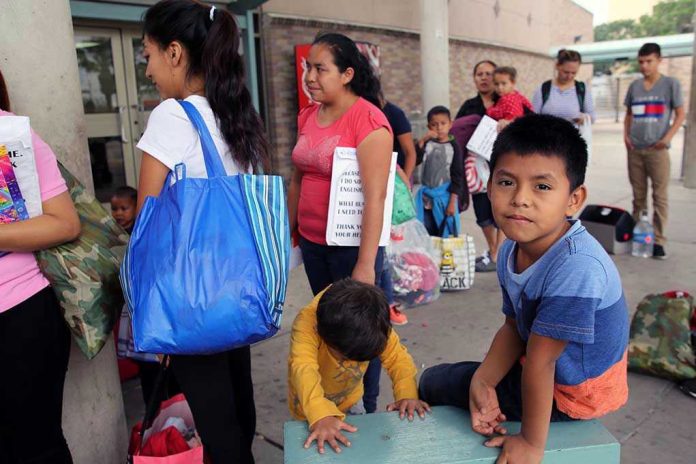
Hundreds of thousands of migrant children flowed through a system built with no real way to follow them, then became ammunition in a political war over who “lost” them.
Story Snapshot
- Why headlines scream “300,000 missing kids” while federal auditors talk about paperwork gaps and broken tracking systems.
- How Biden-era policies sped up releases to sponsors but left gaping holes in vetting and follow‑up.
- What new Trump‑era crackdowns and welfare checks signal about a tougher enforcement shift.
- Why Americans who care about kids and border security should demand hard numbers, not slogans.
How We Got To “Hundreds Of Thousands of Missing Kids”
The firestorm began with a dry oversight report from the Department of Homeland Security’s Office of Inspector General. That report found that from 2019 to 2023, about 32,000 unaccompanied minors failed to appear for immigration court, and Immigration and Customs Enforcement could not always say where they were afterward.[2] The same review flagged about 291,000 children who had not even been placed into removal proceedings because they had never been served a notice to appear in court.[2] Those two numbers – 32,000 and 291,000 – quickly morphed into cable‑ready claims that the government had “lost” more than 320,000 kids.
Supporters of this framing argue that if the federal government cannot say where a child is, or even get them into the court system, that child is effectively missing from oversight. Lawmakers pointed out that the Inspector General itself warned that without the ability to monitor location and status, Immigration and Customs Enforcement has “no assurance” children are safe from trafficking, exploitation, or forced labor.[1][6] From a common‑sense conservative standpoint, if the agencies in charge cannot confirm a child’s welfare, the burden should be on government, not on the child, to prove nothing went wrong.
What The Numbers Really Say, And What They Don’t
Immigration advocates, and even some nonpartisan analysts, push back hard on the word “missing.” They note that Immigration and Customs Enforcement is an enforcement agency, not a child welfare agency, and that its databases are built to track court cases, not daily life. When a child fails to appear, the immigration court can enter an order of removal in their absence, but that does not prove the child vanished into thin air. Critics of the “lost kids” narrative argue many of these children are living with family or sponsors and simply never updated their address or got proper legal help. In their view, headlines imply trafficking where the record, so far, mostly proves data failures.
That distinction matters. The Inspector General did not certify that 323,000 kids were abused or trafficked. It documented three separate problems: children who missed hearings, children who never got a hearing scheduled, and children whose addresses were blank, bad, or never updated.[2] Political actors then merged all three into one shocking figure. From a truth‑in‑advertising perspective, that is sloppy at best. Yet it does not excuse the core failure the audit exposed: federal agencies transferred more than 448,000 unaccompanied minors to Health and Human Services from 2019 to 2023, while still relying on spreadsheets and manual workarounds to follow them after release. For a nation that tracks packages in real time, that is indefensible.
Biden-Era Sponsor Gaps And The Vetting Fight
The Biden administration faced a historic wave of unaccompanied children at the southern border, with encounters reaching record highs in 2022. To clear crowded holding facilities, Health and Human Services’ Office of Refugee Resettlement focused on rapid release to sponsors. Data later made public showed that between January 2021 and January 2025, more than 11,000 children were placed with non‑parent sponsors who were not fingerprinted or background‑checked, despite federal law encouraging those checks.[2] During that period, over 79,000 children under 12 went to homes where no home study was conducted, including nearly 2,000 cases where a home study had been recommended.[2] For conservatives who believe government’s first duty is to protect the innocent, those gaps are not a paperwork error; they are a moral failure.
Defenders of the Biden approach stress that some vetting did occur. Immigration and Customs Enforcement told reporters it issues court notices only after children are placed with sponsors vetted by Health and Human Services.[2] Advocacy groups also argue that many horror‑story examples involve criminal rings, not the whole sponsor pool. They warn that painting every sponsor as a potential trafficker risks scaring off family members who could provide stable homes. Still, the public record now includes Senate letters and House hearings citing lost contact with tens of thousands of sponsored children and confirming that both the Office of Refugee Resettlement and Immigration and Customs Enforcement often failed to share basic information when kids skipped court.[6][7] That is not a fringe accusation; it is the government’s own watchdog talking.
Trump-Era Crackdowns And What Comes Next
The political response under Trump has been to treat the whole Biden‑era system as a crime scene, not just a broken database. A March 2025 oversight hearing highlighted a new Department of Homeland Security task force, launched by Secretary Kristi Noem, to locate unaccompanied children released under Biden policies.[5][6] Inspector General Joseph Cuffari testified that Immigration and Customs Enforcement, working with the Federal Bureau of Investigation and the United States Marshals Service, selected a pool of around 200,000 unaccompanied minors and had already visited roughly 50,000 homes for welfare checks.[6] A separate initiative, the “UAC Safety Verification Initiative,” directs agents and local law enforcement partners to knock on doors, confirm children’s safety, and make sure immigration obligations are met.[5] Supporters see this as the kind of muscular, on‑the‑ground enforcement that should have been built into the system from the start.
🇺🇸⚖️ The Unaccompanied Minors Crisis: From "Super Sponsors" to Trafficking
Details Here:
The Justice Department has charged three individuals in Ohio with conspiracy to smuggle unaccompanied minors across the U.S. border, unsealing a 19-count indictment that includes charges of…
— the-news24.com (@thenews24com) June 11, 2026
Critics counter that these checks double as immigration sweeps, risking the arrest of undocumented sponsors and pushing fearful families deeper into the shadows.[5] They argue that lasting safety comes from better legal counsel, more case managers, and coordinated databases across the Department of Homeland Security, Health and Human Services, and the Department of Justice, not from federal agents showing up at the door.[8][9] Yet from a conservative, law‑and‑order lens, a government that can mobilize to audit corporate fraud but shrugs at missing children has its priorities upside down. A serious solution likely needs both: real‑time tracking technology and tougher front‑end vetting, paired with targeted enforcement against traffickers and fraudulent sponsors rather than a blind sweep of every household.
Sources:
[1] YouTube – Human trafficking of children press conference: Todd Blanche, …
[2] Web – As the Lord Leads, Pray with Us…
[5] Web – Hawley Blasts Mayorkas After Shocking Report Finds DHS Lost …
[6] Web – ICE issues “Unaccompanied Alien Children Joint Initiative Field …
[7] Web – 1
[8] Web – [PDF] September 19, 2024 The Honorable Alejandro Mayorkas Secretary …
[9] Web – [PDF] Analysis and Recommendations Relating to August 2024 DHS IG …