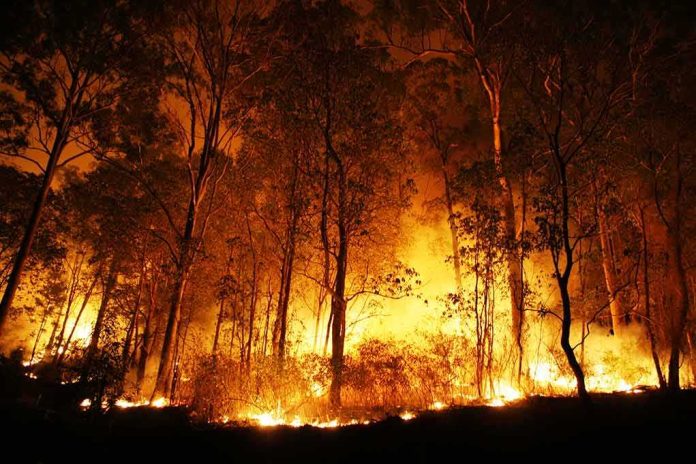
France’s wildfire arrests matter because they show how quickly a fire season can become a criminal-investigative season: the headline number is real, but it bundles together arson, negligence, and accidental ignition, so the public must read it as an enforcement tally rather than a courtroom verdict.
Intro Header
- The Interior Ministry says hundreds of people have been arrested in connection with the summer wildfire season, with the latest public tally reaching 402 and 156 minors among them.
- Some cases are concrete and specific, including Fontainebleau-related arrests, custody decisions, and at least a few reported admissions.
- The arrest figures are not uniform across reports because they were released at different points in an evolving season; totals moved from 59 to 162, 308, 375, and 402.
- The strongest counterpoint is not that the arrests are invented, but that the public record mostly shows suspicion, not final proof, for most detainees.
Why the Arrest Count Is Bigger Than the Story It Appears to Tell
The cleanest way to understand France’s wildfire arrests is to separate three different things that public coverage often compresses into one: an ignition event, a police suspicion, and a legal determination. The Interior Ministry’s numbers show that authorities were not merely watching blazes from the sidelines; they were actively arresting people tied to fire outbreaks across the country. But the ministry’s own language also folds together deliberate fire-setting, negligence, and accidental starts, which means the tally measures the breadth of enforcement, not a single category of wrongdoing.
That distinction is not pedantic. In wildfire policing, one case may involve a person accused of deliberate arson, another a careless cigarette, another a barbeque or agricultural mishap, and another a suspect detained because investigators found multiple ignition points and a plausible human cause. Those are not morally equivalent, and they are not legally identical. A large arrest number therefore tells you that French authorities believed human behavior played a role in many fires; it does not, by itself, tell you that hundreds of people committed the same offense or that every arrest will survive judicial scrutiny.
How the Investigation Pattern Works on the Ground
The most instructive named cases come from Fontainebleau, where reports described a cluster of arrests after investigators saw signs consistent with deliberate ignition. RFI reported that two people were arrested in connection with the blaze, and that seven suspects were later remanded in custody after admitting to deliberately setting fires. Other reporting described an 18-year-old found near the site with a lighter, a detail that may be suggestive but is still only one piece of an evidentiary chain, not a forensic conclusion in itself.
That is how these cases typically develop. Fire investigators look for origin points, timing patterns, and whether a blaze fits natural spread or human initiation; prosecutors then decide whether the available facts support detention, charges, or release. In the Fontainebleau material, the public record shows that officials believed the fire may have been intentionally set, but it also shows that at least one suspect reportedly admitted to accidentally starting a fire by discarding a cigarette. The same incident cluster can therefore contain both apparent arson and inadvertent ignition, which is precisely why the headline number is broad and the individual cases are not.
Why the Totals Changed So Often
One reason this story generated confusion is that the arrest count changed repeatedly as the fire season advanced. Public reporting moved through a sequence of figures — 59, 162, 308, 375, and finally 402 — because each release captured a different moment in an active campaign of arrests, detentions, and referrals. That does not mean the numbers are unreliable in the simple sense; it means they are time-sensitive snapshots, not a fixed ledger. In a fast-moving wildfire season, totals can rise daily while some earlier detainees are convicted, some remain under investigation, and some are released or downgraded to different proceedings.
France also had reason to emphasize the scale. The ministry said there had been 14,540 fires since the start of the season, and other reports placed the burned area at roughly 120,000 hectares. Against that backdrop, even a comparatively small percentage of human-caused ignitions can produce a very large number of police actions. That is why the public narrative often sounds more dramatic than the underlying legal picture: the fire count is enormous, the arrest count is large, and the two together invite a causal leap that the record does not fully justify without case-by-case documentation.
Where the Evidence Is Strongest — and Where It Stops
The strongest evidence in the public domain supports a narrower claim than the headline suggests: French authorities arrested a substantial number of people in connection with wildfire outbreaks, and at least some of those cases involved deliberate fire-setting or admissions of responsibility. That is a serious enforcement story in its own right. It shows an interior ministry willing to treat wildfire ignition as a prosecutable public-safety offense, not merely as an environmental disaster to be managed after the fact.
The weaker part of the story is the leap from arrests to guilt. The record supplied here does not provide police dockets, forensic origin analyses, charging memoranda, or final court outcomes for most of the hundreds detained. That matters because arrests can be justified on suspicion, but suspicion is not adjudication. The public record therefore supports the existence of a broad enforcement campaign; it does not yet support a claim that all, or even most, of the arrested individuals were conclusively responsible in the same way.
🔥 FRANCE — WHAT THE HELL IS GOING ON OVER THERE?!
420 PEOPLE HAVE NOW BEEN ARRESTED FOR STARTING FIRES.
Yeah. FOUR HUNDRED AND TWENTY.
And get this — 166 of them are MINORS.
France is battling its worst wildfire season since World War II, and while firefighters are out there… pic.twitter.com/eA9TW13NZZ
— Kristy Tallman (@KristyTallman) August 9, 2026
What This Means for Reading Wildfire Headlines
The larger lesson is methodological as much as factual. Wildfire coverage routinely mixes public-safety urgency with incomplete evidence, and that mixture produces headlines that are technically true while still easy to misread. “Hundreds arrested” sounds like a settled indictment of hundreds of people. In reality, it is an aggregate description of many different cases, under different theories of liability, at different stages of investigation. France’s summer fire season illustrates that gap with unusual clarity.
For readers, the right discipline is to ask a simple question whenever a wildfire arrest figure appears: what, exactly, do the arrests represent? If the answer is “deliberate arson in some cases, accidental ignition or negligence in others, with limited public case-file detail,” then the number is still meaningful — but only as evidence of intensive policing and a real human role in the fires, not as proof that every detainee belongs in the same moral or legal category. That is the honest reading of the record.
Sources:
humanevents.com, efe.com, rfi.fr, brusselstimes.com, aol.com, aa.com.tr, connexionfrance.com, youtube.com, facebook.com