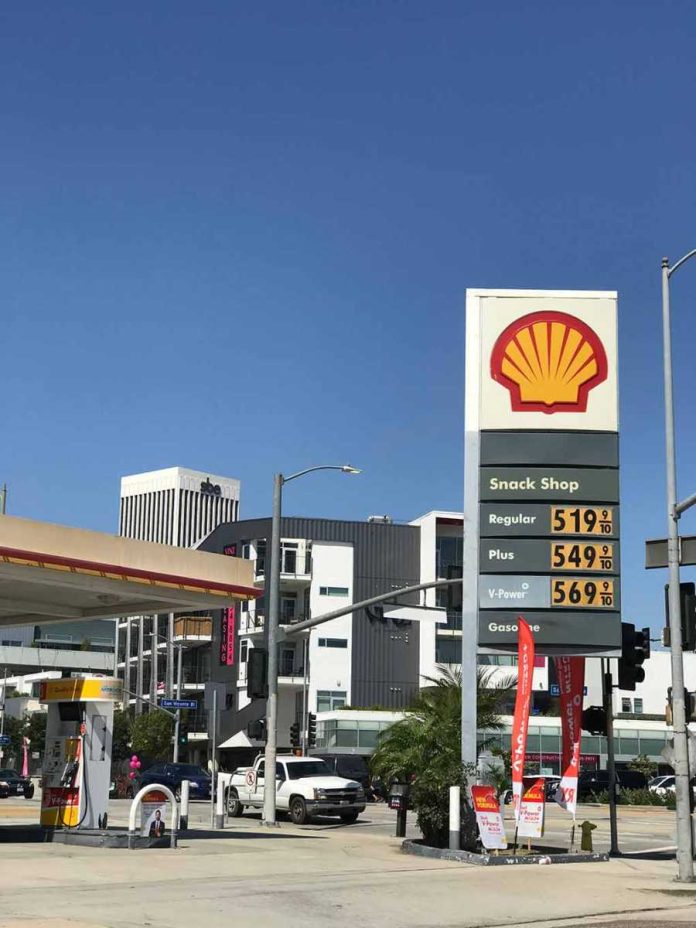
Every time crude oil prices fall sharply and pump prices lag behind, the same political reflex fires — someone in Washington calls it gouging. The evidence, accumulated across decades of federal investigations and peer-reviewed economics, consistently points elsewhere.
Key Points
- President Trump directed the DOJ to investigate alleged price gouging by oil companies, citing a perceived gap between falling crude prices and stubbornly high pump prices.
- Market data at the time of the directive showed gas prices were already declining — 46 of 50 states saw drops in the prior week, at a rate 5% faster than the post-2022 peak decline.
- The phenomenon Trump described — retail prices lagging crude — is a documented market dynamic called asymmetric price adjustment, not evidence of illegal conduct.
- The FTC has conducted repeated in-depth investigations into gasoline pricing and found no evidence of illegal price manipulation; academic research corroborates this finding.
- The DOJ directive raises legitimate questions about executive pressure on prosecutorial independence, regardless of where one stands on gas prices.
What Trump Said, and What the Data Actually Showed
On June 24, 2026, President Trump posted on Truth Social that oil companies were “not dropping their price at the pump commensurate with the sharply lower prices they are paying for Oil,” adding that he had “instructed the DOJ to immediately start looking into this.” The post named no specific companies — that detail came later, in subsequent reporting that identified ExxonMobil, Chevron, Shell, and BP as targets — and offered no quantitative comparison between the rate of crude’s decline and the rate of retail prices. The charge was asserted, not demonstrated.[1]
The contemporaneous market data cut sharply against the gouging narrative. Patrick DeHaan, head of petroleum analysis at GasBuddy, presented figures showing that 46 of 50 states had seen gas prices fall over the prior week, and all 50 states had seen declines over the prior month. Nationally, the average pump price had dropped 68 cents over 35 days — roughly 1.9 cents per day — compared to the 1.8 cents per day decline that followed the June 2022 peak of $5.03 per gallon. That works out to a pace approximately 5% faster than the previous major correction cycle, which is the opposite of what a coordinated price-maintenance scheme would produce. FRED data confirmed the national average had fallen from roughly $4.15 to $3.91 in the weeks immediately preceding Trump’s post.[12][22]
The Mechanism Behind the Lag: Asymmetric Price Adjustment
The lag that Trump characterized as gouging has a name in energy economics: asymmetric price adjustment, sometimes called the “rockets and feathers” effect. Retail gasoline prices rise quickly when crude spikes — like a rocket — but fall more slowly when crude retreats — like a feather. Peer-reviewed research published in the energy economics literature documents this pattern across U.S. regions, finding that most markets increase retail prices more rapidly in response to rising crude than they reduce them when crude falls, with regional variation in both the short-term and long-term adjustment processes.[11]
The mechanism is straightforward once you trace the supply chain. A gas station does not buy crude oil; it buys refined gasoline from a distributor or rack supplier, priced on contracts that reflect crude costs from weeks or months prior. When crude drops suddenly, the station is still selling through inventory it purchased at higher prices. Selling below acquisition cost to match crude’s new level would mean taking a loss on existing stock — a loss that accumulates until higher-cost inventory clears. Former Energy Secretary Dan Brouillette, who appeared on Fox Business to discuss the situation, confirmed exactly this dynamic: retail prices are set by local stations based on crude prices from prior months, not the spot price on any given day. He projected prices closer to $3 per gallon by Labor Day — a prediction consistent with normal market mechanics, not evidence of manipulation.
What the FTC’s Track Record Actually Tells Us
The Federal Trade Commission has been investigating gasoline pricing for decades, and its record is unambiguous. Repeated in-depth investigations have found that changes in gasoline prices are driven by market conditions rather than illegal price manipulation. This is not a conclusion reached once and filed away; it has been revisited after geopolitical shocks, after hurricane-driven regional spikes, and after the 2022 surge driven by Russia’s invasion of Ukraine. Academic research analyzing gasoline pricing around natural disasters — events where the intuitive case for gouging is strongest — likewise found that the conventional wisdom of widespread gouging is not supported by systematic evidence.[10][18]
University of Arkansas supply chain researchers examining the 2022 price spike found that refinery profit rates were not abnormal when measured against revenue, and that gas station gross margins actually fell 17.8% in May 2022 from April — lower in absolute terms than during COVID lockdowns in April 2020, when demand had collapsed. The picture that emerges from the data is not of companies extracting windfall margins but of an industry with thin retail margins absorbing cost volatility across a fragmented supply chain. Crude oil accounts for roughly 47 to 61 percent of the retail price of gasoline; the remainder reflects refining costs, distribution, taxes, and station margins — none of which move in lockstep with the spot crude price.[10][19]
The Refinery Constraint That Complicates the Picture
Economist Brian Wesbury, appearing on Fox Business, raised an underappreciated structural point: U.S. refineries were largely built to process heavy crude, the grade historically imported from the Middle East and Venezuela. Domestic shale production yields primarily light sweet crude, which many existing refineries cannot process efficiently. When the Strait of Hormuz situation disrupted Middle Eastern supply flows — Trump himself referenced a 60-day memorandum of understanding with Iran that allowed 19 million barrels through the strait — the refinery feedstock picture shifted in ways that have nothing to do with pricing strategy at the corporate level. Refinery capacity constraints are a genuine bottleneck; they are also not something a DOJ investigation can dissolve.
The American Petroleum Institute made a similar point in its public response, noting that prices do not move in lockstep with crude due to global disruptions affecting supply, refining, and inventories. This is not special pleading — it is the same explanation offered by the Dallas Federal Reserve and the U.S. Energy Information Administration, both of which have published analyses showing that the retail price of gasoline reflects a layered cost structure that responds to crude prices with a meaningful lag under normal market conditions.[10][13][14]
The Institutional Question: DOJ Independence and Political Pressure
Separate from whether the economics support the gouging claim is the question of what it means for a sitting president to publicly instruct the Department of Justice to open an investigation into named private companies. Politico reported that Trump’s directive represents a departure from the long-standing tradition of agency independence — the norm that prosecutorial decisions are insulated from direct executive instruction, particularly when the instruction arrives via social media post directed at an entire industry. That tradition exists for a reason: investigations triggered by political pressure rather than predicate evidence risk weaponizing law enforcement as a market intervention tool, which creates its own category of distortion.[4]
There is a separate, more credible federal investigation running in parallel that deserves attention. The CFTC has been examining suspicious oil trades made just before key Trump administration policy announcements — dates in late March and early April flagged for unusual spikes in trading volume. Former CFTC head Ken Griffin discussed the complexity of prosecuting such cases, noting the need for AI-assisted pattern recognition to trace trades through intermediaries, and acknowledged that congressional figures including Senators Warren and Whitehouse have called for scrutiny. That investigation — focused on potential insider trading by government-adjacent actors, not on retail pricing by oil majors — rests on a more specific legal theory and a more concrete evidentiary predicate than the gouging claim.
𝐓𝐑𝐔𝐌𝐏 𝐍𝐀𝐌𝐄𝐒 𝐄𝐗𝐗𝐎𝐍𝐌𝐎𝐁𝐈𝐋, 𝐂𝐇𝐄𝐕𝐑𝐎𝐍, 𝐒𝐇𝐄𝐋𝐋, 𝐀𝐍𝐃 𝐁𝐏 𝐈𝐍 𝐃𝐎𝐉 𝐏𝐑𝐈𝐂𝐄-𝐆𝐎𝐔𝐆𝐈𝐍𝐆 𝐏𝐑𝐎𝐁𝐄 𝐀𝐒 𝐎𝐈𝐋 𝐇𝐈𝐓𝐒 $𝟔𝟗
Big Oil thought it could quietly pocket the spread between crashing crude and the pump — and that nobody would notice.… pic.twitter.com/Z9XbwvOE62
— M.A. Rothman (@MichaelARothman) June 29, 2026
What Would Actually Constitute Evidence of Gouging
To sustain a legal price-gouging claim against major integrated oil companies, investigators would need to demonstrate coordinated conduct — internal communications showing agreement to maintain prices above competitive levels, or pricing algorithms designed to suppress pass-through of cost reductions in a manner that goes beyond normal inventory management. Neither Trump’s Truth Social post nor any contemporaneous public evidence approached that threshold. The DOJ investigation, if it proceeds seriously, would need subpoenaed internal documents, forensic margin analysis comparing the current crude-drop period to historical norms, and evidence that the lag in price pass-through exceeds what inventory costs and refining constraints explain. Based on every prior federal investigation of this type, the probability of finding that evidence is low — not zero, but historically very low.
The political economy here is familiar. Gas prices are viscerally salient to voters in a way that, say, mortgage spreads are not. When crude falls and pump prices don’t follow immediately, the intuition that someone is pocketing the difference is natural and understandable. It is also, repeatedly, not what the data shows. The honest answer — that a gallon of gas priced today reflects crude bought weeks ago, refined through constrained infrastructure, and delivered through a fragmented distribution network — is accurate but unsatisfying. It doesn’t fit on a Truth Social post. That gap between economic reality and political narrative is exactly where the gouging accusation lives, and why it recurs with such reliability every time the crude-to-pump spread widens.
Sources:
[1] Web – Trump Flips Out at Gas Companies Over ‘Totally Illegal’ Gouging: ‘DROP …
[4] Web – Trump accuses oil companies of gas price ‘gouging,’ calls for DOJ …
[10] Web – Trump says he ordered DOJ to probe gas price ‘gouging’
[11] Web – How Gasoline Prices Are Determined – American Petroleum Institute
[12] Web – Price pass-through in US gasoline markets – ScienceDirect
[13] Web – Don’t look to oil companies to lower high retail gasoline prices
[14] Web – Gas Prices Explained – US Oil & Gas Association
[18] Web – Oil and Gas Pricing – Oil and Gas Industry: A Research Guide
[19] Web – U.S. Gas Prices and Global Oil Market Dynamics | PDF | Opec – Scribd
[22] Web – [PDF] Hurricanes and Gasoline Price Gouging – Jay Shimshack