
The real story is not that artificial intelligence has learned to invent life from nothing — it is that a genome, like a sentence, turns out to have grammar, and machines have gotten good enough at that grammar to write viable new paragraphs of DNA that a cell will actually read and execute.
Key Points
- Stanford and Arc Institute researchers used AI genome-language models (Evo 1 and Evo 2) to design whole bacteriophage genomes, and 16 of them booted up into functional, infectious viruses in lab tests against E. coli.
- The designs were modeled tightly on ΦX174, a well-studied phage, not invented from a blank slate — the AI worked within a known genetic architecture rather than improvising an entirely novel viral family.
- The conversion rate from AI proposal to working virus was low — roughly 16 successes out of some 285 to 302 synthesized candidates — underscoring that this is proof-of-concept, not push-button virus manufacturing.
- Some AI-designed phages lysed bacteria faster or grew more competitively than the natural template, a genuinely notable result with implications for phage therapy against antibiotic-resistant infections.
- The work has triggered biosecurity debate, but the demonstrated risk so far is capability in a narrow, bacteria-only system — not evidence of misuse, human-pathogen relevance, or real-world escape.
What Actually Happened in the Laboratory
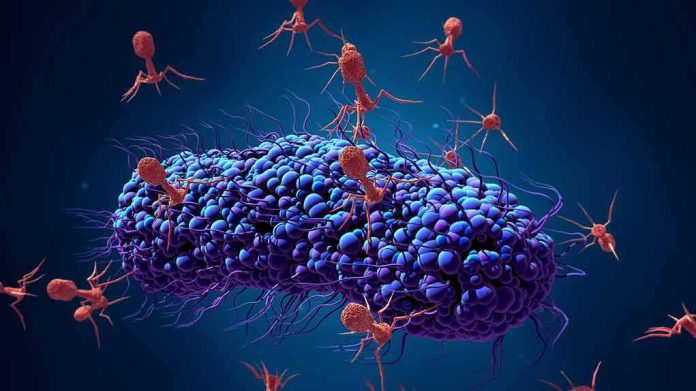
In September 2025, a team led by Stanford chemical engineer Brian Hie and Arc Institute researcher Samuel King reported what they called the first generative design of viable bacteriophage genomes — complete viral blueprints written by an AI model rather than copied, in whole, from nature. The team fine-tuned two genome-language models, Evo 1 and Evo 2, on a curated library of nearly 15,000 Microviridae genomes, then asked the models to generate new genomes in the style of ΦX174, a compact, extensively studied phage that infects Escherichia coli. The output was not a single virus but hundreds of candidate genetic sequences, each a full-length proposal for how a working phage might be built.
Most proposals never made it past the computer. Researchers narrowed the field to sequences that could be chemically synthesized as DNA, then inserted the synthesized genomes into E. coli to see whether any would assemble into an actual, infectious viral particle. Reports of the exact denominator vary slightly across coverage — some cite 285 buildable designs, others 302 synthesized sequences — but the outcome converges on the same number: 16 of those designs “booted up” into functional bacteriophages capable of infecting and killing bacteria. That is the headline result, and it is real, published as a preprint with experimental data behind it, not a simulation or a claim resting on modeling alone.
Why ΦX174 and Not Something More Ambitious
ΦX174 is a workhorse of molecular biology — it was the first DNA-based genome ever fully sequenced, back in 1977, and its small size and well-mapped genetic architecture make it an ideal training template. The Stanford-Arc team did not ask their models to invent a virus family from nothing; they asked the models to generate variations that preserved ΦX174’s essential logic — its gene order, its regulatory signals, its capsid-forming instructions — while introducing enough novelty to produce genuinely new, functional sequences. This is closer to an AI writing fluent new sentences in a language it has studied deeply than to an AI inventing a new language altogether. That distinction matters enormously for how the result should be read: it is a triumph of pattern-learning within a constrained, well-understood genetic system, not evidence that AI can design arbitrary viruses against arbitrary hosts.
The Genuine Scientific Payoff: Phage Therapy
The practical motivation behind this work is not novelty for its own sake. Phage therapy — using viruses that infect and kill specific bacteria — has been explored for a century as an alternative or supplement to antibiotics, and it has taken on new urgency as antibiotic-resistant infections spread globally. One of the persistent problems with natural phages is that bacteria evolve resistance to them just as they evolve resistance to drugs, and the natural world only offers a limited menu of phage variants to cycle through. If AI models can generate large numbers of functional, genetically diverse phage candidates on demand, researchers gain a much larger and more responsive toolkit for staying ahead of bacterial resistance. Notably, several of the AI-generated phages in this study infected bacterial strains that had already evolved resistance to the natural ΦX174 template, and some lysed their targets faster or out-competed the natural virus in direct growth assays. That is the kind of result phage-therapy researchers have been chasing for years, and it is the strongest evidence yet that generative genome design has clinical relevance, not just academic interest.
Where the Biosecurity Concern Comes From — and Where It Doesn’t
Coverage of the study, and considerable social-media commentary, has framed the result as evidence that AI can now “design viruses” in a way that lowers the barrier to biological misuse. That concern deserves a serious hearing, because the underlying capability — a model that can propose full genomes with realistic genetic architecture and have a meaningful fraction of them work — is a capability that did not exist in this form before. Reporting from outlets including The Register raised exactly this alarm, noting that some AI-designed phages proved more infectious than their natural counterparts. Nature’s own briefing on the study likewise flagged the dual-use tension inherent in a headline like “world’s first AI-designed viruses”.
But the specific evidence produced in this study does not extend nearly that far. Every experiment described in the preprint and its coverage involves bacteriophages — viruses that infect bacteria, not humans, animals, or plants — tested exclusively against laboratory strains of E. coli under standard containment conditions. Nothing in the public record shows environmental release, host-range expansion beyond E. coli, or any demonstrated pathway from this pipeline to a human-pathogenic virus. The gap between “AI can design a working bacteriophage genome from a well-characterized template” and “AI can design a dangerous human virus from scratch” is not a small one; it spans differences in genome complexity, host biology, immune interaction, and the sheer scale of unknowns involved in human-infecting viruses that ΦX174’s simple, fully mapped genome does not present. Critics of the alarmed framing are right that no primary evidence yet shows this specific method translating into an operational threat pathway.
What Remains Genuinely Unsettled
The honest scientific caveats are about scope and transparency, not about whether the phages worked. The conversion rate from AI proposal to functioning virus — 16 out of roughly 300 — is low enough that “reliable” overstates the current state of the art; this is proof that the approach works, not evidence that it is yet efficient or predictable. Full disclosure of the rejected candidates, the filtering criteria, and the safety review process behind the study has not been made broadly public, which limits independent researchers’ ability to assess whether the same pipeline could be redirected toward higher-risk designs. And because the work sits in an unavoidably dual-use space, institutions have some incentive toward caution in how much methodological detail they release — a tension that will only sharpen as genome-language models improve.
AI is entering biology.
Researchers at Stanford and the Arc Institute used genome language models to design complete viral genomes—and 16 of the AI-generated designs became functional bacteriophages that infected and killed E. coli in the lab.
This is an important threshold.… pic.twitter.com/zpAxjBEadE
— Farhad Nassiri Afshar, MD (@DrNassiriAfshar) August 7, 2026
The Larger Trajectory
This study belongs to a broader arc in computational biology in which AI models trained on enormous genetic datasets are increasingly used to propose designs — protein structures, regulatory sequences, now whole viral genomes — that are only validated by the much slower, much more expensive process of wet-lab testing. The pattern across that arc has been consistent: models propose far more than nature would ever need to select from, and a small, informative fraction survive contact with biology. That pattern held here. The achievement is real and specific: sixteen new, functional, evolutionarily novel bacteriophages, engineered against a backdrop of rising antibiotic resistance, built from a model trained on a virus humanity has studied since the 1970s. The alarm is understandable but, on the evidence currently public, premature — a capability worth watching closely, not one that has yet crossed into demonstrated danger.
Sources:
insiderpaper.com, press.asimov.com, nature.com, eurekalert.org, letsdatascience.com, scribd.com, cen.acs.org, theregister.com, pubs.acs.org