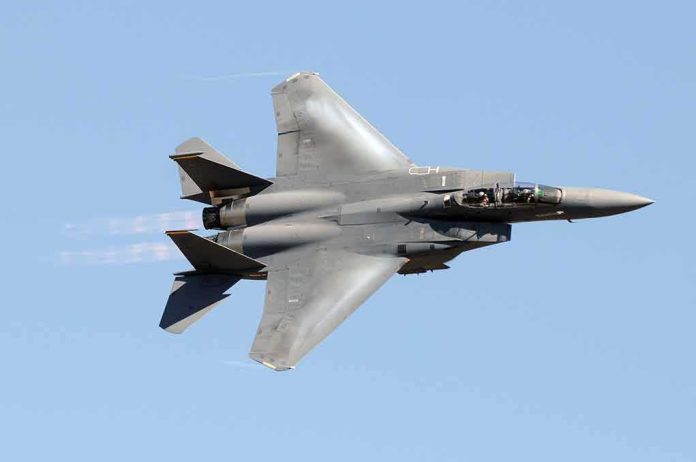
The most consequential truth about America’s AI fighter experiments is not that an algorithm “flew a dogfight,” but that a 1990s F‑16D—reborn as the X‑62A VISTA—has become a rigorously instrumented bridge from simulation to reality, where autonomy must make decisions from live sensors, on a real airframe, under real test discipline. That is how hype becomes capability.
At a Glance
- Lockheed Martin disclosed that its X‑62A autonomy stack executed 27 live, AI‑controlled intercepts against a T‑38 across eight sorties in April 2026, using real sensor data rather than simulation feeds.
- The X‑62A’s role is not ad hoc: it is a dedicated, variable‑stability F‑16D laboratory operated with the Air Force Test Pilot School at Edwards AFB to mature autonomy through disciplined flight test.
- These 2026 intercepts sit on a documented progression from 2022–2024 flights where AI agents flew advanced maneuvers and even sparred within visual range against a human‑piloted F‑16.
- What “success” meant in those 27 intercepts has not been publicly defined, and the autonomy boundary (how and when humans could intervene) remains undisclosed—key caveats for drawing operational conclusions.
Why a 1992 airframe is the testbed for tomorrow
The X‑62A VISTA is not a museum piece pressed into service; it is a purpose‑built, continuously modernized variable‑stability flying laboratory. Originally an NF‑16D, VISTA was engineered to alter its flight‑control laws in real time so test pilots could experience how different aircraft “feel.” That same capability—an open systems architecture that can interpose new control logic between pilot inputs and flight surfaces—makes it an ideal autonomy crucible. Lockheed Martin’s own description is unambiguous: X‑62A is an experimental platform to develop and evaluate AI and autonomy technologies, not a one‑off stunt machine. Edwards Air Force Base publicly ties the jet to a joint DoD campaign for autonomy flight tests, confirming its official role and rigor.
This lineage matters. Variable‑stability aircraft solve the hardest integration problems first: deterministic control at the flight‑control layer, safety envelopes baked into software, and instrumentation that lets engineers audit every millisecond of behavior. In autonomy, that scaffolding is not optional—without it, you cannot credibly translate an AI agent’s simulated brilliance into an aircraft you’re willing to strap a human into.
From simulation to the range: what changed in 2026
Lockheed Martin’s August 2026 disclosures describe a step past “sim wins”: the autonomy stack flew 27 tactical intercepts against a live T‑38 Talon during eight sorties in April, with the system making decisions from real sensor data, not synthetic inputs. That distinction is the test community’s bright line. Simulations compress time and amplify learning, but flight testing exposes latency, noise, and failure modes that synthetic environments smooth away. The reported use of a Legion Pod infrared search‑and‑track (IRST) sensor—passive, geometry‑driven, and inherently resistant to many jamming techniques—further anchored the exercise in operationally relevant sensing rather than pristine lab feeds.
Crucially, none of this occurred in a vacuum. Edwards AFB documented that AI agents piloted the X‑62A through advanced maneuvers during a 2022 test window, and subsequent reporting detailed within‑visual‑range engagements in 2023 pitting the AI‑flown X‑62A against a manned F‑16—an historical first widely covered in the defense press. The 2026 intercepts are best read as the next rung on that ladder: beyond‑visual‑range style intercept geometry driven by a live, passive sensor chain, executed repeatedly enough—27 times—to characterize behavior and stability, not just to prove it once.
Mechanics of trust: how the architecture makes autonomy testable
Two features explain why X‑62A is the Air Force’s autonomy workhorse. First, its open, variable‑stability control system lets engineers inject autonomy at different layers of the flight stack and constrain it with supervisory safety logic; you can let an AI choose an intercept geometry while limiting control surface rates and G‑loads to certified bounds. Second, the aircraft is embedded in the Air Force Test Pilot School’s discipline—flight cards, incremental envelopes, and safety pilots trained to watch for non‑intuitive machine behavior. Edwards’ 2022 statement explicitly tied VISTA’s upgrade path to autonomy testing, which tells you the governance structure was in place before the headline sorties began.
That scaffolding also clarifies what the public record does and does not establish. The 2026 coverage affirms the AI acted on live sensor data to accomplish intercepts, but it does not publish the safety architecture, the criteria for a “successful” intercept, or the precise boundary between supervised autonomy and independent control in those flights. Those omissions do not negate the flights; they set the limits of inference. Absent the test plan and scoring rubric, one cannot assert weapons‑quality tracks or declare parity with frontline tactics. The credible takeaway is narrower and still important: the autonomy stack closed intercept geometries on a live target repeatedly, stably, and from passive IRST inputs.
What counts as a milestone—and what does not
Defense autonomy tends to oscillate between triumphalism and dismissal. A better yardstick is programmatics. The X‑62A’s 2026 intercepts align with a documented progression: autonomous control in 2022 at Edwards; a first‑of‑its‑kind live dogfight against a human pilot reported in 2023; then multi‑sortie, sensor‑driven intercepts in 2026. On that arc, “milestone” is warranted—another link in a chain converting synthetic training into flight‑relevant performance.
But “operational readiness” would require evidence the public record does not yet provide: performance under adversarial conditions (electronic attack, weather, clutter), clearly defined success metrics (geometry versus weapons‑quality), autonomy boundaries (what the AI could and could not decide), and independent technical review inside the test community. Those are the right questions because they map to transition risk—what it would take to move from a flight‑test campaign to fieldable capability. Until those answers surface, calling the result a decisive combat validation overshoots the evidence.
The sensor choice matters: IRST’s implications for autonomy
Relying on a passive IRST to prosecute intercepts forces an autonomy stack to work with angular and kinematic cues rather than radar range gates. That choice surfaces real‑world problems: target aspect, closure rate estimation, and track custody through maneuvers and background clutter. IRSTs also carry operational virtues—emissions control and resilience to many jamming techniques—that align with how future collaborative combat aircraft will survive. Using the Legion Pod in this campaign therefore tested more than a perception checkbox; it rehearsed a tactically coherent sensor‑to‑maneuver loop where the machine must reason under partial observability.
For autonomy engineers, this is where design rigor shows. The agent has to fuse time‑sequenced bearing data, predict target motion, and choose intercept geometries that maintain sensor custody without burning energy margins. The fact that the team executed 27 such runs suggests they were past “if it works once” and into parameter sweeps—varying initial geometries, altitudes, or speeds to harvest the data needed to tune behavior. That is how test organizations build trust in a controller.
Human oversight, by design—not as a fig leaf
Prior X‑62A events made human supervision explicit: safety pilots onboard, progressive build‑ups from defensive to offensive maneuvering, and senior leadership flights to demonstrate confidence in the safety case. The 2026 disclosures do not specify the supervision schema for the 27 intercepts, which means we cannot quantify the machine’s degree of independence in those runs. What we can say, grounded in the aircraft’s mission and Edwards’ governance, is that oversight is a feature, not a flaw. The point of X‑62A is to learn where autonomy is trustworthy, with pilots and engineers positioned to arrest unsafe behavior while preserving the learning signal. That is the only responsible route from lab code to combat aviation.
How to read the number “27”
Headlines love a clean integer. A test team uses it differently: as a sample size. Without the scoring rubric, the 27 intercepts cannot be equated to 27 “kills.” They can, however, be read as sufficient iterations to examine stability, latency, and repeatability across a matrix of starting conditions. If the test objective—publicly stated—was to validate the full cycle from development and simulation through training and flight execution using real sensor data, then a multi‑sortie, multi‑intercept campaign is precisely what you would design to claim that validation with a straight face.
Implications for the autonomy pipeline beyond X‑62A
The Air Force’s autonomy strategy is a pipeline: synthetic training at scale; hardware‑in‑the‑loop integration; supervised flight test on an instrumented jet; and then migration into operational prototypes and, eventually, collaborative combat aircraft. The X‑62A lives in the middle of that pipeline. Its job is to collapse the delta between simulation and reality until the behaviors that look brilliant in a physics engine also look safe, repeatable, and tactically coherent in the sky. The 2026 intercepts, situated on that pipeline, indicate the handoff from pure sim to sensor‑driven autonomy is working as intended—again, within the limits the public record supports.
The next evidentiary steps are straightforward and test‑community standard: publish the scoring definitions for “successful intercept,” document the autonomy boundary and intervention rules, and show how the controller handled degraded inputs or adversarial conditions. Those disclosures would not be marketing gloss; they would be the artifacts that let independent experts judge how far this capability has traveled toward operational relevance.
It found the target using only heat. 😳
The X-62A VISTA (Variable In-Flight Simulation Test Aircraft) is a modified F-16D developed by Lockheed Martin Skunk Works and operated by the U.S. Air Force Test Pilot School at Edwards Air Force Base.
Recently, Skunk Works and the USAF… pic.twitter.com/zfzyI5utAm
— TheAviationFix (@TheAviationFix) August 5, 2026
Bottom line
An old airframe wearing a new brain is doing exactly what it should: turning ambitious autonomy into audited flight behavior. The documented path—AI agents flying advanced maneuvers in 2022, a live dogfight in 2023, and 27 sensor‑driven intercepts in 2026—constitutes real progress backed by official test infrastructure. It is a milestone in maturation, not a verdict on battlefield dominance. Treat it that way, and you can see both the accomplishment and the work still required.
Sources:
migflug.com, instagram.com, eplaneai.com, whothatplane.com, twz.com