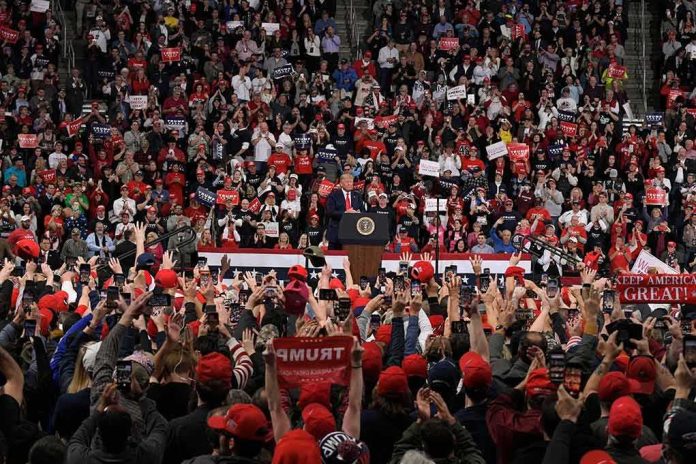
In a party where audiences often function as a live barometer of factional standing, the Dallas GOP midterm convention offered a crisp readout: when President Trump mentioned Senate Majority Leader John Thune, the crowd booed—and Trump, notably, moved to tamp it down rather than escalate it.
At a Glance
- At the Dallas GOP midterm convention, the only boos of Trump’s keynote came when he mentioned Senate Majority Leader John Thune.
- Trump responded by defending Thune from the stage, signaling a preference for unity in that moment over stoking the rift.
- Thune’s low reception reflects ongoing tensions over Senate strategy, including filibuster fights and stalled priorities.
- Conventions and rallies have long used crowd reactions as public signals of intra-party hierarchy and loyalty.
What Happened On Stage—and Why It Lands
During his keynote in Dallas, President Trump name-checked John Thune. The audible response—boos filling the hall—was immediate and distinct from the rest of the speech, which otherwise drew laughs and applause. Multiple contemporaneous accounts isolate that moment as the sole instance of negative crowd reaction. Trump, hearing the blowback, countered with an on-the-spot defense: a concise appeal to the room that Thune is “working hard,” an effort to cool the temperature rather than capitalize on it for a cheap ovation. The exchange matters less for its surprise than for what it telegraphs—who holds standing with the activist core, and whether the party’s titular leader chooses to harden or soften the divide in real time.
The Dallas episode is not an isolated interpersonal dust-up. Thune’s standing with parts of Trump’s base has been strained by Senate tactics and results in a narrowly divided chamber. Disagreements over priorities—most prominently, whether to push procedural hardball such as eliminating the filibuster to advance the White House agenda—have been front and center. Axios chronicled Trump’s frustrations with Thune’s vote-count math and reluctance to promise outcomes the conference could not deliver. Against that backdrop, the boos were less spontaneous noise than a visible register of accumulated dissatisfaction.
How Conventions Turn Applause—and Boos—Into Signals
Conventions and rallies are theater with a purpose: they stage unity, showcase winners and coming talent, and transmit cues about who is aligned with the dominant faction. Political scientists have long observed that mass events serve as “performances” of elite alliance-building; who gets cheered or jeered is not incidental, it is instructive. The Dallas moment fits this pattern neatly. The president’s praise was a top-down signal; the audience’s booing was a bottom-up veto, asserting that Thune, at least for that room, had not earned the applause line.
American politics has a deep record of such audible edits. Convention-floor heckling in 2016 when Ted Cruz withheld an endorsement signaled an unresolved schism; further back, Nelson Rockefeller’s 1964 reception told a similar story in a different party era. These episodes do not decide intraparty disputes, but they do make hierarchies legible. In a polarized environment, where affect and identity often override fine-grained policy distinctions, crowd reactions can matter as coalition signals—cues that downstream candidates, donors, and activists absorb quickly.
The Trump–Thune Friction: Substance Beneath the Theater
The friction is not merely stylistic. It is about outcomes, leverage, and institutional constraint. Presidents set maximal goals; Senate leaders count votes within rules they do not fully control. Trump has pressed for maximalist tactics, including pressure campaigns to curtail or kill the filibuster. Thune’s posture—publicly and in private—has emphasized arithmetic: if the votes are not there, bluffing invites failure and needless exposure of fissures. To Trump’s supporters, that reads as caution bordering on surrender; to Senate tacticians, it is realism essential to avoiding high-profile defeats.
In Dallas, those competing logics met on camera. The president extended a brief olive branch, effectively asking the base to credit the grind of governing in a narrow chamber. The base replied with impatience, calibrated in decibels. That Trump chose to push back on the booing—instead of enjoying it—underscored a strategic choice: keep channels open with leadership he still needs to pass anything consequential, or at least to avoid public disarray that blunts midterm momentum.
Attendance, Optics, and the Sidelines Strategy
Thune’s reduced on-stage profile at the convention reinforced the message embedded in the boos. He attended, but he did not headline. Reporting in the run-up described him working fundraisers and tending to side meetings while others took the spotlight—a classic “sidelines” posture that keeps relationships intact without risking a primetime rebuke. Whether by design or necessity, that choice limited opportunities for a broader confrontation while acknowledging the current mood of the activist core.
Elsewhere around the convention, allied figures leaned into the critique, with some arguing openly that Thune should have skipped the event. That rhetorical line served two purposes: it protected the main stage from potential friction, and it signaled to base voters that their frustration with Senate leadership was not only heard but shared by at least some electeds. Such calibration—who appears, when, and how—is a staple of convention management, especially in seasons when the governing wing and the populist wing are tugging in opposite directions.
What This Means for the Next Legislative Push
Boos do not write bills, but they do shape the incentives that determine whether bills get written, scheduled, and pushed with discipline. If Senate leadership hears base skepticism every time its name is invoked, the conference’s internal whip count grows harder in any vote that can be framed as a loyalty test to Trump rather than a policy trade-off. Conversely, if the president continues to offer cover—however brief and situational—he can lower the intra-party transaction costs that bedevil hard votes in a slim majority. The Dallas exchange suggests both dynamics are in play: a base eager for maximal outcomes, and a president unwilling to burn down bridges entirely to get them.
The practical edge is sharpest on procedural fights. The filibuster question, for example, is not a matter of public sentiment alone; it is a structural lever that, once pulled, resets expectations across multiple policy domains. Trump’s pressure there, set against Thune’s caution, will likely reemerge as the Senate’s agenda tightens and the calendar leaves less room for symbolic skirmishes. In that sense, the Dallas boos are less a coda than a preface to the governing test ahead.
The Durable Lesson: Crowds Keep Score, Leaders Read the Board
The incident in Dallas distilled a perennial truth about party politics: activist audiences keep a running score of who delivers, who resists, and who explains constraints instead of overcoming them. Leaders, for their part, must read that scoreboard without letting it dictate every move. Trump’s instinct to check the boos—briefly but clearly—signaled an understanding that victories require both heat and hinges: the zeal to demand outcomes, and the working hinges inside Congress to open the door. Whether that hinge is John Thune or someone else, the room made clear it expects the door to swing—and soon.
Sources:
thegatewaypundit.com, apnews.com, washingtonexaminer.com, nypost.com, independent.co.uk, axios.com