Presidential personnel signals are policy signals by another name; when a president floats, offers, or teases a press secretary pick in public, he is telegraphing how he intends to manage information, conflict, and the daily grind of governing.
At a Glance
- President Trump publicly said he offered UFC chief Dana White the White House press secretary job, naming a roster of MMA stars as would-be assistants.
- White acknowledged the outreach and said he was flying to Washington for a meeting to discuss it.
- Reporting contemporaneous to the exchange described a planned Oval Office conversation about the role.
- The next day, Trump said he had been kidding about the offer, underscoring the episode’s ambiguous status as signaling rather than a completed appointment.
What Happened: A Public Offer, An Acknowledgment, And A Planned Meeting
Across a weekend flurry, President Trump used his social media feed to say he had offered the job of White House press secretary to Dana White, the longtime executive atop the UFC. The post was unusually specific: beyond praising White in the language Trump favors, it suggested a bench of UFC champions as assistants — Islam Makhachev, Khabib Nurmagomedov, Justin Gaethje, Daniel Cormier, Amanda Nunes, and Kayla Harrison — a flourish that made the announcement sound more like a personnel tableau than a casual aside.
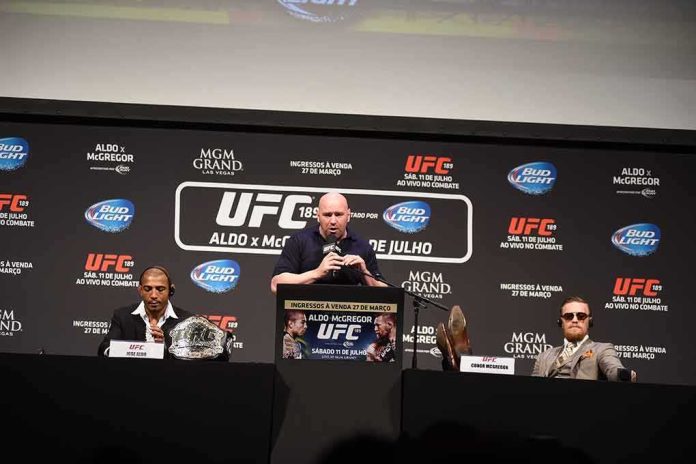
White did not treat the outreach as hypothetical. Speaking at a post-fight news conference in London, he said he was en route to Washington and planned to meet Trump on Monday, indicating the two would talk further and that he expected to have more to say after that. In parallel, entertainment press that often breaks news on personality-driven politics reported that an Oval Office meeting was slated to “talk things over,” attributing the detail to sources familiar with the planning.
Trump Reframes The Next Day: “Only Kidding”
Within twenty-four hours, Trump told reporters that he had been “only kidding” about the offer, while also adding that White “loves the idea.” The revision introduced built-in ambiguity — a hallmark of Trump’s public style, in which a bold proposition can be advanced, tested for reaction, and then reclassified as banter without formally closing the door on the underlying concept. That clarification matters for how to interpret the weekend’s signals: not as a settled hiring decision, but as a performative trial balloon that still spurred a real-world meeting itinerary.
To date in the record summarized here, there is no documentation of White accepting the role, no official White House announcement with terms or start date, and no readout of the planned Monday discussion’s outcome; the on-the-record facts establish a presidential statement, White’s public acknowledgment of talks, and a described plan for an in-person discussion. A single caveat belongs here and no more: an offer relayed on a social platform and in press gaggles is not the same as execution of an appointment.
How To Read The Signal: The Press Secretary Job Is Built For Presidential Latitude
The modern press secretary is a creature of practice rather than statute; starting in the late 1920s, presidents gradually formalized a role to shape and transmit their message. It is a senior White House position, instantly visible and relentlessly tactical — briefing the press corps, coordinating with policy advisers, and setting ground rules for information flow. Critically, it requires no Senate confirmation, which gives presidents extraordinary discretion to select for loyalty, combativeness, communication skill, or personal chemistry over any credential checklist.
That institutional design explains why a White–Trump pairing, however unconventional in résumé terms, is not structurally implausible. The job is as much orchestration and presence as it is craft briefing; presidents have at times preferred a spokesperson who can inhabit the administration’s posture with conviction over a Beltway veteran schooled in line-by-line policy exegesis. Dana White’s public persona — combative, promotorial, comfortable in high-stakes media environments — maps onto one of the archetypes that have periodically occupied the podium, even if his domain has been sports promotion, not public policy.
Why The Names Matter: Assistants As Rhetoric And Brand
Trump’s flourish naming elite fighters as putative assistants should be read as message architecture. It was an image — a press shop staffed by champions — that conveyed combativeness, tribal loyalty, and a willingness to scrap with the press. Even if no one expected Nurmagomedov to be vetting talking points, the tableau made a point about mood and method. In political communication, those cues can be as consequential as a formal org chart, because they tell allies and adversaries what style to expect in the briefing room.
At the same time, the specificity of the roster elevated the post above the level of a throwaway joke, giving it enough texture that both White and the press treated it as an actionable opening for a conversation. That duality — elaborate imagery paired with elastic commitment — is the essence of a trial balloon: it provokes reaction, flushes out support and resistance, and can be walked back or executed depending on the feedback loop.
The Vacancy, The Demands Of The Podium, And The Appeal Of An Unconventional Pick
Context amplifies interest. The press secretary slot had been a point of churn in the months prior, with turnover highlighting how punishing the role can be when the president is his own primary messenger and the news cycle is a perpetual sprint. Briefings, stakeholder calls, crisis response, and alignment across agencies create a workload that chews through even seasoned communicators. In that environment, presidents sometimes reach for an ally with proven stamina and an appetite for confrontation — a surrogate who can absorb fire and project the administration’s attitude hour after hour.
White’s track record in promoting contentious events, managing unpredictable personalities, and converting conflict into audience engagement illustrates a skill set that some presidents would prize in a spokesperson. The tradeoff is domain knowledge: a press secretary must navigate the thicket of policy, law, and interagency nuance without tripping into unforced errors. That is teachable, but it is not trivial; the best briefers marry message discipline with a granular feel for what they can and cannot say from the podium.
Trump now says he was "only kidding" when he offered UFC boss Dana White the job of White House press secretary.
On Saturday he posted the offer, calling White a "violent Fighter and Warrior" and suggesting he bring UFC champions along as assistants.
On Sunday he told reporters…
— RV (@__R_V___) November 9, 2026
Bottom Line: A Trial Balloon With Real-World Gravity
Strip away the theatrics and the timeline is clear. Trump publicly said he offered Dana White the press secretary job and laced the statement with a made-for-TV support cast. White said he was heading to Washington to discuss it. Reporting at the time pointed to an Oval Office meeting on the books. The next day, Trump said he had been kidding, even as he praised White’s interest. No formal appointment followed in the materials at hand. That is the anatomy of a modern presidential signal: part entertainment, part personnel exploration, and part test of how a combative communications posture would land with the country.
Sources:
tmz.com, people.com, cleveland.com, rmb.reuters.com, abc27.com, sports.yahoo.com, en.wikipedia.org