Holiday broadcasts promise shared family ritual; brand partnerships and Broadway spectacle promise something edgier. When those promises collide on live national TV, the result is not a mystery but a recurring programming tension—one that surfaced plainly when the rescheduled Macy’s Thanksgiving Day Parade aired a Broadway medley featuring The Rocky Horror Show.
At a Glance
- The 100th Macy’s Thanksgiving Day Parade was postponed for weather and aired on Saturday.
- NBC and Macy’s programmed a 10-minute “All-Star Broadway” medley that included Richard O’Brien’s The Rocky Horror Show.
- Viewers complained that the Rocky Horror segment (“The Time Warp”) featured revealing costumes and suggestive choreography for a family broadcast.
- No formal standards violation has been identified; the dispute centers on taste, not law.
What aired, and why the choice mattered
The rescheduled parade—moved off Thanksgiving due to severe weather—retained a special 10-minute Broadway medley commissioned as a one-time centerpiece for the event’s centennial. NBC’s own preview materials named nine participating productions, with The Rocky Horror Show listed alongside mainstream titles such as Wicked, Aladdin, and Hamilton; the medley was explicitly framed as a tribute to Broadway’s past and present, a theater-lover’s collage designed for the national stage. Reporting on the broadcast confirms that the medley ran as planned and that Rocky Horror’s signature number, “The Time Warp,” was performed on-air during the parade telecast.
Shortly after the broadcast, some viewers objected to how the Rocky Horror material read in a parade context, citing revealing costumes and suggestive choreography as mismatched with a family ritual many set on in the living room while children wander in and out. Those complaints centered on taste and suitability, not on an allegation that the telecast crossed the line of legally actionable indecency.
How we got here: the parade, the postponement, and the medley
Macy’s and NBC repositioned a complex outdoor live event when a coastal storm forced the first postponement in the parade’s history. The move to Saturday preserved headliners and a carefully coordinated roster—which included marching bands, floats, and the made-for-TV Broadway medley—rather than scrapping the showpiece segments assembled for the 100-year milestone. That decision kept the programming intent intact: a celebratory, one-time sequence joining nine productions under a single medley banner, with the Rocky Horror selection presented not as a standalone provocation but as one tile in a Broadway mosaic.
From a production standpoint, the medley format distributes creative control across multiple shows while passing through network standards review. NBC and Macy’s billed the segment as a curated journey across eras, a strategy that trades on recognizable brands to widen appeal. That programming calculus is familiar: attach culturally ubiquitous properties (Wicked) to more cult, adult-coded fare (Rocky Horror) and trust the edit, the costumes, and the camera to keep it broadcast-friendly.
Taste versus law: what the rules actually say
The heart of the dispute is cultural expectation, not compliance. U.S. broadcast indecency doctrine—shaped by decades of FCC practice and case law—focuses on protecting children from patently offensive depictions or descriptions of sexual or excretory activities or organs, as measured by contemporary community standards for the broadcast medium. Enforcement has long narrowed around time-of-day “safe harbor” concepts and high-threshold tests, making most taste controversies matters for programmers rather than regulators. Legislators have at times encouraged “family viewing” windows, but those are guidance and industry norms, not binding law that polices a parade medley’s wardrobe or choreography.
That distinction explains why a Rocky Horror excerpt can be simultaneously permissible on network TV and unacceptable to some families watching a centennial parade. “Inappropriate for families” is an editorial judgment anchored in audience expectations; “legally indecent” is a constrained legal category with specific elements and limited hours of application.
Why Rocky Horror became the flashpoint
Programmers selected Rocky Horror with eyes open. The title’s theatrical identity is adult-coded: camp, gender play, innuendo, and a long midnight-movie tradition. Precisely because it is iconic, it delivers instant recognition inside a medley built to telegraph “Broadway history” in seconds. NBC’s preview materials named it explicitly, which means its inclusion was not a surprise booking but an intentional creative choice set alongside family-familiar franchises. Reports on the telecast confirm the Rocky segment aired within the medley on Saturday’s parade broadcast.
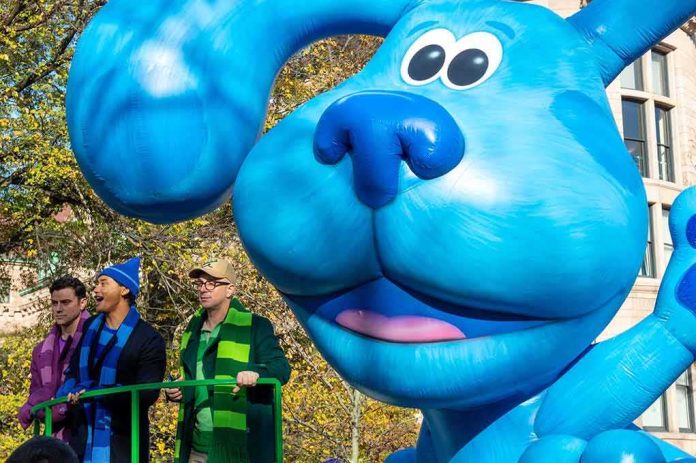
What changed the reception is context. A number that feels cheeky or nostalgic on a stage or in a theater fan’s feed reads differently when sandwiched between floats, marching bands, and animated character balloons—especially on a holiday morning when extended families gather around one screen. Viewers who complained were not misreading the source material; they were rejecting the fit between that material and the ritual the parade represents for them.
Is this a new problem? Not remotely.
American broadcast culture has been negotiating this seam for a century: networks chase eventization with marquee names and live spectacle, and audiences filter that spectacle through evolving but durable expectations about what belongs when children are likely to be watching. Across that history, the FCC’s enforcement intensity has varied, but the long arc has narrowed what qualifies as indecency while leaving vast ground to programmers and viewers to hash out via taste and brand reputation rather than fines. Industry bodies and lawmakers have periodically pushed “family hour” norms, yet in practice these norms function as editorial guardrails, not legal tripwires.
The result is predictable friction whenever adult-coded but mainstream culture—rock, pop, or Broadway—crosses into tentpole family broadcasts. The uncertainty does not arise from hidden rules; it arises from the absence of a single, enforceable definition of “family-friendly,” which is precisely why standards-and-practices teams exist and why controversies surface despite them.
New York"s Macy"s Thanksgiving parade finally happened today 2 days late. https://t.co/VCflO7hguj
— Edwin Lazaro (@EdwinLazaro7) November 28, 2026
What responsible programming looks like going forward
Three disciplines help reduce this kind of whiplash. First, contextual editing: if you include adult-coded repertoire for cultural completeness, adjust costuming, camera framing, and choreography to the broadcast’s implicit covenant with families without hollowing the material into parody. Second, expectation-setting: when a medley contains a spicier title, the broadcast can signal the tonal shift in voiceover and sequencing so it reads as history, not as provocation. Third, audience measurement beyond viral reaction: compile transparent data on viewer feedback and complaints to separate loud outliers from genuine majority discomfort.
None of this requires abandoning Broadway or sanitizing art into wallpaper. It does require acknowledging that the Macy’s Parade is not simply another live performance venue; it is a shared intergenerational ritual. Curators can honor Broadway’s full spectrum and still keep faith with that ritual by tailoring the execution. The centennial medley achieved the former. The reaction suggests it only partially achieved the latter.
Sources:
apnews.com, nbc.com, yahoo.com