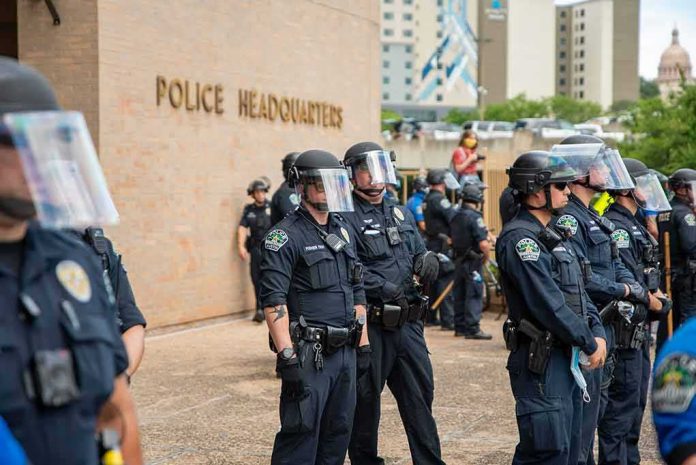
The Houston order is narrower than either side’s rhetoric suggests: it does not forbid police from working with federal immigration agents, it simply moves the trigger point from suspicion of immigration status to an actual new criminal charge — and that distinction, more than any slogan, is where this fight will actually be decided.
Key Points
- Mayor John Whitmire’s November 6, 2026 executive order bars Houston police from contacting ICE based solely on immigration status, but still permits notification when someone with a civil immigration warrant is arrested on a jailable offense.
- Police Chief J. Noe Diaz publicly endorsed the change, undercutting claims that the directive is unworkable or merely symbolic for officers on patrol.
- The order extends an April 2026 council ordinance that already ended HPD’s practice of holding people at traffic stops for up to 30 minutes awaiting ICE.
- Texas Republican officials — including Gov. Greg Abbott, Sen. John Cornyn, and the Harris County GOP chair — argue the policy violates state law and risks public safety, and Abbott has threatened to pull roughly $110 million to $200 million in state grants.
- Academic research on similar “sanctuary” restrictions elsewhere shows no consistent rise in overall crime, but Houston’s own policy has not yet been independently measured.
What the Order Actually Changes
Strip away the headlines and the operative text is a two-page directive with a single mechanical rule: immigration status, by itself, is no longer sufficient grounds for an HPD officer to call Immigration and Customs Enforcement. The order states plainly that “the fact that a person is, or is suspected to be, subject to immigration enforcement shall not, by itself, be a basis to contact ICE,” and it forbids prolonging someone’s detention for civil immigration purposes alone. That is a narrower change than “ending cooperation” implies. Officers may still notify ICE — but only once a person is already facing a new jailable charge and carries an administrative immigration warrant, a threshold confirmed by both Houston Public Media and the Texas Tribune.
That distinction matters because it reframes the debate from an up-or-down vote on cooperation to a question of sequencing: does a civil immigration flag alone justify a federal call, or must there be an independent criminal basis first? Chief Diaz’s public endorsement at the announcement — that officers would not contact ICE over an immigration warrant absent a jailable offense — is meaningful evidentiary weight here, because it signals the department’s own leadership views the rule as administrable, not a political gesture imposed over operational objections.
The Road to November: A Fight Already in Progress
This order did not emerge from nowhere. Houston’s city council had already voted in April 2026 to eliminate a standing HPD practice requiring officers to hold people at traffic stops for up to 30 minutes while ICE agents responded — a policy later revised, under pressure, to require only contact and a “reasonable” wait. Whitmire’s November directive is best understood as the second and more sweeping move in a sequence, not an isolated reaction to one election. Mayor Whitmire has framed the underlying rationale consistently: that the city should pursue people “that pose a danger, not those that are going about their family business, work and education,” arguing the shift reduces fear in immigrant neighborhoods without abandoning enforcement against serious offenders.
The Case Against the Order — and It Is a Specific One
The opposition here is not vague grumbling; it is on-the-record, named, and consequential. Sen. John Cornyn called full HPD-ICE cooperation a matter of national security, arguing there is “no logical reason” police shouldn’t fully assist federal agents enforcing immigration law, while Harris County GOP chair Cindy Siegel said the approach “ties the hands of law enforcement” and “puts politics ahead of public safety”. The Houston Police Officers’ Union, through president Doug Griffith, went further, saying the prior policy “was working” and that the new limits “put our officers in jeopardy” by creating uncertainty about how to perform routine duties. A Department of Homeland Security spokesperson added that the move disappoints federal officials who view local cooperation as essential to identifying people they consider public-safety threats.
The sharpest leverage point is financial, not rhetorical. Gov. Abbott has argued Houston’s restrictions violate Texas Senate Bill 4, the 2017 law barring local departments from limiting cooperation with federal immigration authorities, and has threatened to withhold roughly $110 million in public-safety grants over the ordinance. The Associated Press reported the threatened figure climbing to nearly $200 million when Austin and Dallas were included in Abbott’s warning. That threat predates the November order and remains unresolved — meaning Houston’s policy now exists with a live fiscal gun pointed at it, regardless of how well it performs operationally.
What the Broader Evidence on “Sanctuary” Policies Actually Shows
Strip the Texas-specific politics away and there is a substantial research literature on exactly this tradeoff — local police cooperation versus community trust — accumulated from a decade of similar fights in other cities. The consistent finding is that aggressive local-federal cooperation tends to suppress crime reporting among immigrant residents, including victims of domestic violence, because fear of deportation outweighs fear of the underlying crime. Conversely, research on jurisdictions that adopted restrictions similar to Houston’s — commonly called sanctuary policies — found no statistically significant increase in overall crime rates, and in some analyses a decrease in aggravated assault. None of that research validates Houston’s specific implementation; it simply establishes that the public-safety catastrophe predicted by critics is not the typical outcome elsewhere, while the trust-building benefit claimed by supporters is plausible but has not yet been measured locally.
Houston will limit ICE cooperation in response to Democrats taking power in Texas, mayor says https://t.co/sVydU9wdlg
— lauraphillips25 (@LauraPhillips25) November 7, 2026
What Remains Unsettled
Three open questions will determine whether this policy is remembered as durable reform or a short-lived political statement. First, its legal survival under SB4 is genuinely contested and untested in court as applied to Houston’s specific order. Second, the operational definition of “jailable offense” has not been published in full, leaving room for inconsistent application by individual officers. Third, the funding standoff with Abb