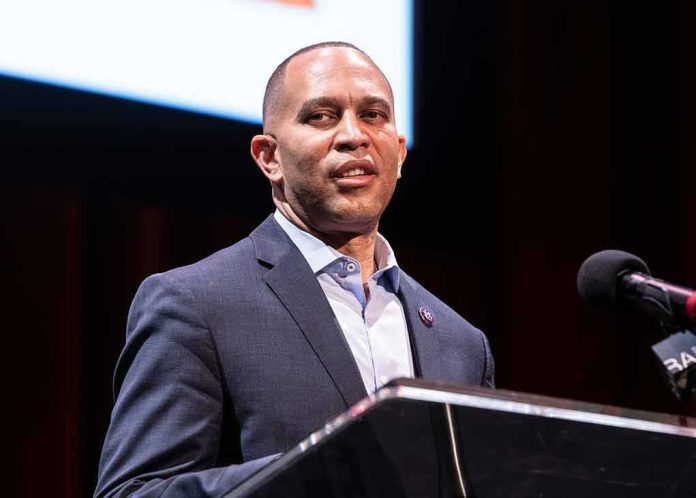
The spectacle in Denver was not about one insult shouted from the gallery; it was about a durable rift inside big-tent parties between movementers who want transformational policy on the clock and institutional leaders who count votes, manage coalitions, and legislate under constraint. The clash is recurrent, predictable, and consequential—because how Democrats resolve it will determine whether electoral wins translate into governing outcomes or dissolve into factional disappointment.
The Short Version
- Protesters interrupted Hakeem Jeffries at a Democratic “What’s Next” conference, pressing for impeachment and major progressive priorities, while Jeffries kept his footing and moved on.
- The interruption echoed a broader tension: activists measure success in policy delivery (Green New Deal, Medicare for All), leaders emphasize affordability, accountable governance, and passable bills.
- Jeffries’ fundraising profile and his Team Blue PAC ties fuel critics’ claims about donor influence, even absent a proven quid pro quo.
- Media coverage skewed toward the disruption and Jeffries’ composure, a familiar “protest paradigm” that can eclipse underlying policy disputes.
What happened in Denver—and what it actually signifies
During a post-election Democratic conference in Denver, protesters confronted House Democratic Leader Hakeem Jeffries—now poised to convert midterm gains into an agenda—accusing him of ducking accountability and failing to prioritize sweeping progressive policy. Cameras caught the epithet, the “traitor” charge, and Jeffries’ cool retort: “I’m from Brooklyn, this is light work.” The facts of disruption are not in dispute; C‑SPAN’s clip fixed the incident in the public record. What matters is the argument under the noise: activists demanded movement-scale outcomes—Green New Deal, Medicare for All, impeachment—while the leader under fire has been describing an approach organized around affordability and results that can become law.
That disjunction is the core story. In coverage from local to national outlets, the encounter was framed largely as heckling that Jeffries handled with composure, with the substance summarized in passing: calls for climate-scale investment, universal coverage, and a more confrontational posture toward the Trump administration. One protester affiliated with the Sunrise Movement voiced a common movement critique—voters delivered the majority; they expect the promised program, not incrementalism. Whether a few voices in a ballroom speak for a large share of Democratic voters is unproven; that is the nature of such confrontations and also their leverage.
The leadership case: affordability first, accountability by process
Jeffries has been explicit about the frame he intends to govern within: affordability, accountability, and what he calls a return to American values. He enumerates five affordability fronts—housing, healthcare, energy and utilities, groceries, and caregiving—and promises decisive action calibrated to those cost-of-living pressures. On accountability, he pledges to “follow the facts, apply the law, [and] be guided by the Constitution” rather than precommitting to targets or remedies; the message is process-discipline over spectacle.
The legislative stance follows from that frame. Jeffries has signaled he is uninterested in messaging bills that cannot become law and is wary of importing Senate products into the House without caucus ownership—permitting reform being an immediate case in point. Even preservation advocates took note, welcoming the call for a more inclusive process on the bipartisan affordability-and-jobs package, which is a tell: leadership aims to control the coalition process, not outsource it. This is not the stuff of viral clips, but it is exactly how speakers-in-waiting secure outcomes in fractured chambers.
The movement grievances: mandate claims, climate scale, and Medicare for All
The protesters’ demands track with the most ambitious planks of the progressive agenda. A Green New Deal implies industrial policy at climate scale; Medicare for All would replace the current mixed system with a single-payer guarantee. These are programmatically coherent demands—and they are structurally hard lifts in any closely divided Congress. The Denver confrontation, then, is less an evidentiary claim about a specific betrayal than a pressure tactic aimed at redefining the party’s governing center of gravity. In political terms, it seeks to convert a tactical majority into a programmatic mandate.
Two further claims animate the critique. First, that donor networks—particularly pro-Israel organizations, corporate law firms, and private equity—have outsized influence on leadership priorities. OpenSecrets documents the scale and sources of Jeffries’ support over multiple cycles, including substantial fundraising linked to AIPAC, other pro-Israel groups, Paul Weiss, and Apollo employees. Second, that institutional leaders protect incumbents against primary challenges from the left; Team Blue PAC, co-founded by Jeffries, formalizes that defense posture. Neither point proves transactional corruption; both reinforce a perception of structural bias toward caution, which is exactly what movements try to disrupt.
What the protest can—and cannot—prove
The Denver incident conclusively demonstrates discontent among some progressive activists and their willingness to impose reputational cost on leadership in public venues. It does not show that Jeffries blocked a specific impeachment article, buried a vote, or cut a deal to protect allies; no such documentary trail is in the record presented here. Nor do contribution tallies, by themselves, establish quid pro quo. The fundraising profile and the incumbency-defense posture are facts; the insinuated causal link to discrete policy choices remains an allegation absent transaction-level evidence tying money to an official act.
Scope is another limit. Reports describe a small, quickly escorted group, outshouted by attendees chanting the leader’s name—a reminder that party conferences are, by design, controlled environments. That asymmetry of access and amplification is not scandalous; it is structural. Leaders speak from podiums with streaming feeds; activists wedge their message in the gaps and hope the cameras catch enough to alter the narrative arc.
How the cameras change the stakes
Because most people encountered the confrontation through short clips and headline framing, the media lens matters. Decades of research describe a protest paradigm in which coverage emphasizes disruption and deviance over policy substance; audiences come away remembering conflict, not content. That pattern was visible here: “protesters interrupt,” “hecklers,” “traitor”—and Jeffries’ composed put-down—outcompeted the underlying list of demands. Movements know this and still choose confrontation because it forces an editorial decision: ignore the policy or at least summarize it. Even a mention can be a win; the cost is that tone can overshadow program.
Denver protesters confront House Democratic Leader Hakeem Jeffries on Friday, calling him out for holding private meetings with Jared Kushner, his funding from private equity, and his betrayal of the progressive Democratic base.#usa #AIPAC #resistance https://t.co/DXeUXX2jw4
— PartyRepublik (@PartyRepublik) November 13, 2026
What this means for Democrats’ governing window
If Democrats want the current majority to produce lasting policy, two imperatives collide. First, leadership must translate the affordability frame into visible, bankable household gains—lower premiums, cheaper insulin, more housing supply, energy bills that move down and stay there. Jeffries’ suggestion that restoring Affordable Care Act subsidies and reversing large Medicaid cuts could clear both chambers is precisely the kind of near-term deliverable that can stiffen a coalition and reduce the oxygen available to internal revolt. Second, the movement wing needs channels to shape bills early—committees, markups, rule-writing—where ambitions can be negotiated into text rather than shouted into rooms. That requires coordination, not just confrontation.
The impeachment thread underscores the political nature of accountability. Impeachment is not a courtroom; it is a constitutional tool wielded by elected branches, where prudence, vote counts, and public tolerance all shape timing and targets. A leader promising to follow facts and law will draw fire from those who see delay as complicity; a movement demanding immediate remedies will be accused of theatrics. Both instincts can be sincere. Only one turns into statutes or articles that pass.
How to read the next confrontation
Expect more scenes like Denver whenever leaders assemble to tell a story about governing priorities. The useful question is not whether decorum was breached; it is whether any durable bargaining channel opens afterward. Watch committee calendars, not just clips. Follow which affordability planks get legislative text, which climate and health provisions get scored, and whether oversight aims produce subpoenas with teeth or just soundbites. The distance between a chant and a line in a bill is where parties either reconcile their wings—or lose altitude.
Sources:
youtube.com, nbcnews.com, foxnews.com, reuters.com, cnn.com, c-span.org, denvergazette.com, savingplaces.org, republicanleader.senate.gov