
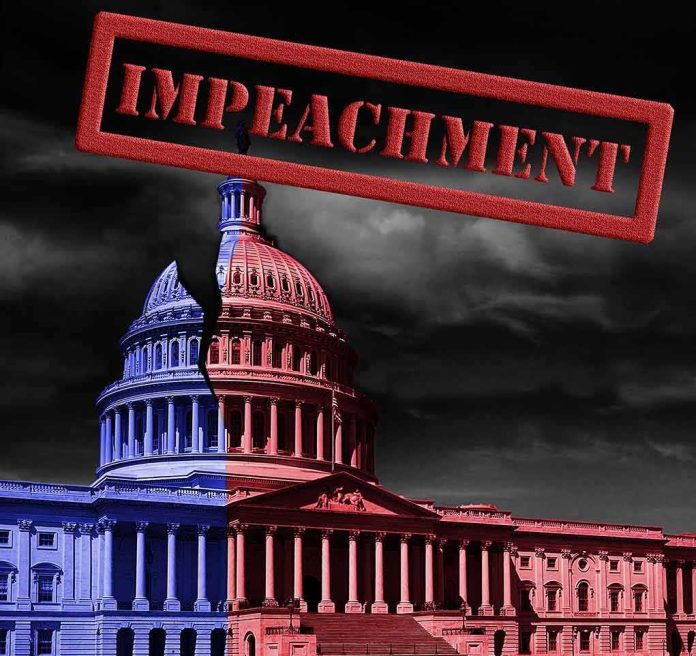
Impeachment is not a legal verdict so much as a constitutional stress test: it forces Congress to translate disputes over war-making, executive power, and accountability into yes-or-no votes under rules the Framers designed for political judgment. The current effort targeting Defense Secretary Pete Hegseth is best understood through that lens—where the charge sheet is specific, the counter-arguments are categorical, and the outcome hinges less on courtroom proof than on whether enough members conclude that the secretary’s conduct crossed the threshold of “high Crimes and Misdemeanors.”
At a Glance
- The House is being forced to vote on articles of impeachment against Secretary Hegseth that center on alleged War Powers violations and abuse of authority.
- Proponents ground their case in eight enumerated articles that assert statutory and constitutional breaches tied to military action against Iran.
- Hegseth and the Pentagon flatly deny wrongdoing, framing the effort as political theater and asserting compliance with the law.
- Impeachment of a cabinet officer turns on political thresholds, not criminal ones; removal would require a Senate supermajority that is historically difficult to assemble.
What the House Is Being Asked to Decide
Representative Thomas Massie has compelled a floor decision on whether the House should impeach Secretary Pete Hegseth. The resolution lays out eight distinct articles, led by a War Powers theory that alleges the secretary waged war against Iran absent a declaration, specific statutory authorization, an armed attack on the United States, or an imminent threat that would satisfy limited executive authority to repel sudden attacks. The text, drawn from Massie’s official submission, provides the spine of the case: it is not a generalized protest of policy, but a claim that the department executed offensive hostilities in defiance of Congress’s prerogatives under the Constitution and the 1973 War Powers Resolution.
Major outlets corroborate the scope and focus of those accusations. Reporting describes the same eight-count framework: violations of the Constitution and federal statutes, misuse of authority in the conduct of the Iran campaign, and related civil-liberties concerns, all packaged as “high Crimes and Misdemeanors” for a cabinet officer rather than the president. The through-line is clear: if Congress’s war power has concrete meaning, proponents argue, then disregarding it is an impeachable breach of public trust.
The Defense: Categorical Denials and Institutional Backing
Secretary Hegseth’s reply is not a narrow legal brief; it is a categorical rejection. He has called the impeachment drive a sham and vowed to remain in office through President Trump’s term. The Pentagon, through spokesperson Sean Parnell, has amplified that stance, asserting the department “followed the law” and that Hegseth will “stand and fight every single day to support and defend the Constitution”. In public appearances and social-video messages, Hegseth has paired that denial with a political frame—positioning the charges as payback for policy choices and emphasizing continuity of leadership during an ongoing security environment.
That juxtaposition—fact-specific articles versus across-the-board denial—sets the terms of the House’s inquiry. Impeachment investigators and floor debaters are not adjudicating battlefield efficacy or grand strategy; they are deciding whether the secretary exceeded lawful authority and, if so, whether that warrants removal. A single article sustained by a majority is sufficient for impeachment in the House; acquittal or removal then turns on Senate supermajority dynamics that historically favor the accused.
How War Powers Disputes Become Impeachment Contests
The War Powers Resolution, enacted over a presidential veto in 1973, attempts to cabin unilateral executive uses of force by requiring consultation, reporting, and time-limited deployments absent congressional authorization. In practice, administrations of both parties have argued that Article II provides latitude for limited hostilities and have often styled operations as falling short of “war” in the constitutional sense; Congress, for its part, has oscillated between asserting the purse and acquiescing to presidential claims. Congressional Research Service histories document this push-and-pull, and the ambiguities it leaves in fast-moving contingencies.
Impeachment enters when members conclude that the executive branch crossed not a gray zone but a bright line. The Massie articles assert precisely that—contending that the Iran campaign constituted “war” without constitutional or statutory basis, and that the secretary, as the department’s civilian head, executed unlawful orders. Supporters are not asking the House to second-guess tactics; they are asking it to enforce the structural constraint that only Congress may authorize sustained hostilities. Whether enough members agree turns on their reading of the facts and of the Resolution’s reach.
Politics Is Not a Dirty Word Here—It’s the Design
Impeachment is unavoidably political by constitutional design. Comparative research on impeachment shows that elite polarization is a consistent precondition for initiating proceedings; successful removal tends to require something more—public mobilization, scandal gravity that breaks partisan loyalties, or defections within the governing coalition. Studies of recent U.S. impeachments similarly find that partisanship and media ecosystems shape public opinion and legislative behavior, complicating any straight-line inference from allegations to outcomes.
Those base rates matter. Even if the House were to impeach, conviction in the Senate requires a two-thirds vote—a bar rarely cleared in American practice. Cabinet-officer impeachments are historically scarce, and the Senate’s removal threshold has functioned as a stabilizer, forcing a bipartisan coalition before ejecting a top executive official. In other words, the constitutional architecture expects disagreement and even partisan heat; it demands consensus for the most severe sanction.
🚨 Rep. Ro Khanna says he is working with Rep. Thomas Massie to secure votes for Massie’s effort to impeach Defense Secretary Pete Hegseth. “He needs to go,” Khanna says in the footage, citing the U.S. war with Iran.
Massie’s resolution contains eight articles alleging unlawful… pic.twitter.com/x8DnlYumfN
— California Courier (@cacourier) November 10, 2026
Where the Real Disagreement Lies
The consequential dispute is not over whether Iran posed challenges to U.S. interests; it is over whether the particular use of force met constitutional and statutory requirements. Proponents point to the absence of a tailored authorization as dispositive. The defense replies that the department acted lawfully and appropriately in defense of national security. Members weighing those claims should focus on three hard questions: Did the operation constitute “hostilities” that trigger War Powers timelines? If so, were reporting and drawdown requirements satisfied or mooted by a lawful basis? And does a cabinet officer’s implementation of presidential direction, in this context, cross the line into impeachable misconduct?
Peripheral debates—such as generalized claims about election administration or voting technology—do not bear on those questions. Independent reporting during the same period found no evidence that localized voting-machine issues altered vote counts or were deliberately exploited, which is to say, those arguments neither strengthen nor weaken the War Powers case against the secretary. The House’s job, here, is to judge a specific theory of executive overreach.
What This Means Going Forward
Two outcomes are durable. First, the House vote—whichever way it goes—will become part of the War Powers canon. Future administrations and Congresses will cite it as precedent for how far civilian defense leaders may go under color of Article II when the legislature has not spoken. Second, the episode will reinforce a familiar pattern: impeachment becomes viable when partisan incentives align to put a constitutional question on the floor, and removal only when a broader consensus emerges to answer it.
That is not cynicism; it is constitutional realism. The Framers located impeachment in the political branches because they expected that the gravest disputes over public trust would not be resolved by judges but by elected representatives accountable to voters. The Hegseth case, built on a concrete theory of unlawful war-making and rebuffed by categorical denial, is a textbook example. However the roll call breaks, it will teach future officials how Congress now understands the boundary between necessary force and unauthorized war—and it will remind the executive that, sometimes, the most important battlefield is the House floor.
Sources:
youtube.com, massie.house.gov, nytimes.com, nbcwashington.com, spectrumlocalnews.com, ap.org, factcheck.org, defenseone.com, courier-journal.com, openworks.wooster.edu, cambridge.org, jewlscholar.mtsu.edu