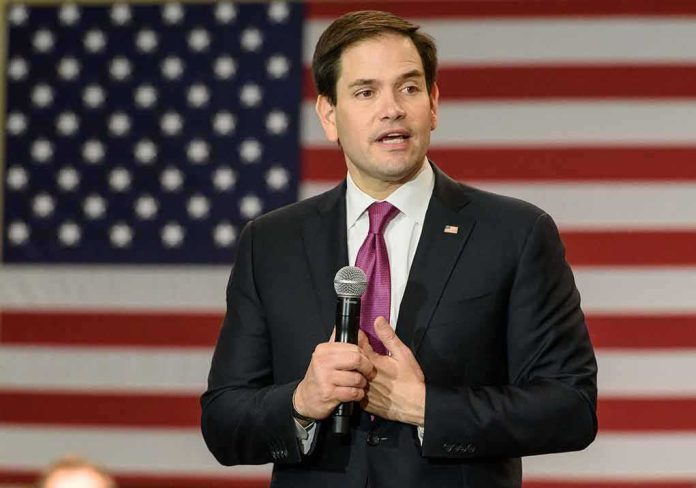
Secretary of State Marco Rubio is heading to the Gulf this week on a high-stakes mission to sell America’s Iran deal to nervous allies — and the outcome could shape Middle East security for years to come.
Story Snapshot
- Rubio travels to the United Arab Emirates, Kuwait, and Bahrain from June 23–25 to brief Gulf allies on the U.S.-Iran framework agreement.
- The Trump administration signed a memorandum of understanding with Iran, opening a 60-day window for broader nuclear and security talks.
- Gulf nations have real concerns — including a proposed $300 billion reconstruction fund for Iran and no limits on Tehran’s ballistic missile program.
- Rubio will also meet with the Gulf Cooperation Council in Bahrain to align regional defense priorities with Washington’s new diplomatic stance.
Rubio Heads to the Gulf With a Deal to Sell
Secretary of State Marco Rubio will visit the United Arab Emirates, Kuwait, and Bahrain from Tuesday through Thursday. The trip is his first official Gulf visit since the Iran war broke out. State Department spokesman Tommy Pigott confirmed Rubio will discuss “regional priorities including the memorandum of understanding with Iran, efforts to secure full and free safe transit through the Strait of Hormuz, and the importance of peace and stability in the region.”[3]
The timing is critical. The Trump administration signed a memorandum of understanding with Iran just last week, starting a 60-day clock for broader negotiations.[2] Vice President JD Vance described weekend talks in Switzerland on June 22 as a “good foundation for a successful final deal.” Now Rubio must convince Gulf partners — who have been on the front lines of Iranian aggression — that Washington has their backs.[1]
Gulf Allies Are Nervous — And They Have Good Reason
Gulf nations are not simply cheering this deal. Some officials have raised serious concerns about a proposed $300 billion reconstruction fund for Iran. They are also troubled that the framework does not address Tehran’s ballistic missile program.[2] These countries endured missile attacks during the Iran war. They want real security guarantees, not just diplomatic paperwork. The Trump administration’s job is to show them this deal makes the region safer — not just Iran richer.
Gulf allies were also reportedly frustrated that the U.S. did not notify them before striking Iran and ignored their early warnings.[23] That damaged trust. Rubio’s visit is partly about repairing that relationship and reassuring partners that America will not leave them exposed. The second Trump administration has tied security guarantees to Gulf investment commitments in the U.S. economy — a direct, transactional approach that replaces the vague promises of past administrations.[17]
The Strait of Hormuz Is the Flashpoint
Iran shut down the Strait of Hormuz during the war — blocking one of the world’s most vital shipping lanes. Rubio has been blunt about it: “The Straits of Hormuz do not belong to Iran. They don’t have a right to shut it down and blow up ships and lay mines, and that’s what they’ve done.”[10] The U.S. military is now guiding stranded commercial ships through the strait under a program called Project Freedom, which aims to rescue roughly 23,000 civilians from 87 countries trapped in the Persian Gulf.
Rubio to visit Gulf capitals
US Secretary of State Marco Rubio plans to visit the UAE, Kuwait, and Bahrain from June 23 to 25 to discuss the recently signed memorandum of understanding between the US and Iran and efforts to ensure unimpeded transit through the Strait of Hormuz,… pic.twitter.com/Oxje5WDpeo
— S p r i n t e r (@SprinterPress) June 22, 2026
Two U.S.-flagged merchant ships have already passed through safely as a proof of concept.[10] Getting the strait fully open again is not just a regional issue — it affects global energy prices and supply chains that hit American wallets directly. Rubio’s Gulf meetings will push to lock in free navigation as a permanent condition of any final Iran deal, not a temporary concession that Tehran can reverse when it suits them.
A Gulf Cooperation Council Summit Rounds Out the Trip
While in Bahrain, Rubio will meet with the Gulf Cooperation Council — a group of six Gulf monarchies that includes Saudi Arabia, Qatar, Oman, Bahrain, Kuwait, and the United Arab Emirates.[3] The multilateral session gives Washington a chance to align all six nations behind a shared security framework. Gulf states are already exploring new defense partnerships and increasing direct contacts with Iran to manage risk on their own terms.[19] The Trump team needs to make sure those moves complement U.S. strategy rather than undercut it.
This is American leadership in action. Rather than outsourcing Middle East policy to international bodies or hoping for the best, the Trump administration is sending its top diplomat directly to the region to make the case face-to-face. Whether Gulf allies fully buy in will depend on whether the final Iran deal actually delivers — on missiles, on nuclear limits, and on keeping the strait open for good.[20]
Sources:
[1] Web – The Trump Administration Just Deployed Marco Rubio to the Middle East
[2] Web – Rubio Heads To Gulf As US Seeks To Cement Iran Framework …
[3] Web – Rubio to Visit Gulf Allies as Trump Administration Seeks Support for …
[10] Web – US Secretary of State Marco Rubio will begin a trip to three Gulf …
[17] Web – This week, I had the chance to question Secretary of State Marco …
[19] Web – How the Iran war could change the US relationship with Gulf states
[20] YouTube – Trump’s Gulf Allies Reassess US Defence Umbrella After Iran War
[23] Web – Iran: What’s Next for US Policy as the Region Seeks to Move On