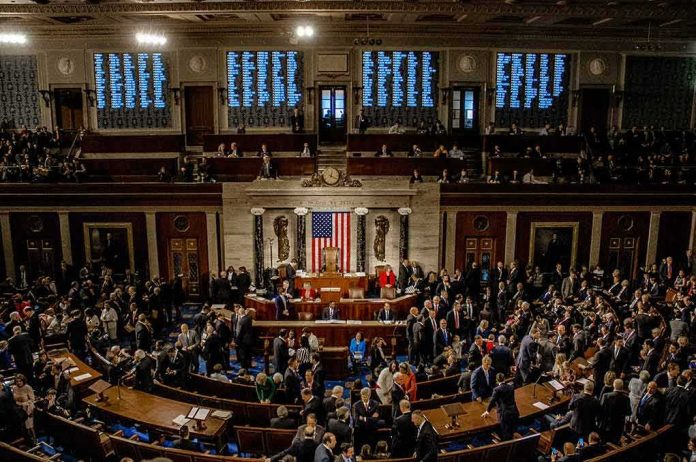
The filibuster debate is not really about Senate procedure — it is about which party gets to govern without restraint, and both sides know it.
At a Glance
- Trump has repeatedly demanded that Senate Republicans eliminate the 60-vote cloture threshold, warning that failure to act will cost the party the next two election cycles and hand Democrats unchecked power.
- A group of House Democratic caucus leaders introduced a resolution calling for Supreme Court expansion, judicial term limits, a code of ethics for justices, and filibuster elimination — though the resolution’s full text has not been independently verified beyond Politico reporting.
- Senate Republican leaders including Majority Leader John Thune publicly oppose killing the filibuster, creating a significant fracture within the GOP that undermines Trump’s push.
- Trump’s most dramatic predictions — that Democrats would pack the Court with five to nine new justices and admit DC and Puerto Rico as states on their first day in power — lack a specific legislative proposal or Democratic leadership endorsement to substantiate the timeline or the numbers.
- The filibuster has been weaponized by both parties for decades; the current crisis fits a well-documented pattern in which whichever party holds the majority demands reform while the minority defends the rule as a constitutional safeguard.
The Mechanism: What the Filibuster Actually Does
The Senate’s cloture rule — codified as Rule XXII — requires 60 votes to end debate on most legislation and force a final vote. In practice, this means the minority party can block any bill it opposes unless the majority can peel off ten members from the other side. That threshold has not been a neutral procedural guardrail for most of American history; it has been a weapon, deployed most infamously to kill civil rights legislation through the 1950s and 1960s before being reformed in 1975 to lower the threshold from two-thirds to its current three-fifths.
What has changed dramatically in recent decades is not the rule itself but the frequency and casualness of its use. The modern “stealth filibuster” — in which a senator simply signals opposition to cloture without ever holding the floor — allows obstruction without political cost, a dynamic that has made the 60-vote threshold the de facto standard for nearly all consequential legislation. The rule is not constitutionally mandated; the Constitution is silent on supermajority requirements for ordinary legislation, and Congress has changed the size and structure of the Senate’s procedural rules repeatedly throughout its history.
Trump’s Demands and the Evidence Behind Them
Trump’s case for eliminating the filibuster rests on two distinct arguments: an affirmative one about passing his own agenda, and a preemptive one about what Democrats will do if they regain power. The affirmative case is straightforward — without 60 votes, the SAVE America Act, which includes voter ID requirements and other election integrity measures, cannot pass the Senate. Trump declared the bill a “national emergency” and demanded its passage before signing other legislation. That pressure is real, documented, and consistent across multiple public statements.
The preemptive case is more complicated, and the evidence for its most alarming specifics is thinner than the rhetoric suggests. Trump has warned that Democrats, upon regaining the presidency and both chambers, would pack the Supreme Court with “at least five justices, possibly up to nine,” admit Washington DC and Puerto Rico as states to gain four new senators, and move on all of this within their first days in office. A group of House Democratic caucus leaders — Greg Casar of Texas, Yvette Clarke of New York, Grace Meng of New York, and Hank Johnson of Guam — did introduce a resolution calling for Court expansion, judicial term limits, an ethics code, and filibuster elimination, as reported by Politico. That resolution represents a real Democratic policy position, not a fabrication. But no specific bill proposing five or nine new justices, no Democratic leadership endorsement of that number, and no formal legislative mechanism for the “first day” timeline has been produced. Trump’s specific figures are predictions dressed as certainties.
The Republican Fracture That Changes Everything
The most significant political fact in this debate is not what Democrats want to do — it is that Republican Senate leaders have publicly refused to go along with Trump’s demand. Senate Majority Leader John Thune, along with Senators Mike Lee, John Barrasso, and others, has repeatedly stated opposition to holding a vote to eliminate the filibuster. This is not a minor procedural disagreement; it is the majority leader of the president’s own party blocking the president’s stated top legislative priority.
The irony runs deep. Trump is arguing that Republicans must kill the filibuster now to prevent Democrats from killing it later — but Republican senators are essentially betting that the filibuster protects them when they are in the minority more than it costs them when they are in the majority. That calculation is not irrational. The procedural history of the Senate shows that majorities consistently hesitate to eliminate the filibuster precisely because they can envision being the minority again. What political scientists have documented, and what the current standoff illustrates, is that the filibuster’s survival depends less on principle than on the self-interest of individual senators who expect to need it.
The Historical Pattern: This Has Happened Before
The current fight fits a pattern that recurs with almost mechanical regularity in American politics. Every time one party loses institutional control — of the presidency, the Senate, or the Supreme Court — it frames the other party’s procedural reform proposals as an existential power grab. Every time a party gains control, it demands the same reforms it previously denounced. Republicans invoked the “nuclear option” on judicial nominations in 2017; Democrats had done the same for lower-court nominations in 2013. The Court-packing debate that Trump warns about in apocalyptic terms mirrors the warnings Democrats issued about Republican judicial appointments throughout the Obama years.
This does not mean the stakes are fake — they are genuinely high. A Supreme Court expanded by five justices would be a transformative institutional change, and statehood for DC and Puerto Rico would permanently alter the Senate’s partisan balance. But the framing of these possibilities as imminent, coordinated, and inevitable on “day one” of a Democratic administration overstates what the evidence actually shows. Democratic caucus members have introduced a resolution; Democratic leadership has not committed to a timeline or a specific number of justices. The distance between a House resolution and enacted law is, under normal circumstances, vast.
What the Evidence Actually Supports
Stripping away both the apocalyptic framing and the reflexive dismissal, the evidence supports a more precise set of conclusions. First, there is a genuine and documented Democratic interest in eliminating the filibuster and expanding the Court — not a conspiracy theory, but a real policy position held by a meaningful faction of the party. Second, Trump’s specific predictions about the number of justices, the timing, and the certainty of these actions are not supported by primary-source evidence; they are extrapolations, and aggressive ones. Third, the filibuster’s survival currently depends not on Democratic restraint but on Republican senators — particularly Thune — who are resisting their own president’s demands.
The “blue slips” tradition that Trump has also targeted — the Senate custom by which home-state senators can effectively veto a judicial nominee from their state by withholding a slip of paper signifying approval — is a real procedural mechanism that has blocked nominees, though the specific claim of ten blocked nominees awaits verification against Senate Judiciary Committee records. The broader point Trump is making about minority-party leverage over judicial appointments is substantively accurate as a description of how the Senate operates, even if some of the supporting specifics are unverified.
🚨🇺🇸 Trump is sounding the alarm on a Democratic resolution targeting the filibuster and the Supreme Court, warning Republicans it's an existential play.
Trump on the plan:
"They will TERMINATE THE FILIBUSTER in their first hour, and I'll be sitting home with tears in my eyes… pic.twitter.com/OhAl0b9AUA
— Mario Nawfal (@MarioNawfal) July 4, 2026
Why the Outcome Matters Beyond the Moment
The filibuster debate is ultimately a debate about what kind of legislature the Senate is. A 60-vote threshold in a polarized chamber where party-line voting is near-universal means that the majority party can almost never govern; it is structurally designed to produce gridlock. Political scientists have found that eliminating the filibuster would not, by itself, dramatically increase legislative output, because internal party divisions — not just minority obstruction — are the primary reason majority parties fail to pass their agendas. The current Republican difficulty passing the SAVE America Act despite holding the Senate majority is itself a demonstration of that principle.
What elimination would change is the nature of the political risk. Without the filibuster, each election becomes higher-stakes: a party that wins the trifecta — presidency, House, Senate — can govern without any structural check from the minority. That is precisely what Trump is promising Republicans they could do, and precisely what he is warning them Democrats will do. Both descriptions are accurate. The question is whether any party trusts itself — and its successors — enough to remove the last procedural guardrail between electoral victory and unchecked legislative power. History suggests the answer is usually no, right up until the moment it is yes.
Sources:
redstate.com, politico.com, time.com, npr.org, thehill.com, youtube.com, newsmax.com, freerepublic.com, jacobin.com