When a sacred text is torn in public, the act is never “just” destruction; it is a message—aimed, layered, and meant to be seen—whose meaning depends on where it happens, who does it, and what conflict it is trying to enter.
The Short Version
- The Bible-ripping at a contentious 9/11–adjacent protest in Lower Manhattan functioned as expressive conduct—communication through action—not random vandalism.
- Symbolic desecrations reliably split audiences: supporters frame them as political critique; opponents see them as contempt and provocation; both readings can be true at once.
- U.S. First Amendment doctrine protects much offensive symbolic speech, but context—time, place, and manner—can lawfully narrow it when it disrupts public order or targets protected spaces.
- History shows desecration of religious texts invites cross-ideological condemnation even from those who defend the right to offend; the act’s expressive aim carries social costs.
What happened, and what it was trying to say
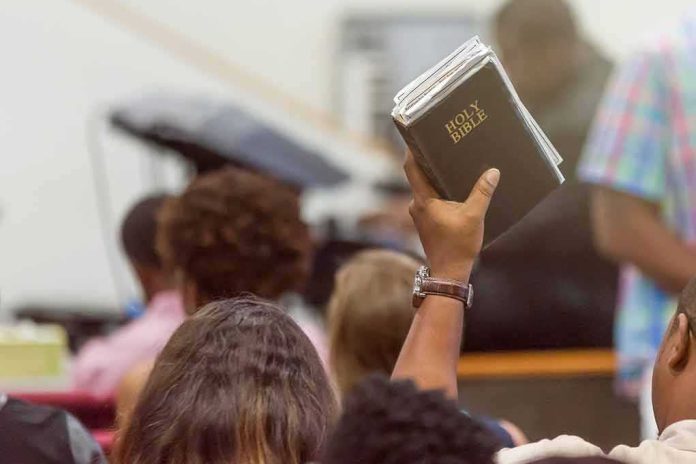
During a heated demonstration in Lower Manhattan tied to 9/11 commemorations—where a march framed as the “Crusader March” confronted political grievances around attendance at official ceremonies—video and reporting captured a counterprotester wearing devil horns tearing pages from a Bible outside City Hall. The setting was not accidental theater; it was chosen precisely because the surrounding ritual and symbolism heighten visibility and stakes. In that environment, book tearing is a communicative act directed at the event’s ideology, its participants, and the broader culture watching on. That is classic expressive conduct: an action chosen for what it says as much as for what it does.
Expressive conduct is a term of art in free-speech analysis. It describes behavior “sufficiently imbued with elements of communication” such that observers reasonably understand a message even without words. In American jurisprudence, that category has long encompassed acts like flag burning, armband wearing, and draft-card destruction; the question is not whether the message offends, but whether the conduct communicates and how the government may regulate its time, place, and manner without targeting its viewpoint.
Desecration as a political language: how it works on audiences
Desecration of a revered object compresses a thesis into a single, legible image: “your authority is illegitimate; your narrative oppresses; your sacred is not mine.” Groups on every side of culture conflict have reached for it because it travels fast—on camera, in memory, in news cycles—and forces a reaction. The same mechanism, however, guarantees backlash. For those who hold the symbol dear, the message lands not as critique but as an attack on identity, community, and the dead being honored nearby. Even observers who defend robust speech may condemn the choice of method or venue, distinguishing rights from judgment. This dual reception is not a contradiction; it is the predictable cost structure of shock politics.
Comparative examples underline the point. Episodes of Quran or Bible desecration—whether in Cairo, New York, or Northern Europe—provoke not only anger from believers but also explicit condemnation from religious and civic leaders who nonetheless affirm the legal right to offensive expression. When a cleric in Egypt tore and burned a Bible during a U.S. Embassy protest, Coptic leaders labeled the act “villainous and barbaric,” and the state pursued penalties—illustrating that the social and legal responses can diverge dramatically across jurisdictions even as the symbolic grammar remains constant. Scholarly work on protest framing finds media and audiences rapidly sort such images into moral narratives—oppression, disorder, sacrilege—shaping perceptions of both the protesters’ cause and their opponents.
Law’s line: protected expression versus punishable conduct
In the United States, the constitutional baseline is durable: offensive expression is not a category the government may ban simply because it offends. Courts ask instead whether the act communicates, and if so, whether restrictions address non-speech interests—safety, access, noise, or disruption—through neutral rules that leave ample alternatives for the message. That is why flag burning, though outrageous to many, has been protected, while blocking an entrance or threatening violence is not. Applied to scripture tearing at a public demonstration, the line is clear: the message itself is protected; the state may regulate where and how it is delivered to protect order during a solemn civic event. The more emotionally charged the venue—memorial grounds, houses of worship, funeral processions—the more likely time, place, and manner limits are sustained, provided they are viewpoint-neutral and narrowly tailored.
Location, then, is not incidental. A Bible torn in a private gallery reads as art; the same act inside a church during worship is disruption; at a memorial perimeter, it becomes a test of how far civic tolerance extends when grief and politics intersect. The Lower Manhattan event existed in that tense overlap, which is why the imagery resonated beyond the small number of people physically present.
Strategy and backlash: why activists choose desecration, and what it costs
Activists reach for desecration when they believe ordinary speech cannot puncture a dominant story. It externalizes dissent in a way that resists paraphrase: anyone can say “I object to your theology’s role in public life,” but ripping the text forces cameras to linger. That leverage is real. Yet it is also volatile. Desecration tends to collapse nuanced critique into a single charge—contempt—inviting counter-mobilization and hardening sympathies for the targeted community. Movements that rely on changing minds, building coalitions, or persuading institutions often discover that transgression wins attention but loses persuadables. History is littered with campaigns that briefly dominated feeds with a viral affront, only to find fundraising, turnout, and legislative outcomes move against them once the outrage framed the cause rather than the underlying grievance.
There is also an internal moral calculus. Many who favor maximal speech protections nonetheless judge some forms of expression as corrosive to the civic fabric—especially around memorial dates like 9/11, where the line between public square and sacred space blurs. That is why, across traditions and political camps, leaders often both defend a dissenter’s legal right and censure the act as indecent or injurious to social trust. Comparative episodes of text desecration repeatedly produce that two-track response—legal tolerance, social repudiation—because a plural society requires both a capacious free-speech perimeter and norms that discourage gratuitous humiliation of one another’s deepest commitments.
Nothing to see here.
Just a "transgender activist" in devil horns tearing pages out of a Bible while engaging in some sort of a 9/11 protest outside New York City Hall. pic.twitter.com/a3cNfS2YfB
— Professor Iratus Genium (@PGenium) September 11, 2026
How to read future incidents: a practical framework
When the next viral clip appears—Quran pages in a plaza, a Torah scroll defaced, a Bible torn at a courthouse—ask four questions. First, mechanism: what specific message was the actor trying to send through this object rather than through words? Second, venue: was the site chosen to communicate with adversaries, to trespass on a protected ritual, or to exploit a media focal point? Third, regulation: were any legal restraints applied neutrally to preserve order, or was viewpoint targeted? Fourth, consequence: did the act advance the stated cause among undecided audiences, or did it mainly consolidate opposition? Those questions cut through performative outrage and get to outcomes.
In the Lower Manhattan case, the answers are direct. The act was designed as visible repudiation of a religious-political presence at a highly symbolic moment; it communicated. The venue maximized attention and emotional charge; it guaranteed backlash. The legal envelope, in U.S. terms, largely protects the symbolic act while allowing police to manage disorder; that is a stable equilibrium. And the political effect, as usual with desecration, is likely mixed: energizing sympathizers who read liberation into blasphemy, while persuading few beyond them and alienating many who might otherwise engage on policy or principle.
Sources:
lifesitenews.com, youtube.com, cbsnews.com, aina.org