When an active-duty Air Force major in full uniform is handcuffed on the Capitol steps after calling for the impeachment and removal of the sitting president, the event is not just an arrest; it is a collision between military discipline, constitutional conscience, and the outer limits of acceptable dissent in uniform.
Key Points
- Major Jason Watson, a decorated active-duty U.S. Air Force officer with 17 years of service, was arrested on the steps of the U.S. Capitol after publicly calling for the impeachment and removal of President Donald Trump and Vice President JD Vance.
- Watson appeared in uniform, identified himself as active-duty, and delivered a detailed constitutional indictment of the administration’s conduct before refusing Capitol Police orders to end what authorities classified as an illegal demonstration.
- Supporters frame his arrest as a nonviolent act of civil disobedience in defense of his oath to the Constitution, while law enforcement and military-law commentators emphasize violations of Capitol regulations and the Uniform Code of Military Justice (UCMJ).
- A fundraiser launched in the aftermath taps into a long-running tension: how far a serving officer can go in political speech before crossing from conscience-driven protest into punishable misconduct.
The arrest on the Capitol steps: what actually happened
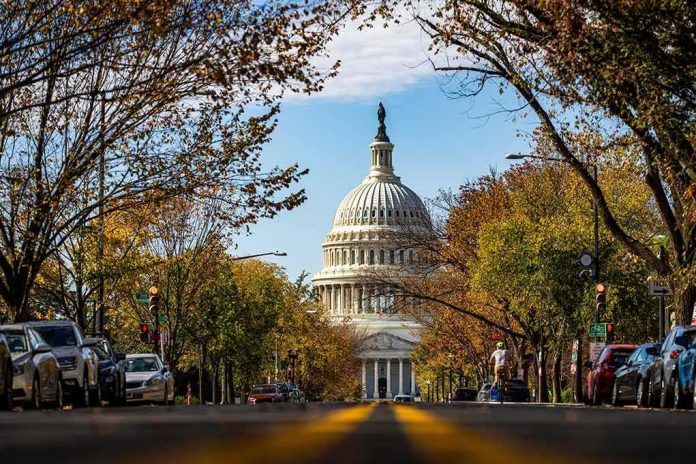
On a summer day in Washington, D.C., Major Jason Watson stood on the steps of the U.S. Capitol in his Air Force uniform and delivered a prepared statement calling for Congress to impeach, convict, and remove President Trump and Vice President Vance. The event was organized by the Removal Coalition, a grassroots activist group focused on Trump’s removal from office. Watson introduced himself as an active-duty logistics readiness officer and invoked his oath to “support and defend the Constitution of the United States against all enemies, foreign and domestic.”
According to U.S. Capitol Police, members of the public are not allowed to demonstrate on the House steps unless accompanied by a member of Congress. Representative Al Green of Texas did appear and, according to police, “escorted” Watson to the steps before leaving the area. Once Green departed, officers told Watson the event was an unauthorized demonstration and issued what they described as “lawful orders” to cease or face arrest. Watson continued his protest. Capitol Police then arrested him under D.C. Code 22‑1307, the misdemeanor offense of “Crowding, Obstructing, and Incommoding.”
Watson was later released, and a D.C. Superior Court official told CNN that a possible case would not be formally filed, indicating local prosecutors chose not to proceed on the misdemeanor charge. That decision, however, does not shield him from potential military consequences under the Uniform Code of Military Justice.
Who Major Jason Watson is, and why his voice carried weight
Watson is not a junior airman acting on a whim. In interviews and supporter statements, he is described as an active-duty major with approximately 17 years of service, a logistics readiness officer assigned to a NATO unit in Poland, and a recipient of high-level commendations including the Defense Meritorious Service Medal and a Joint Service Commendation Medal. That profile matters: when a mid-career officer with command-resume credentials breaks ranks so publicly, it signals a considered decision to risk a great deal.
In a long-form interview after his detention, Watson traced the evolution of his dissent. The January 6 Capitol attack, the administration’s handling of immigration enforcement, and what he interprets as unconstitutional military operations abroad convinced him that quiet internal objection was insufficient. He founded a small activist group, Defenders of Our Republic, aimed at mobilizing service members and veterans around constitutional concerns about the Trump administration.
Watson also pointed to earlier, largely unnoticed protests: he reportedly engaged in a hunger strike on or near Capitol grounds in 2022 to draw attention to what he saw as unlawful actions by the administration, but the effort drew little mainstream media coverage. By the time he stepped onto the Capitol steps in uniform, he appears to have concluded that only a direct, highly visible confrontation would match the gravity of the constitutional violations he perceives.
What Watson said: a constitutional bill of particulars
Watson’s speech on the Capitol steps, amplified in a separate video posted by the USMCAngryVeteran channel, was not a brief slogan but an extensive list of alleged constitutional violations by the Trump administration. At its core was the claim that the president had ordered offensive military actions in Venezuela, Cuba, and Iran absent an imminent threat or congressional authorization, in violation of the War Powers Clause, and that these actions resulted in the deaths of 13 U.S. service members and hundreds of wounded. The available reporting does not independently corroborate those casualty figures; they should be understood as Watson’s allegations rather than settled fact.
He further asserted that an “unelected mega donor” had been delegated sweeping power to shut down federal functions and access government databases, allegedly resulting in the termination of tens of thousands of civil servants and the abrupt cessation of foreign aid that he links to massive loss of life among impoverished populations. In the material available, the donor is not named and no specific legal instrument is cited, leaving this allegation in the realm of unverified assertion rather than documented misconduct.
On domestic policy, Watson criticized the administration’s immigration enforcement and detention practices, particularly the transfer of detainees to El Salvador’s SECOT prison, which he described as notorious for human rights abuses and incompatible with the Fifth and Eighth Amendments. He catalogued incidents in which peaceful protesters, clergy, and legal observers were harmed or killed by law enforcement, framing them as First and Second Amendment violations.
Legally, his most sweeping claim is that Trump is already an “adjudicated insurrectionist” barred from office under Section 3 of the Fourteenth Amendment, a status that, he argues, Congress has failed to enforce or overturn by amnesty. The research provided does not identify a specific court decision definitively assigning that status to Trump as a matter of final, controlling law; Watson is adopting a legal interpretation advanced by some scholars and litigants rather than citing a singular, dispositive ruling.
Supporters’ framing: civil disobedience and oath-driven duty
Advocacy organizations and many sympathetic observers quickly cast Watson’s arrest as a classic act of civil disobedience—deliberate, nonviolent violation of a regulation in order to dramatize a larger injustice. Free Speech For People, a constitutional advocacy group, described his conduct as a “nonviolent act of civil disobedience” consisting of standing on the Capitol steps with a sign calling for impeachment, removal, and conviction. Their statement emphasized his oath to the Constitution, his years of decorated service, and his willingness to risk career and liberty for constitutional accountability.
Representative Al Green, who has long pressed for Trump’s impeachment, publicly praised Watson’s stand, noting that he “stood for impeachment of the president” before being taken into custody. On social media, short clips of his arrest were framed with language like “risked everything” and “doesn’t fear arrest,” reinforcing the narrative that this was a conscious sacrifice rather than a spontaneous outburst.
Within that framing, the arrest is less about the D.C. misdemeanor on the charge sheet and more about the symbolic clash between a constitutional oath and what Watson regards as an unlawful presidency. The fundraiser launched in his name leverages precisely this symbolism: contributors are invited to support not only his legal and financial needs, but also the broader cause of defending constitutional government against a lawless executive.
The institutional view: law, order, and the UCMJ
Law enforcement and military-justice perspectives, by contrast, start from a different set of obligations. For the Capitol Police, the core issue was straightforward: Watson was part of a demonstration in a restricted location, was warned that it was unauthorized, and refused orders to stop, triggering an arrest under a standard public-order statute. From that vantage point, describing the event as “crowding, obstructing, and incommoding” reflects a neutral application of Capitol grounds rules rather than any judgment on the merits of his message.
The U.S. military operates under an even more stringent regime. Active-duty personnel, especially commissioned officers, are bound by the UCMJ and detailed regulations restricting political activity in uniform. Commenters with military-law knowledge quickly pointed to potential violations of Article 88 (contempt toward officials), Article 92 (failure to obey lawful orders or regulations), and related provisions. Article 88 specifically criminalizes “contemptuous words” against senior civilian leaders including the president and vice president, with a maximum punishment of dismissal, forfeiture of all pay and allowances, and up to a year of confinement.
Military law specialists stress that Article 88 does not distinguish between public and private settings: if contemptuous words aimed at the president are communicated to another person, and the speaker is a commissioned officer, the offense is potentially complete. Publicly calling for impeachment is not, by itself, necessarily contemptuous; the line is crossed when the language becomes personally insulting, demeaning, or otherwise displays contempt. Some observers note that Watson’s rhetoric, while harshly critical of policy, largely focuses on alleged constitutional violations rather than name-calling—but any formal assessment would depend on an exact transcript and command judgment.
Separately, Department of Defense rules and service-specific regulations bar members from participating in partisan political demonstrations in uniform. Reddit discussions among current and former service members, though informal, accurately reflect this: “You also can’t participate in a demonstration while wearing a uniform,” one commenter notes, before predicting that Watson could face charges under Articles 88 and 92. Historically, uniformed participation in high-visibility political protest has often led to reprimands or more serious disciplinary action.
A longer pattern: military dissent and the post–January 6 landscape
Watson’s protest does not occur in a vacuum. Recent years have seen an uneasy spotlight on political extremism and dissent within the ranks. After the January 6, 2021 attack on the Capitol, an Associated Press review identified at least 21 current or former members of the U.S. military or law enforcement among those at or near the riot, prompting intense scrutiny from Pentagon leaders. The Pentagon responded with an unusual memo reminding service members that free speech “gives no one the right to commit violence” and reiterating obligations to uphold the Constitution and lawful authority.
The system’s basic tension is enduring and structural. Civilian officials and senior commanders have a strong incentive to enforce strict nonpartisanship in the ranks; visible dissent in uniform can erode the perception of an apolitical military and threaten civilian control. Advocacy groups and dissenting officers, on the other hand, argue that fidelity to the Constitution sometimes requires speaking out against unlawful orders or unconstitutional leaders—even at personal risk.
At the statutory level, Article 88 and related provisions embody this tension. They protect civilian authority by criminalizing contemptuous speech from officers but sit uneasily alongside First Amendment principles, especially for retirees and reservists who remain subject to the UCMJ. Legal scholars have called for reform, arguing that broad speech restrictions on retirees and on purely political criticism veer too far toward suppressing legitimate civic engagement.
Heroism, recklessness, or something in between?
How one interprets Watson’s actions tends to track one’s priors about military dissent. To his supporters, he is a textbook case of courageous civil disobedience: a decorated officer, acutely aware of the career-ending stakes, deciding that silence in the face of grave constitutional violations would betray his oath. They emphasize the nonviolent nature of his protest—standing with a sign, delivering a speech, refusing to leave—and the fact that local prosecutors declined to pursue the misdemeanor charge.
To institutionalists, he is an officer who knowingly violated both Capitol regulations and clear military rules against partisan activity in uniform, potentially undermining the apolitical norm that is foundational to U.S. civil–military relations. They stress that the merits of his constitutional critiques are not the point; the issue is the method and the uniform, not the message.
The law itself does not adjudicate heroism. It will ask narrower questions: Did he violate specific provisions of the UCMJ or standing regulations? Were his words “contemptuous” within the meaning of Article 88? Did his participation in a partisan protest in uniform breach explicit prohibitions? On those fronts, he appears to have exposed himself to real risk. Maximum authorized punishments under Article 88 include dismissal and a year of confinement, and Article 92 violations can also carry severe consequences.
The fundraiser in his name, and the broader campaign around “standing with” Jason Watson, are attempts to answer a different question—one of public judgment rather than legal outcome. Was this the kind of disciplined, transparent act of conscience that a constitutional republic ought to honor, even as it enforces its rules? Or was it a dangerous blurring of lines that protect civilian control of the military?
Whatever answer readers land on, the case of Major Jason Watson exposes a hard truth about oaths and obedience. A military officer’s loyalty is formally to the Constitution, not to any particular president. But the mechanisms for acting on that loyalty, when one believes the president himself has become a domestic threat to constitutional order, are narrow, fraught, and often personally ruinous. Watson appears to have walked into that narrow space with eyes open. The legal system—and, just as importantly, the public—now must decide what that walk meant.
Uniter
💯 the Capitol Police handcuffed him for a misdemeanorMajor Jason Watson doesn’t fear arrest over his protest as much as court martial for demand to impeach, convict & remove the sitting president. His team set up this fundraiser for his family.https://t.co/JuwxuN51oF
— Divider Decider 👩🏻⚖️⚖️💯 Flip Congress Blue 🌊 (@DeciderDivider) July 2, 2026
This moment in the larger civil–military debate
In the coming years, Watson’s protest is likely to be cited in debates over the reform of Article 88, the scope of political speech permitted to active-duty and retired personnel, and the handling of extremism and dissent within the ranks. It will also resonate in activist circles as an example—either inspiring or cautionary—of how far a serving officer can go in opposing a sitting president.
For citizens watching from outside the military, the episode is a reminder that constitutional conflicts do not play out only in courtrooms or cable-news studios. They also unfold in the choices of individual officers in uniform, weighing their careers, their families, and their consciences against the rules of a system built on both obedience and principle. That is why a single arrest for “crowding, obstructing, and incommoding” can matter far beyond the steps where the handcuffs clicked shut.
Sources:
twitchy.com, facebook.com, reutersconnect.com, freespeechforpeople.org, reddit.com, bileckilawgroup.com, ucmjdefense.com, en.wikipedia.org, justsecurity.org, warroom.armywarcollege.edu, pbs.org, instagram.com