
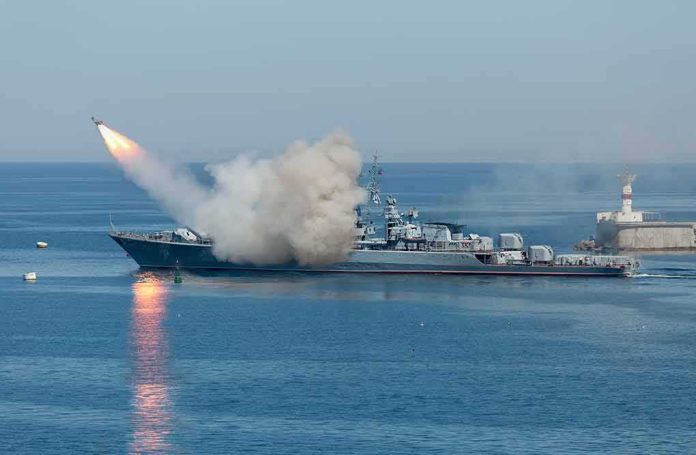
When a government uses an official diplomatic channel to publicly name individual foreign military officers and vow retribution, it is not just rhetoric; it is state intimidation tied to a live theater of war, with real consequences for force protection, deterrence signaling, and the information contest that surrounds civilian-harm allegations.
At a Glance
- Iran’s embassy in South Africa used its official account to accuse two USS Spruance officers of ordering Tomahawk strikes that killed children in Minab—and declared, “We will find you.”
- The post named Cmdr. Leigh R. Tate and Executive Officer Jeffrey E. York, specified “three” Tomahawk launches, and alleged a death toll in the hundreds.
- The warning landed as the Spruance returned from a 12-month combat deployment linked to U.S.–Israeli strikes beginning February 28, 2026.
- Open-source reporting reproduces Iran’s allegation and threat; the Navy has highlighted Spruance’s Tomahawk role during the campaign.
What Iran said, how it was said, and why that matters
On March 28, 2026, the Iranian Embassy in South Africa used its verified X account to publish a direct accusation against two identified U.S. Navy officers—Cmdr. Leigh R. Tate and Executive Officer Jeffrey E. York—asserting they “ordered the launch of Tomahawk missiles three times,” killing children at a school in Minab. The same account followed with an explicit warning: “We will find you.” This is not an anonymous flyer or a proxy channel; it is an attributable statement from an organ of the Iranian state, delivered in a venue designed for global amplification. The content and the form both matter: the naming of individuals, the operational specifics (weapon, number of launches, location), and the threat language elevate this beyond propaganda into the domain of coercive state communication.
The embassy’s message fits a pattern that wartime observers recognize: civilian-casualty claims are rapidly intertwined with attribution and criminality narratives, then yoked to intimidation aimed at eroding enemy morale and complicating future deployments. Tehran’s choice to push this through an embassy account underscores intent to professionalize and legitimize the allegation in the diplomatic arena while harnessing the reach of modern social platforms to shape public opinion.
The operational backdrop: Spruance’s combat tour and the February 28 strikes
The USS Spruance’s return to San Diego capped a 12-month deployment that Navy and regional reporting describe as historically long and combat-intensive. Public accounts place Spruance among the U.S. and allied units that launched Tomahawk strikes into Iran beginning on February 28, 2026, during the opening phase of the campaign sometimes labeled Operation Epic Fury. While security constraints limit target-by-target specificity, multiple outlets have characterized Spruance’s role as significant in those opening salvos. That timeline is the hinge on which Tehran’s Minab-school accusation swings; the embassy’s post directly links the named officers to supposed actions on that first night.
Context is important here. Tomahawk land-attack cruise missiles are long-range, precision-guided weapons tasked to fixed targets in integrated strike packages. On Arleigh Burke–class destroyers like Spruance, release authority, targeting, and timing are embedded in a chain of command and a rules-of-engagement matrix that involves the ship but also higher headquarters. The embassy’s framing, by naming the commanding officer and executive officer, personalizes what is operationally a distributed decision regime; that personalization is common in influence campaigns seeking to convert institutional actions into individual culpability narratives.
Threats to named U.S. personnel as an instrument of strategy
Iran’s statement sits inside a broader communications strategy that marries kinetic action with intimidation and information operations. Researchers have documented Tehran’s use of overt and covert messaging—ranging from embassy posts to inauthentic accounts—to shape perceptions of its military and to depict adversaries as immoral or criminal, particularly when civilian casualties are alleged. The specific tactic of naming and threatening U.S. personnel leverages fear as a force-multiplier, aiming to change behavior, chill future operations, or extract political concessions at home and abroad. In recent months, U.S. officials and service members have reported heightened security postures tied to Iranian threats, illustrating how online statements can drive real-world protective moves.
Two things make this episode notable. First, the immediacy: the warning surfaced just as Spruance completed its deployment, ensuring maximum psychological impact on the officers, their families, and their crew. Second, the precision of the accusation: naming officers, citing three Tomahawks, and pointing to Minab—details calibrated to read as accountability rather than bluster, even as the forum remained social media. That is sophisticated narrative engineering, not a late-night rant.
The allegation itself: specificity, repetition, and coverage
The embassy’s post provided an unusual level of granularity for a social account: a school in Minab, a toll described as in the high hundreds in some accounts, and a sequence of “three” Tomahawk launches. Media coverage in the United States and abroad picked up the embassy’s claims and threat language, repeating the names of the officers and the Minab framing while anchoring the timing to the February 28 start of U.S.–Israeli strikes. That repetition is part of the information-theater objective; the more mainstream outlets reproduce a specific account, the more it hardens into the narrative substrate of the conflict, irrespective of pending investigations or classified operational records.
Spruance’s own public-facing return narrative, by contrast, emphasized the length and intensity of the deployment and acknowledged Tomahawk operations at the campaign’s outset. Those facts do not adjudicate the embassy’s deeper claims about specific targets or civilian tolls, but they help explain why this allegation, unlike many wartime rumors, has gained traction: the overlap between an acknowledged strike role and an adversary’s detailed accusation is fertile ground for strategic messaging.
Iranian Embassy Post Targets Two Navy Officers as USS Spruance Returns to San Diego
AI narration and illustration. pic.twitter.com/zLfsg5BJZS— BreakingNewsNation.com (@BreakingNNation) November 15, 2026
Information warfare lens: why this tactic endures
State-directed influence operations endure because they exploit asymmetries. A single post can force a complex response—security reviews for named personnel, public-affairs counter-messaging, and diplomatic management—at minimal cost to the sender. Iran’s communications doctrine has, in open-source analyses, emphasized intimidation, claims of battlefield success, and the cultivation of international sympathy by foregrounding alleged civilian victimhood. In that schema, naming officers and promising to “find” them is not a departure; it is a throughline that binds battlefield narratives to personal vulnerability, with the potential to erode domestic support for prolonged deployments.
Implications for policy, protection, and the next phase of the campaign
For U.S. commanders, the lesson is operational and human. Operationally, combat narratives now unfold in parallel on the strike cell’s console and on a diplomat’s social feed; adversaries will target not only order of battle and logistics, but the psyche and reputation of individual leaders. Humanly, the duty of care for named officers and their families does not end when the ship moors; it expands to anticipate digitally enabled intimidation and its spillover into physical risk. Expect continued embassy-to-platform messaging from Tehran calibrated to upcoming milestones—homecomings, award ceremonies, congressional hearings—when attention is greatest.
Diplomatically, Washington and partners will need to manage a dual track: condemning threats to personnel through formal channels while avoiding overreaction that further amplifies the adversary’s narrative. Practically, that means steady, fact-based public communication about lawful targeting and precautionary measures, coupled with robust protection for those singled out. Strategically, it means recognizing the pattern and preparing for its recurrence across services and theaters as long as the conflict endures.
Sources:
foxnews.com, ground.news, x.com, zetik.com, moneycontrol.com, timelinedaily.com, kpbs.org, sandiegouniontribune.com, fox5sandiego.com, tandfonline.com, usatoday.com