
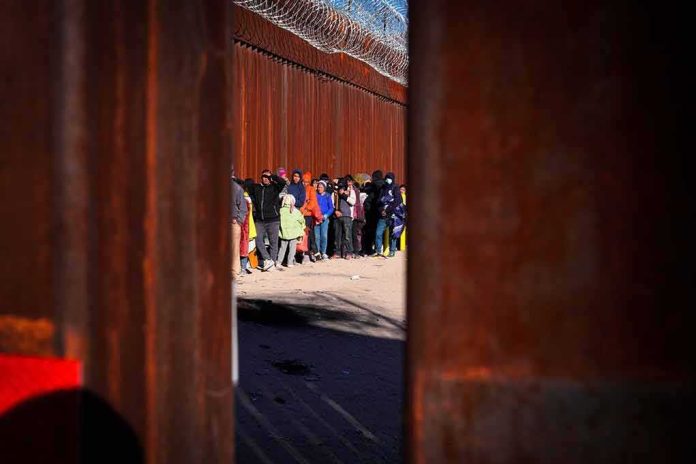
When politicians argue about “caravans,” they are often fighting over a definition as much as a fact: a caravan is both a moving crowd you can film and a policy artifact authorities can disperse, redirect, or rename. Understanding that duality is the key to reconciling Mexico’s claim that no caravan has reached the north with reporting that hundreds to thousands of people were indeed on the road in Chiapas.
At a Glance
- Mexico’s president said no migrant caravan has reached the northern border since early 2025, distinguishing southern movement from arrival at the U.S. frontier.
- Contemporaneous reporting documented sizable groups leaving Tapachula, with estimates ranging from roughly 1,000 to 1,500 people in at least one formation.
- Mexican authorities engaged to fragment groups, provide guidance, and steer people away from a northbound march; one Chiapas group reportedly shrank from 500–600 to about 100.
- President Trump cast the movements as “huge CARAVANS” and threatened to immediately double tariffs on Mexico unless they were stopped.
Why the same facts produce opposite headlines
Two claims traveled in parallel. President Trump framed large groups moving through southern Mexico as an “invasion” and demanded that Mexico halt them under threat of doubled tariffs. Mexico’s President Claudia Sheinbaum countered that, since Trump returned to office, “not a single migrant caravan has reached the north,” and pointed to on-the-ground efforts in Chiapas to break up groups and counsel migrants on U.S. restrictions. Both can be true in a narrow sense: groups can form and walk north in the south, while authorities prevent a unified, highly visible column from ever reaching border states.
The dispute is amplified by language. “Caravan” is elastic; it can mean a single column, multiple clusters departing the same origin, or an emergent flow that repeatedly fragments and recombines. Politically, the word signals crisis; operationally, it’s a moving target for officials who have learned to disrupt it before it hardens into a spectacle at the border.
What actually moved, and where it stalled
Reports in mid-November described at least one substantial group departing Tapachula, near the Guatemalan line, with headcounts between roughly 1,000 and 1,500 people and an initial trajectory toward Mexico City. A second, smaller group was reportedly blocked. These are consequential numbers for local logistics and safety, but they remain far from the geographic and political threshold that Sheinbaum emphasized: reaching the north.
Mexico’s account details a containment strategy shaped by experience since 2018: meet groups early, explain the improbability of U.S. entry, extend humanitarian assistance, and induce dispersal. One Chiapas formation reportedly dwindled from about 500–600 participants to around 100 after such engagement—evidence that the state can degrade the caravan as an organized unit even if individuals continue northward alone or in small bands. That is the crux: dispersal transforms a headline-grabbing caravan into background migration that is harder to count and harder to leverage politically, but it does not verify where every person ultimately goes.
The evidence base and its limits
On Mexico’s side, the strongest specific claim is bounded: no caravan, as a caravan, has reached the northern border since January 2025. Supporting accounts describe contact with groups, guidance on U.S. entry limits, and visible shrinkage of at least one group in Chiapas. On the counter side, independent outlets documented large departures from Tapachula and characterized the direction as northward, with estimates from a Chiapas source of about 1,500 people—enough to qualify as a caravan by common usage.
What neither side has published is a route-level ledger that would settle the matter for skeptics: a consolidated, auditable record of how many people from each southern group accepted return, entered shelters, were detained, or moved on, and whether any intact formation reached northern Mexico during the disputed window. The absence of that dataset doesn’t falsify Sheinbaum’s narrower statement; it does, however, leave space for rhetorical escalation and selective framing.
Caravans as tactic, symbol, and administrative problem
Since the 2018 Honduran caravan swelled dramatically in Chiapas—doubling to roughly 7,000 as it moved—the term has functioned as a multiplier for attention and leverage. Authorities in both Mexico and the United States drew lessons: visible caravans invite cameras, inspire copycat organization, and trigger policy threats; less visible flows are easier to process, return, or redirect. Academic and policy work underscores how caravans emerged as collective-security tactics in response to layered enforcement, then became targets for early disruption—stop them in the south, and you avoid a televised confrontation in the north.
That operational doctrine explains Mexico’s emphasis on “not reaching the north.” In bureaucratic terms, preventing arrival of a massed column at the U.S.-Mexico frontier is success; in political terms, images of thousands marching in Chiapas are enough to revive the “caravan” narrative. Both logics operate at once, and they talk past each other.
The tariff lever and message discipline
Tariff threats are not new to this playbook. In 2019, the United States used the prospect of escalating duties to induce Mexican crackdowns on transit migration; the instrument is blunt but difficult to unwind quickly once invoked. In the present dispute, Trump’s immediate-doubling threat raised the economic stakes and incentivized Mexico to stress control—no caravan at the northern border—over releasing granular movement data that could be cherry-picked to depict failure.
This dynamic encourages narrative maximalism. Trump’s “huge CARAVANS” frame treats any sizable, northbound formation as proof of a breakdown; Mexico’s precision—“none has reached the north”—draws a bright line at a location that matters for sovereignty optics and for avoiding a repeat of 2018-style border showdowns. The media’s varying paraphrases—“no caravan to the border” versus “no caravan exists”—compound the dissonance.
How to read competing claims going forward
First, separate formation from arrival. A caravan can exist in Chiapas without ever appearing, intact, in Tamaulipas or Sonora. Second, distinguish the unit from the flow. Dispersal can end the caravan as a political symbol while the underlying migration continues via buses, safehouses, and small groups. Third, privilege trackable specifics over rhetoric: dated departures, headcounts at named locations, documented shelter intakes, and verifiable returns.
Applied to the current case, the most defensible synthesis is this: substantial groups did form and begin moving in southern Mexico; Mexican authorities acted to fragment and redirect them; and, based on the public record to date, Mexico’s narrower assertion—that no caravan reached the northern border during the window in question—stands as a claim not disproven by the available evidence, even as it elides the likelihood that some individuals kept traveling. That is how the politics of “caravans” work: the column matters until it doesn’t, and the flow remains.
What better evidence would look like
For rigorous accountability, two datasets would close the gap between image and outcome: Mexico’s segment-by-segment accounting for groups departing Tapachula and Arriaga during the relevant week—intakes, returns, dispersal points—and complementary U.S. sector-level encounter data tagged to any identified caravan cohorts. Short of that, the caravan will continue to function as a versatile symbol: concrete enough to film, flexible enough to deny, and potent enough to move trade policy.
Sources:
myarklamiss.com, courthousenews.com, spectrumlocalnews.com, reuters.com, english.elpais.com, vtcng.com, ttnews.com, detroitnews.com, academic.oup.com, fortune.com