Celebrity cameos at campaign rallies are not sideshows; they are stagecraft with a purpose, and Ted Nugent’s turn at President Trump’s Kansas event shows how a well-known persona can be used to frame a crowd’s mood, values, and expectations before the headliner ever walks to the lectern.
At a Glance
- Ted Nugent addressed the crowd at President Trump’s October 19 Kansas rally before Trump spoke, delivering a brief, hard-edged warmup rooted in faith, constitutionalism, and gun-rights rhetoric.
- Local outlets and broadcast clips confirm Nugent’s presence on the program as a speaker rather than a documented full musical “opening act”.
- Nugent embraced the label “extremist” for a platform he cast as God, family, country, and self-defense, calibrated to energize an already sympathetic audience.
- Research on celebrity involvement in politics is mixed; celebrities can help draw attention and boost mobilization, but persuasion effects on vote choice are inconsistent.
What Happened In Kansas: Nugent as the Rally’s Warmup
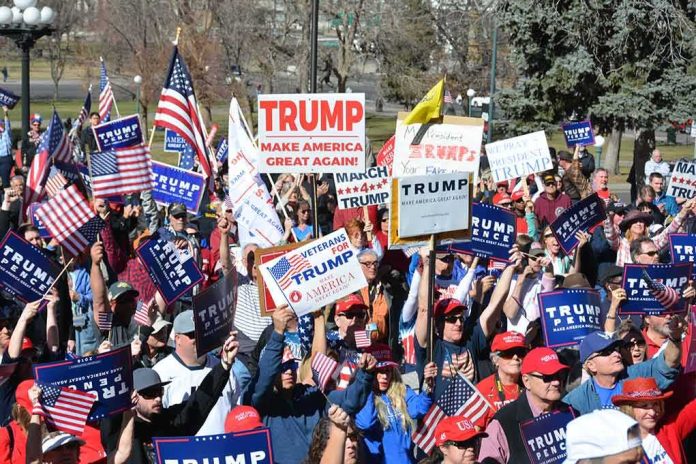
On October 19, 2026, at Heartland Credit Union Arena outside Wichita, Ted Nugent took the stage as part of a slate that preceded President Trump at a rally backing Senator Roger Marshall’s reelection bid. Local coverage identified Nugent among the speakers, alongside Kansas officeholders; broadcast segments captured him addressing the crowd, situating his appearance squarely within the rally’s program rather than as a standalone concert set. Footage shows Nugent working the classic warmup role—short, emphatic, values-heavy—before yielding the stage to the headliner.
Reporting indicates the arena’s capacity and the crowd’s near-full turnout, with estimates approaching 6,000 attendees; as with most rallies, those figures are best understood as informed counts rather than audited tallies. The point for campaign practitioners is less the precise headcount and more the usable energy in the room—and Nugent’s job was to prime that energy for the candidate.
The Message: Identity First, Then Mobilization
Nugent’s remarks fit a familiar template: assert a moral frame, define the in-group, and convert applause lines into an action request. From the podium he leaned into a personal brand that fuses outdoorsmanship and uncompromising conservatism—“I’m a radical. I’m extremist”—then immediately specified what that meant: God, family, the Constitution, the Bill of Rights, self-defense, and private property. He praised local law enforcement, saluted Kansas officials, and pushed voter turnout, including a pointed nudge at licensed hunters he said had sat out prior elections—a line meant to turn cultural identity into political habit.
Structurally, this is rally rhetoric doing what rally rhetoric does. Before a candidate arrives, a surrogate sharpens contrast and reduces complexity. Labels like “communism” for the opposing coalition are not policy analysis so much as signal flares for group cohesion. The persuasive lift is modest; the mobilization lift—get your friends, vote early, bring three more—is the actual deliverable in the minutes before the principal walks out.
Performer, Speaker, or “Opener”? Why Labels at Rallies Blur
Audiences and outlets often use entertainment language—“opened for,” “headliner,” “show”—to describe political events because the structure is similar: sequenced acts culminating in a star. Yet on the production side, a campaign rally is a mobilization program, not a concert bill. Schedules pair elected officials, local validators, and occasional celebrities to keep attention aroused and thematic through-lines clear for the candidate’s entrance. That is why one report may call Nugent a speaker while another, leaning on show-business shorthand, says he “opened” for Trump. Both can be descriptively true about sequencing while implying different levels of musical performance that the documentation does not establish here. Scholarship on rallies as genre underscores this blending of symbolic performance and political messaging; audiences interpret the components through that hybrid lens.
For assessment, the narrow, well-supported claim is the right one: Nugent spoke ahead of the president and warmed up the room. Whether he was a formally designated musical “opening act” is not substantiated by the available reporting and video, which capture his speech rather than a set list.
Why Campaigns Use Celebrities: Attention, Affinity, and the Limits of Persuasion
Campaigns do not slot celebrities into programs out of whimsy. Name recognition concentrates attention, and attention is the scarcest commodity in modern politics. The research record on whether celebrity participation moves actual votes is, at best, mixed. Some studies and reviews find little to no persuasive effect on candidate evaluations; others document meaningful boosts to attitudes and turnout intentions under certain conditions. The most consistent benefits are not direct conversion of skeptics but rather second-order gains: bigger crowds, more earned media, a sharper emotional arc inside the venue, and identifiable cues for politically aligned subcultures.
Nugent’s brand—guns, hunting, unapologetic religiosity—maps onto a well-defined voter segment. In a rally context, that is useful not to change minds across the aisle, but to turn soft supporters into reliable participants: register, show up, bring someone else. His specific barbs at the ATF and his embrace of a maximalist self-defense ethos are not random; they are cultural keystones for an audience that translates identity into turnout behaviors.
JUST IN: The Legendary Ted Nugent drops the 🎤 saying “I got a call from President Trump saying 'can you come to Kansas and RAISE SOME HELL”
THIS IS THE MOST EPIC VIDEO 🔥 pic.twitter.com/n5uaaE1nLD
— 🇱🇷🍩JULIE DONUTS Q🍩🇱🇷 (@rejulie_Donutsq) October 20, 2026
What It Means Going Forward
Expect more of this interplay between celebrity identity and campaign mobilization as competitive races tighten. For practitioners, the Kansas rally illustrates a durable rule: a celebrity surrogate is most valuable when the persona is legible to the target audience and the message funnels emotional assent into a concrete ask—volunteer, vote early, bring neighbors. For readers separating spin from structure, keep two questions in mind. First, what did the celebrity actually do on stage—perform music, deliver remarks, or both? Second, how did that slot prime the room for the candidate’s frames and calls to action?
Sources:
thegatewaypundit.com, kmuw.org, kansascity.com, kansas.com, kspress.com, kwch.com, yahoo.com, kcur.org