Satire cuts through techno-optimist fog because it names the real tradeoffs: the AI systems people use in a browser run on vast, hungry machinery somewhere, and where we put that machinery—and who pays the costs—has become a defining infrastructure question of the decade.
At a Glance
- The Onion’s viral spoof of an OpenAI data center built in a child’s bedroom is fiction; the frictions it lampoons—power, water, noise, land use, and consent—are not.
- AI data centers are a distinct class of facility built around high-density compute (GPUs/accelerators), extreme power draw, and advanced cooling; they are the physical backbone of modern AI services.
- Local opposition is widespread as communities shoulder concentrated impacts while benefits accrue regionally or to platforms; polling shows 7 in 10 Americans oppose an AI data center near them.
- U.S. law strongly protects satire about public figures and institutions, which is why parody has become a frontline medium in the AI infrastructure debate.
What the satire gets right: scale, siting, and consent
The Onion’s video works because its absurd premise mirrors a recognizable pattern: projects framed as inevitable, beneficial, and urgent are sited in places that must live with their consequences. Even boosters concede that AI data centers are no longer a marginal digital utility; they have moved “from the background of the digital economy to center stage,” with colocation and hyperscale operators racing to add capacity for training and running large models. That race collides with finite local infrastructure—substations, transmission, water rights, and roads—and with civic timelines that move slower than venture roadmaps. Communities see the externalities first. Developers tend to promise tax base and jobs later.
Opposition has cohered quickly because the costs are concentrated and legible. In survey research, 70% of Americans oppose building an AI data center in their area, with nearly half “strongly opposed”. Local hearing rooms are filled by people who hear diesel backup tests, see truck traffic and water permits, and worry about brownouts as peak loads mount. Those are not abstract harms; they are daily life. The joke lands because the public understands that the physical footprint of “the cloud” is on the ground, somewhere near someone.
What makes an AI data center different
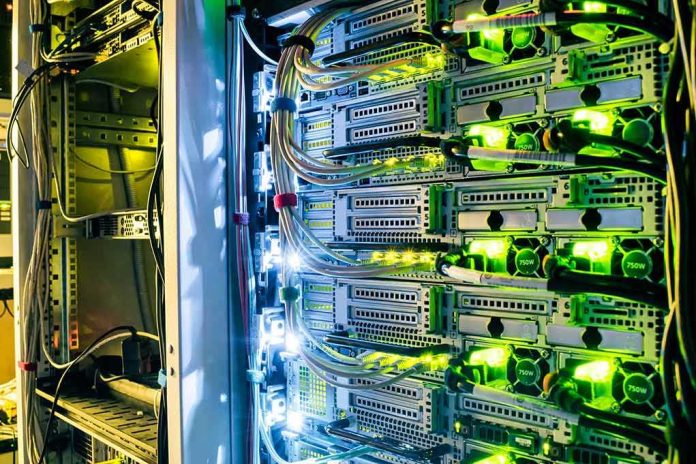
Traditional enterprise data centers were built for mixed workloads—email, databases, web apps—with relatively modest and predictable power density per rack. AI facilities invert that profile. They are designed for parallel computation with thousands to tens of thousands of accelerators (GPUs, TPUs, or custom AI chips) linked by high-bandwidth fabrics; a single training cluster can draw tens of megawatts continuously. That density drives two design imperatives: power delivery and heat rejection. Operators add new substations, loop into high-voltage transmission, and deploy advanced cooling—rear-door heat exchangers, immersion, or warm-water liquid loops—because air alone cannot reliably evacuate the heat at modern rack densities.
The operational pattern is also different. Training runs are bursty but massive; inference is steady and at global scale. Both push toward 24/7 utilization. Backup generation fleets, harmonic filtering, power factor correction, and sophisticated microgrid controls are not nice-to-haves but preconditions. Water enters the picture via evaporative cooling and power generation—especially in regions where the grid itself is water-intensive. None of this makes data centers malign; it makes them industrial plants with industrial footprints. Communities evaluate them accordingly.
How we got here: policy, capital, and a speed mismatch
Two arcs converged. First, a decade of AI research improvements—architectures, data, and especially specialized accelerators—unlocked commercially valuable models, pulling compute demand forward by years. Second, capital markets and cloud platforms aligned behind hyperscale buildouts. Permitting, however, remains local and fragmented. There is no single national siting regime; approvals are shaped by overlapping zoning boards, utility commissions, water authorities, air districts, and negotiated community benefits. Developers accustomed to rapid, repeatable deployment templates run into neighbors who expect deliberation, environmental review, and enforceable mitigation.
That mismatch is now a systemic bottleneck. Analyses and reporting describe dozens of projects delayed or rejected as local consent becomes the gating factor for capacity additions. The common thread isn’t anti-technology sentiment so much as a demand to price externalities correctly and to match benefits with burdens—grid upgrades that serve residents, credible noise and water controls, and binding commitments instead of aspirational renderings.
Where the real disagreements lie
The dividing lines are practical, not philosophical. Proponents emphasize macro benefits—productivity gains from AI-infused services, regional tax receipts, construction jobs, and the option value of being on the cutting edge. Opponents focus on siting particulars—whether a given feeder line can handle the load without crowding out housing or small industry, whether water draw is appropriate for an arid basin, whether diesel testing will degrade local air quality, and whether promised jobs are numerous and lasting enough to justify the transformation next door. The empirical center of gravity has shifted toward caution because early projects sometimes underdelivered on community benefits while overconsuming local capacity.
Polling captures that shift cleanly. Support for data centers in the abstract is higher than support for one around the corner; when framed specifically as an AI facility, local support drops further. In the latest Gallup measure, only about a quarter of Americans favor an AI data center in their area; opposition reaches 70%. That sentiment is not immutable, but it sets the political baseline for any permitting process.
Liquid Death has partnered with former NFL star Jason Kelce and Garage Beer on a humorous video campaign addressing artificial intelligence water consumption. The satirical initiative proposes using urine to cool data centers, bringing attention to the massive environmental… pic.twitter.com/xcP84juJuy
— Ali Moheyaldeen (@ShowsAli) August 21, 2026
Why satire is the messenger of choice
Parody can say the quiet part out loud. U.S. jurisprudence—most famously Hustler Magazine v. Falwell—protects even caustic satire about public figures so long as no reasonable person would mistake it for literal fact. That protection has made satire a safe and effective way to compress sprawling policy disputes into relatable sketches. In the AI infrastructure context, exaggeration spotlights asymmetries of power and consent—decision-makers distant from the people who will hear the generators at 2 a.m.—without the throat-clearing of a white paper. The format persists not because facts are unavailable, but because jokes travel faster.
What a workable path forward requires
Communities and developers can both get more of what they want by treating AI data centers as critical-but-conditional infrastructure. Three principles reliably change outcomes. First, capacity realism: plan against grid and water constraints with transparent studies, staged interconnects, on-site generation where appropriate, and firm caps that trigger automatic throttles. Second, mitigation you can measure: enforceable noise envelopes, air-quality limits for backup fleets, and water budgets tied to basin health, all with third-party monitoring. Third, benefits that arrive early: local-rate relief funded by the project, priority connections for schools and hospitals, and workforce pipelines that convert construction booms into durable employment. Where those elements are present, siting friction drops; where they are absent, satire writes itself.
Sources:
aiproductivity.ai, en.wikipedia.org, ibm.com, youtube.com, reddit.com, rhdickerson.com, azcc.gov, theguardian.com, supreme.justia.com