
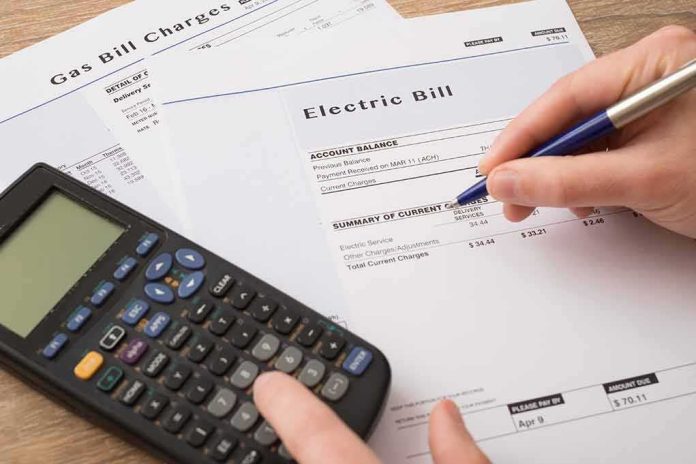
Every fight over the American electric bill eventually collapses into the same unresolved argument: is the price you pay determined by how much energy the country produces, or by how tightly government lets producers operate? Doug Burgum and Chuck Schumer just restaged that argument in public, and neither side offered the kind of hard, apples-to-apples data that would settle it — which is itself the most instructive part of the story.
Key Points
- Interior Secretary Doug Burgum accused Democratic energy policy of practicing “energy subtraction” and credited the Trump administration’s supply-expansion approach with lowering costs.
- Senate Democratic Leader Chuck Schumer countered that a specific Trump administration deal — a $1.22 billion payout to cancel RWE’s offshore wind leases — would make electric bills more expensive, calling it “corruption at your expense.”
- Both claims are asserted with confidence but not backed, in the public record so far, by independent price data isolating the effect of either party’s policy.
- Electricity and gas prices move on fuel markets, weather, grid capacity, and regulation simultaneously, which is why blame in these disputes rarely survives close empirical scrutiny.
- The exchange fits a recurring, decades-old pattern in energy politics rather than a one-off news event, and it will keep recurring under whichever party holds power next.
The Exchange That Sparked the Fight
The immediate trigger was concrete: the Trump administration agreed to pay the German utility RWE $1.22 billion to abandon its offshore wind development rights, a deal reported by The Hill and framed by the administration as clearing costly, underperforming generation off the books. Schumer called it corruption, arguing on social media that Trump was “spending billions of taxpayer money to limit the U.S. energy supply” and that the arrangement “will only make your utility bill MORE expensive.” That is a direct, on-the-record rebuttal — not vague skepticism, but a specific causal claim tied to a specific transaction.
Burgum’s response reframed the entire debate rather than litigating the RWE line item alone. He argued that the prior administration’s approach amounted to “energy SUBTRACTION,” restricting supply and driving prices up, while the current approach — “energy ADDITION” — expands production, investment, and jobs, which he says lowers costs. He has repeated versions of that framing at industry gatherings, telling energy executives at CERAWeek that the “energy transition” under the previous administration was really energy subtraction and that “we need energy addition.” It’s a tidy slogan, and slogans travel well in cable-news soundbites, but a slogan is not a price series.
What Each Side Can Actually Point To
Burgum’s case rests on specific, named actions: a record-setting Alaska lease sale that he says drew more acreage, more revenue, and more bidders than prior sales after the region had been closed to development; a $625 million Department of Energy investment in coal generation aimed at supporting steel and cement production and baseload electricity; and energy-supply agreements with Japan and other allies intended to diversify sourcing away from adversarial suppliers. He has also sparred directly with House Democrats who accused Interior of “kneecapping” wind and solar power in favor of oil and gas, a charge he does not fully deny so much as reframe as a deliberate return to baseload reliability. The throughline in Burgum’s argument is that expanding domestic supply — of any fuel type — mechanically pushes prices down by relieving scarcity.
Schumer’s case rests on a narrower but sharper point: canceling an already-built pipeline of offshore wind capacity doesn’t just remove a disfavored technology, it removes megawatts that utilities had already begun planning around, and replacing that capacity elsewhere carries its own cost, which utilities pass to ratepayers. That’s a coherent mechanism, and it’s the same logic regulators use when they evaluate stranded-asset costs in rate cases. The trouble, on the public record so far, is that neither Schumer’s floor remarks nor Burgum’s cable-news appearances have been accompanied by a transparent, contract-level cost model showing what the RWE cancellation actually does to projected system costs or retail rates. Both men are arguing mechanism with conviction; neither has published the arithmetic.
Why Neither Side Has Delivered a Knockout
This is where the dispute reveals its structural weakness rather than its partisan winner. Retail electricity prices are the output of a genuinely tangled system: wholesale fuel costs (natural gas, coal, uranium), weather-driven demand spikes, transmission and distribution infrastructure that takes years to build, state-level rate-case decisions made by public utility commissions largely insulated from federal policy, and — yes — permitting rules and subsidy structures that shift generation mix over time. Attributing a household’s monthly bill increase cleanly to one administration’s philosophy, whether “addition” or a renewables mandate, requires controlling for all of those variables simultaneously. Neither Burgum’s talking points nor Schumer’s floor speech does that work, because floor speeches and cable hits are not built to do that work.
Congressional Democrats have pressed Burgum on this exact gap in hearings, accusing the Interior Department of favoring fossil fuel production while claiming credit for price relief that hasn’t been demonstrated in utility-commission filings. Burgum has also drawn a consistent contrast with the prior administration, arguing that gasoline prices exceeded five dollars a gallon under Biden-era supply constraints and that Democrats voiced no comparable outrage then — a fair rhetorical point about partisan consistency, but again one that substitutes a memorable comparison for a controlled analysis of what specifically caused those spikes, which included a war in Ukraine and OPEC+ production decisions well outside any U.S. president’s control.
The Pattern This Fits, and What to Watch For
None of this is new, and it will not resolve itself in this particular skirmish. American energy politics has run this same play under every administration since at least the 1970s oil shocks: the party in power credits its supply policy for whatever relief consumers see, and the opposition blames the incumbent’s regulatory choices for whatever pain consumers feel, while the actual price is being set largely by global commodity markets and decades-old infrastructure decisions neither party controls in the short run. The useful move for anyone trying to evaluate these claims honestly is to demand the same evidence from both sides: state-by-state retail price data from the Energy Information Administration, utility-commission rate-case filings, and contract terms for specific deals like the RWE cancellation — not slogans, and not selective anecdotes about who was silent when gas hit five dollars. Until that data is put on the table by either camp, “energy addition” versus “corruption at your expense” is a debate about framing, not a settled verdict on your electric bill.
Sources:
twitchy.com, theguardian.com, advancedbiofuelsusa.info, reddit.com