
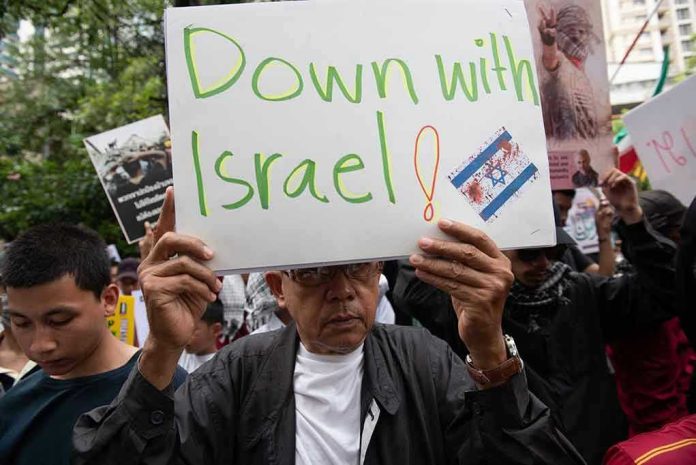
When Ted Cruz says antisemitism on the right is becoming “a cancer” and an “existential crisis” for his own party, he is not simply describing personal discomfort; he is forcing conservatives and observers alike to confront how online radicalization, conspiratorial thinking, and intra-right media warfare are reshaping the landscape of Jew‑hatred in the United States.
Key Points
- Cruz has launched a sustained, public campaign warning that antisemitism is rising inside the American right, especially among younger conservatives, and that Republican leaders are not confronting it with sufficient urgency.[1][3][10]
- His claims rest heavily on anecdotal and experiential evidence—social media abuse, campus events, specific right‑wing influencers—rather than on formal statistics that isolate “right‑wing” perpetrators.
- Independent data from the Anti‑Defamation League (ADL) and others confirm historically high levels of antisemitic incidents in recent years but also show a significant overall decline from 2024 to 2025, complicating any simple “continuous rise” narrative.[8][9]
- Research and official analyses suggest that conspiratorial and authoritarian worldviews—not party identification alone—are the strongest predictors of antisemitism, which now manifests across the political spectrum.[11][12][13][14]
What Cruz Is Actually Arguing
Cruz’s recent speeches form a coherent message rather than a one‑off headline line.
At Christian Zionist gatherings, Jewish communal conferences, and Republican Jewish Coalition events, he has repeated a core claim: in roughly the last year to 18 months, he has seen more antisemitism on the right than at any point in his life.[1][3][10] He describes this trend as a “growing cancer” and an “existential crisis” for the Republican Party and the country.[6][7] For a politician whose career has been anchored in the conservative movement to say that, in front of right‑leaning audiences, is itself significant.
Cruz’s account has three pillars. First, he insists the phenomenon is real and organic, not simply the product of foreign troll farms or bot networks. Recounting a private conversation with Israeli Prime Minister Benjamin Netanyahu, he says Netanyahu initially attributed much of the right‑wing antisemitism Cruz sees online to Qatar, Iran, and bots; Cruz replied that while foreign money and amplification matter, the people posting the abuse are “real human beings, and it is spreading.”[5][9]
Second, he points to lived experience on social media. If he posts something as banal as “good morning,” he says, within minutes he receives hundreds of blatantly antisemitic replies—sexualized harassment, classic antisemitic tropes, Holocaust denial.[5][2] The volume is not independently audited, but for Cruz it functions as a barometer of what a vocal slice of the right now feels free to say in public.
Third, he highlights a generational and institutional drift. Cruz describes a “tangible, dangerous antisemitic contingent on the right” gaining traction with young audiences.[2][10] He cites student reactions at Turning Point USA events and conservative influencers who flirt with, or openly embrace, antisemitic narratives, from Holocaust revisionism to conspiracy theories about Jewish control of media and government.[4][5][10]
Targets and Tensions Inside the Right
Cruz is not making these points in a vacuum; he is breaking an implicit taboo by naming parts of his own coalition.
He has singled out Tucker Carlson as “the single most dangerous demagogue in this country,” accusing him of providing a platform and audience for figures such as white nationalist streamer Nick Fuentes and mainstreaming conspiratorial narratives that edge into Jew‑baiting.[4][6] At one Republican Jewish gathering, he implicitly tied Carlson’s popularity on the right to a broader “anti‑Israel right” that is no longer marginal.[6][7] He has also referenced incidents in which prominent right‑wing voices publicly mused that “maybe Hitler wasn’t that bad a guy after all,” warning that what once lived on the fringe is now seeping toward the center of conservative discourse.[5]
This is politically costly rhetoric. Carlson and his allies still command large right‑wing audiences, and institutions like the Heritage Foundation have defended him and, at times, minimized the significance of Fuentes’ antisemitism. That institutional reluctance is part of Cruz’s critique: he argues the “church is asleep” and that pastors, Republican officials, and movement organizations are failing to draw clear red lines, thereby letting a small but loud faction shape younger conservatives’ worldview.[4][10]
At the same time, Cruz maintains a familiar partisan frame. He repeatedly contrasts the emerging antisemitism on the right with what he sees as a longer‑running failure of Democrats to police antisemitism on their left flank, including campus activism and what he calls a “pro‑Hamas contingent” in the Democratic Party.[1][5] He led, with Senator Tim Kaine, a unanimous Senate resolution condemning antisemitism as a “unique form of prejudice,” using that bipartisan act to argue that moral clarity against Jew‑hatred should transcend party competition.[1][6]
What the Data Can — and Cannot — Tell Us
When Cruz says he has “seen more antisemitism” on the right in recent months than ever before, he is making an experiential claim rather than presenting a new dataset. That distinction matters.
The ADL’s annual audits of antisemitic incidents show a dramatic surge after the October 7, 2023 Hamas attack and the ensuing war, with 2024 recording 9,354 incidents in the United States.[8][13] College campuses in particular saw an explosion: according to ADL and other reporting, campus incidents spiked by more than 300 percent in the months after the attack, with a majority referencing Israel, Zionism, or Palestine.[13] This confirms that antisemitism has intensified in public life, especially in spaces where Israel is constantly debated.
However, the ADL’s 2025 audit records 6,274 antisemitic incidents—a 33 percent decline from 2024, though still five times higher than a decade earlier and the third‑highest year on record.[9] On its face, that trajectory complicates any claim of a simple, monotonic “rise” over the last 18 months. The reality is more nuanced: antisemitism surged to unprecedented levels in 2023–24, then fell from that peak but remained extraordinarily elevated.[9][13] Cruz’s rhetoric captures the sense of unprecedented intensity, but the idea of a continuous upward slope is not supported by the aggregate data.
Moreover, the audits do not systematically classify incidents by the perpetrator’s political affiliation. They do distinguish between, for example, white supremacist propaganda, anti‑Israel activism, and other categories, but they cannot cleanly answer the question Cruz implicitly poses: “Is the right becoming more antisemitic than the left?” That is simply not a question our current datasets are built to resolve.
Beyond Left and Right: Conspiracy, Authoritarianism, and Jew‑Hatred
To understand where the strongest empirical footing lies, you have to step outside the partisan frame.
Deborah Lipstadt, the U.S. Special Envoy to Monitor and Combat Antisemitism, has argued that antisemitism now appears “from right to left and in between,” and that ideological position on a standard left‑right spectrum is a weaker predictor of antisemitic attitudes than a conspiratorial, authoritarian worldview.[14] Research conducted for the ADL on antisemitism and support for political violence reinforces that point: Americans who embrace multiple antisemitic tropes are dramatically more likely to endorse anti‑democratic conspiracy theories and to justify political violence for both right‑wing and left‑wing causes.[11]
In other words, the deepest common denominator among contemporary antisemites is not party registration but a way of seeing the world—hierarchical, besieged, and animated by shadowy elites. Jews are cast, depending on the narrative, as globalist puppet‑masters, subversive outsiders, colonialist oppressors, or some combination of the above. Those narratives can be attached to “Christian nationalism” on the right, to certain anti‑Zionist currents on the left, or to idiosyncratic online subcultures that defy neat partisan labels.[11][14]
Public opinion surveys capture a similar complexity. A Brookings analysis found that a clear majority of Americans who hold opinions on the topic believe antisemitism is increasing compared to five years ago, but many resist labeling criticism of Israeli policies as antisemitic, even while overwhelmingly agreeing that hostility to Jews or Judaism does qualify.[15] A University of Maryland poll series shows that since before October 7, more Americans view the term “antisemitic” as rightly applied to genuinely antisemitic behavior, suggesting increased awareness—but also more disputes over where the line lies.[12]
Against that backdrop, Cruz’s decision to focus tightly on the right is both understandable and incomplete. As a Republican leader speaking primarily to conservative audiences, his comparative advantage is to call out his own side; the left has no shortage of critics willing to highlight left‑wing antisemitism. The risk, as Lipstadt and others have warned, is that each side points to the other as the “real” problem and thereby avoids the hard introspection that would actually protect Jewish communities.[13][14]
How Cruz’s Warnings Fit the Broader Pattern
Cruz is hardly the first political figure to discover antisemitism “on the other side.” What is unusual is that he is insisting his own movement has a problem at precisely the moment when right‑wing media ecosystems are fragmenting and competition for young, online audiences is pushing some commentators toward more radical, transgressive content.
In his speeches, he links antisemitism to other ideological shifts among younger conservatives: declining support for Israel, flirtations with isolationism, and attraction to aestheticized authoritarianism.[3][4][10] He portrays antisemitism as a “gateway drug” to anti‑capitalism and anti‑Americanism, arguing that once you accept conspiratorial narratives about Jews, it becomes easier to reject liberal democracy more broadly.[10][11] That framing matches the ADL’s finding that highly antisemitic individuals are also more likely to support anti‑democratic measures and political violence.[11]
The institutional conservative response remains unsettled. Some leaders have echoed Cruz’s concerns and drawn sharper lines around Holocaust denial, Fuentes‑style white nationalism, and explicit Jew‑baiting. Others have prioritized coalition maintenance, free‑speech concerns, or simple reluctance to alienate popular media personalities. That ambivalence is precisely what Cruz is targeting when he says the church is “asleep” and warns of an existential crisis: if the movement does not police its own boundaries, the boundary‑pushers will define what “the right” means to the next generation.[4][6][10]
What a Serious Response Would Require
Taking Cruz’s warnings seriously does not mean treating every assertion as empirically settled. Some of his more specific claims—such as the share of students applauding anti‑Israel questions at particular events, or the degree of foreign funding behind right‑wing antisemitic content—remain anecdotal or unsubstantiated in the public record. They invite, and would benefit from, rigorous documentation rather than being accepted on authority alone.
But the core of his alarm aligns with a broader body of evidence: antisemitic incidents have surged to historically high levels; online ecosystems are amplifying extremist narratives at scale; and those who embrace antisemitic worldviews are disproportionately drawn to conspiracy and political violence, regardless of whether they fly a red or blue banner.[8][9][11][13][14] For a conservative senator deeply embedded in his movement to say, in effect, “this is happening on our watch, in our house,” is an important, and relatively rare, act.
For readers trying to make sense of this moment, two truths can coexist. Antisemitism is genuinely rising in public life, even if the exact trajectory year by year is jagged. And it is not confined to one side of the political spectrum, even if particular factions on the right—or the left—are currently providing disproportionate oxygen to some of its ugliest expressions. The work, for conservatives and progressives alike, is less about proving that the other camp is worse and more about deciding how far they will let their own fringes define what they stand for.
Ted Cruz: "We are seeing a cancer on the right. It is rising antisemitism … here's the scary thing: I've seen more antisemitism on the right over the last 18 months than any time in my life. And it's spreading like a cancer. Tucker Carlson is the most dangerous demagogue in…
— Afshine Emrani MD FACC (@afshineemrani) June 25, 2026
Why This Debate Will Not Go Away
Antisemitism has always been a mirror that reflects deeper anxieties and fault lines in a society. In the United States today, those fault lines include geopolitical upheaval, generational transition, digital radicalization, and a fraying consensus about liberal democracy itself. Cruz’s campaign to confront antisemitism on the right sits at that intersection: part moral warning, part intra‑party power struggle, part attempt to define the next generation’s political imagination.
Whether one agrees with his emphasis or not, ignoring the phenomenon he describes would be a mistake. The numbers show that incidents remain far above historic baselines; the research shows that antisemitic worldviews map onto a broader rejection of pluralistic norms; the politics show that when respectable institutions fail to draw boundaries, fringe rhetoric does not stay fringe for long.[9][11][13][14] In that sense, the question Cruz poses—what the right is willing to tolerate in its own ranks—has implications that reach well beyond the future of the Republican Party.
Sources:
[1] YouTube – Cruz on rising antisemitism on the right
[2] Web – Cruz-Kaine Anti-Semitism Resolution Unanimously Passes Senate
[3] YouTube – Ted Cruz reveals antisemitic troll messages at Jewish conference
[4] Web – Ted Cruz warns of rising antisemitism on the Right
[5] Web – Cruz: Republicans must stand firm against antisemitism
[6] YouTube – ‘This Is Simply Not True’: Ted Cruz Promotes Amendment To Prevent …
[7] Web – Cruz: ‘My anti-Semitism resolution speaks to prejudices Jews …
[8] Web – Sen. Ted Cruz (R-TX) on Thursday said there is a rise in … – …
[9] Web – Audit of Antisemitic Incidents 2024 – ADL
[10] Web – ADL Records Historic High in Antisemitic Assaults and Attacks with …
[11] YouTube – ADL Briefing: Latest Data on Antisemitic Incidents in the U.S.
[12] Web – Portrait of Antisemitic Experiences in the U.S., 2024-2025 – ADL
[13] Web – Audit of Antisemitic Incidents 2025 – ADL
[14] Web – [PDF] Cause for Concern 2024: The State of Hate (Nisreen update)
[15] Web – The Daily — Police-reported hate crime in Canada, 2024