When the Knicks finally broke a 53‑year championship drought, New York got both the story it wanted and the one it would rather ignore: genuine joy on the streets, and a smaller but consequential slice of the crowd that turned a historic night into a serious public‑order problem.
Key Points
- There is solid, multi‑outlet evidence of significant disorder in Midtown and near Times Square after the Knicks’ title win, including arrests, fights, vandalism, and confrontations with police.[1][2][5]
- The most viral headline numbers and some precise details (“63 arrests,” “10 cops injured in the title‑night riot,” “school buses torched in Times Square”) either come from earlier Game 4 unrest or remain only partially documented.[1][2][4]
- Independent reporting supports claims that a bus connected to World Cup shuttle service was set on fire and that a 17‑year‑old was shot during celebrations, but the available evidence still leaves location and causation less than perfectly clean.[4][6]
- Coverage and social media posts blend incidents from multiple nights—Game 3 loss, Game 4 comeback, and the Game 5 clincher—creating narrative inflation if those distinct events are lumped together.
- The Knicks chaos fits a well‑known pattern in sports‑riot research: real but numerically limited violence magnified by crowd size, camera density, and partisan media incentives.
What We Can Say With Confidence About the Knicks Celebrations
The starting point is straightforward: large, exuberant crowds poured into Midtown Manhattan after the Knicks closed out the Finals, and a meaningful fraction crossed the line from celebration into disorder.
ABC News describes the pattern clearly in its recap of the earlier Game 4 comeback: rowdy fans fistfighting, climbing scaffolding and poles, blocking traffic, ripping down street signs, jumping on taxis, and damaging police vehicles.[1] In that episode alone, NYPD records cited by ABC put 56 people into custody, including 15 formal arrests and 41 criminal court summonses, with charges ranging from assault on a police officer to criminal mischief and weapons possession.[1] Ten officers were reported injured in that post‑game chaos, one hit in the face by a glass bottle.[1]
Those numbers do not describe the title‑clinching night itself, but they establish two essential facts. First, this fan base and this series had already produced serious disorder in precisely the same Midtown footprint. Second, when the department does release data, it sometimes comes later, through morning statements and parsed counts of “taken into custody” versus arrests. That delay creates space for speculation to fill the gap.
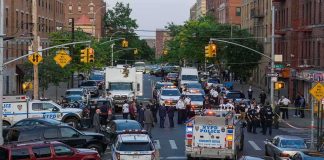
On championship night, independent outlets depict a similar pattern, even if the official tally is not yet as precise. Fox News reports that after the Knicks won their first title since 1973, celebrations “quickly turned chaotic” in Manhattan, with videos showing individuals jumping on an NYPD vehicle and smashing its windshield, as well as people climbing on and into school buses near Times Square.[2] CBS New York’s segment on “violence erupts in Times Square” shows police in riot gear moving in as dozens of people swarm buses, smash windshields, and ultimately set one bus on fire.[5] A separate broadcast notes police taking “several individuals” into custody in connection with the unrest and confirms a 17‑year‑old was shot in the foot during the celebrations.[4]
Taken together, the record supports a firm baseline: after the Knicks’ championship, thousands of people flooded the streets near Times Square and Madison Square Garden; a smaller subset engaged in assaults, vandalism, bus arson, and defiance of police orders; and some were arrested or detained.
Where the Headline Framing Overreaches
The viral framing that “NYC erupted in violence” with exactly “63 arrests, 10 cops injured, school buses torched and a shooting in Times Square” compresses multiple nights and mixes confirmed with unconfirmed figures.
The “10 cops injured” figure is real, but it belongs to the Game 4 comeback chaos, not the title night.[1] ABC’s reporting explicitly ties those ten injuries to the earlier game and specifies the associated custody numbers and charges.[1] There is, so far, no independent source that attributes the same injury count specifically to the championship celebration.
The “63 arrests” number likewise does not appear in any of the mainstream or broadcast sources in the research package. The closest verified count is 56 people “taken into custody” after Game 4, of whom only 15 were actually arrested.[1] That nuance matters: “taken into custody” sweeps in people who receive summonses and are released, whereas “arrest” is a narrower legal category. Without an NYPD incident ledger for the title night, any specific claim of 63 arrests is, at best, uncorroborated.
Even the bus narrative illustrates how imprecision creeps in. CBS and Fox segments show what they describe as school buses being climbed and ultimately set on fire, framing the images in the geography and mood of Times Square celebrations.[2][5] Reuters‑linked social posts, however, describe a convoy of shuttle buses transporting football fans from a Brazil–Morocco World Cup match; according to that account, one shuttle was torched and a teenager shot as Knicks fans filled the streets.[6] Another broadcast, echoing this, calls the burned vehicle a “World Cup shuttle bus” rather than a school bus.[4] The core point—buses were swarmed and one was burned—is solid; whether it was technically a school bus or a privately contracted shuttle is where the narrative slips from precise reporting into shorthand.
The same applies to the shooting claim. A YouTube segment, citing police, states that a 17‑year‑old was shot in the foot during the unrest.[4] Social‑video captions and some commentary characterize this as a Times Square shooting, but the underlying material in this packet does not provide a specific cross‑street or an NYPD complaint number that would lock down the location.[4][6] Absent that, the honest summary is that a teenager was shot somewhere in the Midtown celebration zone, not that we can pinpoint the event to the iconic square itself.
How Multiple Nights Became One “Riot Story”
To understand how an evening of mixed celebration and misbehavior becomes a “city explodes” narrative, you have to pull the timeline apart.
Game 3, which the Knicks lost at home with a sitting president in attendance, produced its own burst of unrest. NewsNation documents fights breaking out outside Madison Square Garden and at a relocated Bryant Park watch party, with NYPD deploying pepper spray as they tried to clear 42nd Street.[7] Separate fan videos shared in Spurs‑supporter spaces show brawls and an aggressive police push on that night as well.[7]
Game 4, the miracle comeback that even ABC likened to a religious experience on fan lips, unleashed both euphoric celebration and the first wave of widely documented mayhem: fists, scaffolding climbs, damaged vehicles, and the 56‑custody, ten‑officer‑injured tally.[1] That episode generated the first serious NYPD statements about increasing presence around the Garden and canceling or constraining outdoor watch parties.[1]
Game 5, the clincher in Texas, sent crowds back into Midtown and Times Square, this time with a title finally secured. That is the context in which Fox, CBS, and others show buses being swarmed, a bus burning, a teenager shot, and officers in riot gear trying to regain control.[2][4][5][6] It is also the night when NYPD spokespeople, at least in the sources we have, were still promising to “advise total numbers later in the day” rather than releasing a clean arrest count.[2]
Social media, and some partisan commentary, flatten these into one continuous riot. Clips from Game 3’s pepper‑sprayed brawls, Game 4’s bottle‑thrown officer, and Game 5’s bus fire become interchangeable “proof” that New York descended into lawless chaos over a single championship. The research packet itself shows how easy it is to lose track of which violence belongs to which box score: Game 3 loss unrest, Game 4 miracle comeback disorder, and Game 5 title celebrations are all present, often unlabeled or loosely timestamped.
An expert reading of the evidence separates them. The question is not whether bad behavior occurred—it clearly did on multiple nights—but whether the narrative you encounter is aggregating three sets of incidents and assigning them to one game and one cause.
Mechanism: Why Big Sports Wins Produce Small, Intense Pockets of Violence
The Knicks’ saga is not an anomaly; it is a vivid instance of a pattern that social scientists and police planners know well. High‑stakes games that tap deep local identity can generate what researchers call “celebratory riots”—events where the majority of participants are there to revel, not to fight, but where a relatively small subset uses the cover of crowds and noise to engage in vandalism, assaults, or opportunistic crime.
Several mechanisms converge. Alcohol consumption and emotional arousal lower inhibitions. Crowds create anonymity and reduce the perceived risk of being singled out by police. The physical environment—narrow Midtown streets, scaffolding, stationary vehicles—offers both climbing structures and fragile targets. When people see others climbing onto trucks or buses without immediate consequences, copycat behavior spreads quickly; what began as an attention‑seeking stunt can escalate into property damage and clashes with officers.
From a policing standpoint, there is an inherent trade‑off. Heavy, pre‑emptive presence can deter some misbehavior but may inflame resentment and create flashpoints. Light presence preserves the party atmosphere but leaves officers outnumbered when pockets of violence emerge. The Knicks series illustrates both sides: intensive security planning and no‑bag policies at the arena; yet scattered street scenes where officers were clearly overwhelmed or forced into rapid escalations like pepper‑spray deployments.[1][7]
Media Incentives and the Politics of “Lawless NYC”
Overlaying the raw events is a highly polarized media ecosystem. Right‑leaning outlets and commentators have structural incentives to frame any New York disorder as evidence of broad urban breakdown; left‑leaning voices, or those anxious about over‑policing narratives, may be quicker to emphasize that “most fans were peaceful” and treat violent clips as outliers.
The evidence in this packet cuts both ways. It undercuts the most inflated numerical claims but simultaneously shows that several nights of the Finals did, in fact, produce conduct serious enough to injure officers, damage property, and send at least one teenager to the hospital.[1][4][6] To deny either side—pretending the city was either in flames or entirely serene—is to ignore the record.
Short‑form video worsens the distortion. Clips optimized for virality strip away date, location, and context; the “wow” factor of a bus on fire overwhelms the question of whether that bus was a school bus, a contract shuttle, or even filmed on the same night as the headline it accompanies. Platform moderation and deletions, meanwhile, can remove less dramatic footage that might show the scale of the crowd behaving normally, leaving only the most sensational fragments in circulation.
This is why incident‑by‑incident reconstruction matters. Serious claims—like the exact number of arrests, the distribution of police injuries across nights, or the precise location of a shooting—require either the underlying NYPD and FDNY reports or later, methodical follow‑up by local outlets. In their absence, the most responsible stance is calibrated: affirm what is clearly supported, bracket what is not yet documented, and resist the temptation to turn three nights of mixed behavior into a single cinematic riot.
Win the Finals, lose 5 people to violence?
That’s not celebration, that’s destruction 💔
Knicks deserve better fans. NYC deserves better nights.
Keep the same energy for helping your city, not hurting it 🗽— SQUIDWARD 🦑 (@squidwardd92) June 14, 2026
What This Means for Future Big‑Event Policing and Coverage
For New Yorkers and city leaders, the takeaway is not that championship celebrations are inherently unmanageable; it is that predictable pressure points deserve more precise planning and more transparent public accounting afterward.
On the planning side, the Knicks series underscores the need to map out specific crowd‑flow scenarios for Midtown, including how to keep shuttle routes, emergency lanes, and transit arteries from becoming impromptu stages. It also suggests the value of clearer public communication about what will trigger an NYPD move from tolerance to dispersal—fans should not have to guess when climbing onto a vehicle crosses from tolerated exuberance into arrestable conduct.
On the information side, police and fire agencies could reduce speculative noise by committing to timely, consolidated post‑event reports: uniform definitions of “taken into custody” versus arrested, breakdowns of charges, clear geographic tags for serious incidents like shootings or arson, and explicit separation of data by date and game. That kind of ledger will not eliminate partisan spin, but it narrows the plausible space for the most extreme distortions.
For readers and viewers, the discipline is simpler but no less important. When confronted with sweeping claims—“the city exploded,” “dozens of cops injured,” “buses torched in Times Square”—ask four questions. Who is the named source? Are there numbers, and do they come from police, hospitals, or someone’s headline? Does the coverage separate nights and locations, or treat the whole series as one long riot? And, crucially, does it show you the denominator—the tens of thousands who simply celebrated and went home—alongside the numerator of people who chose violence?
In the Knicks’ long‑awaited title run, both stories are true. A city starved for a basketball champion finally got its parade‑worthy moment. And in the margins of that joy, a few hundred people, over several nights, gave New York another kind of headline—one that demands careful reconstruction if we want to understand what really happened, rather than just how it looked in 15 seconds on a screen.
Sources:
[1] Web – UPDATE: NYC Erupted in Violence After Knicks Clinched First Title in …
[2] Web – Chaos unfolds in New York City after Knicks win first NBA …
[4] Web – Search underway for New York mob that attacked Spurs …
[5] YouTube – WATCH | Knicks Historic Win Overshadowed By Violence …
[6] YouTube – Violence erupts in Times Square during Knicks …
[7] Web – Celebrations turned chaotic when hundreds of Knicks fans …