
When the memory of a national tragedy is yoked to the language of imminent internal threat, a campaign stop becomes more than stump rhetoric; it turns an election into a referendum on who counts as a protector or a danger inside the republic.
The Short Version
- At a Port Huron, Michigan rally, David Beamer — father of Flight 93 passenger Todd Beamer — warned that the enemy is “among us,” explicitly naming Democratic Socialists and tying the stakes to September 11 memory.
- Beamer stood with President Trump and alleged that Senate candidate Abdul El-Sayed would disarm police, defund the military, and replace the Constitution with sharia law; these were presented as Beamer’s claims from the stage.
- Coverage identified Beamer’s appearance, the date, and the setting; the moment was framed around Todd Beamer’s “Let’s roll” legacy and applied to Michigan voters’ choice.
- El-Sayed has publicly and repeatedly disavowed the Muslim Brotherhood and affirmed the Constitution as his “guiding light” in contemporaneous reporting.
What Happened Onstage In Port Huron
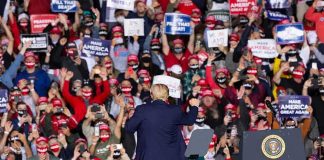
At an October 25, 2026 rally in Port Huron, Michigan, David Beamer, father of United Flight 93 passenger Todd Beamer, joined President Trump and delivered a stark warning that the threat facing the United States was domestic rather than foreign. Contemporary accounts quote him saying, “What’s different this time is the enemy has not come from abroad,” and, “The enemy is right here among us, local terrorists, local citizens that want to demolish our country. They call themselves Democratic Socialists of America.” The event’s coverage, by both national and local outlets, anchors the details: the speaker, the venue, the date, and the framing that drew a line from the Flight 93 story to the Senate race at hand.
From the same stage, Beamer advanced a set of specific allegations about Michigan Senate candidate Abdul El-Sayed: that El-Sayed would disarm police, defund the military, and replace the U.S. Constitution with sharia law. These claims were reported as Beamer’s characterizations during the rally; they were not paired in the coverage with documentary citations from El-Sayed’s platform or legislative texts, but they were central to the crowd-facing message that evening. The pairing of Beamer’s presence with 9/11 imagery amplified the scene’s emotional charge and made the political appeal unmistakable: treat the election as an act of internal defense.
Why This Rhetoric Carries Unusual Force
David Beamer is not a random surrogate. Todd Beamer’s “Let’s roll” became a national shorthand for civilian courage in extremis after the hijacking of Flight 93. When his father stands beside a sitting president and transfers that legacy to a state race, it collapses the distance between wartime vigilance and peacetime politics. In practice, the move reclassifies ordinary ideological opponents as potential demolition crews operating under domestic colors. Political communication research has long documented how fear appeals work: they command attention, shape perceptions of risk, and orient voters toward those promising protection, even when policy specifics are thin. That mechanism helps explain why a single, vivid frame at a rally can set the terms of a week of coverage.
The content architecture on display — naming internal enemies, invoking sharia replacement of the Constitution, and tying a Muslim candidate to transnational Islamist organizations — tracks with patterns identified in broader analyses of terrorism-inflected political speech and campaigns involving Muslim American candidates since 2001. Scholars describe recurrent elements: threat amplification, conflation of disparate groups, and moral urgency that narrows the space for nuanced policy deliberation. In campaign settings, these cues often move audiences before fact-checking catches up, which is why strategists reach for them.
The Specific Claims And The Public Record
The Port Huron moment rested on several distinct propositions. First, that “the enemy is among us,” explicitly linked to Democratic Socialists as a category. Rally reporting captured the phrasing but did not tether it to any identified plot, charge, or official threat assessment; its power lay in its framing, not in case files. Second, that Abdul El-Sayed’s agenda would disarm police, defund the military, and replace the Constitution with sharia. Here, the coverage presented these as Beamer’s assertions from the stage rather than as quotations from El-Sayed’s record; no concomitant platform document or bill text was surfaced in the rally accounts.
A separate thread in the 2026 Michigan contest concerned allegations about the Muslim Brotherhood. In the weeks surrounding the rally, El-Sayed publicly addressed that line of attack repeatedly, saying he “absolutely” disavowed the Muslim Brotherhood and calling the Constitution his “guiding light.” Those statements were reported by CNN, Bridge Michigan, and fact-checked with primary video by PolitiFact, which documented the exchange in which El-Sayed answered “Sure, yeah, absolutely” when asked to disavow the group. That public record matters because it establishes a contemporaneous counterstatement from the candidate himself on a central allegation in circulation.
How The Frame Fits A Larger Pattern In American Campaigns
American candidates in security-adjacent cycles often fuse identity, ideology, and danger into a single, portable story. Fear appeals — messages calibrated to arouse anxiety and direct it toward a behavioral endpoint, such as voting or donating — are a staple of that repertoire. A broad meta-analysis from the American Psychological Association found fear-based messages can be effective in shaping attitudes and behaviors, with effects moderated by audience and context. In electoral arenas, the move to recast an opponent as an existential hazard also simplifies complex policy terrain into a binary: guardians versus subversives. That simplification is rhetorically potent because it reduces cognitive load; it is also politically potent because it justifies extraordinary remedies.
The Rutgers Center for Security, Race and Rights cataloged dozens of cases since 2001 in which Muslim American candidates faced frames centered on sharia, shadowy foreign ties, or divided loyalties, often absent substantiating records. The pattern’s persistence is the point: those claims function less as empirically adjudicated charges and more as cues about belonging and risk, particularly when paired with cultural memory like September 11. The Port Huron rally sat squarely in that lineage — a high-salience symbol carried into a local race, with a named opponent linked to an architecture of threat without a reliance on granular policy citation.
What Voters Should Watch Going Forward
When campaigns elevate existential frames, the burden on voters is to separate the charge from the charter: what a candidate actually proposes to do with police budgets, military appropriations, or constitutional interpretation versus what opponents say those proposals imply. The Port Huron episode ensures that Michigan’s race will be read through a security lens; it also highlights where the public record speaks clearly. El-Sayed has, on the record, disavowed the Muslim Brotherhood and affirmed the Constitution as his guiding principle. Beamer’s rally assertions, voiced with the moral authority of a father who lost a son on 9/11, channeled a different kind of authority — symbolic and affective — to urge voters to treat ideological adversaries as internal saboteurs.
Sources:
twitchy.com, foxnews.com, freep.com, cnbc.com, yahoo.com, cnn.com, politifact.com, bridgemi.com, thehill.com